
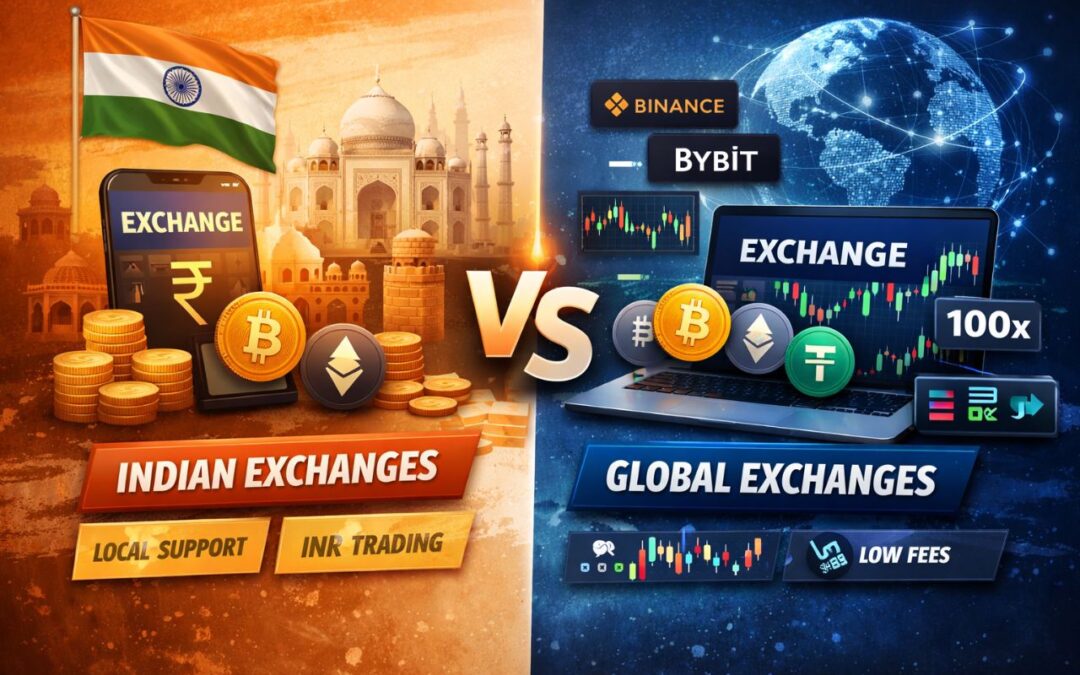
Synopsis: Indian crypto exchanges simplify trading with local support and regulation. Global exchanges offer diverse assets and advanced tools. Investors should pick platforms based on experience and risk tolerance.

Cryptocurrency is booming, and people are eager to invest in it. But when it comes to choosing the platform to trade, people are always confused between choosing an Indian exchange or a Global exchange.
Let’s break it down in simple terms, so that you can make the best choice for your money.
So let us understand what Crypto Exchanges are?
Crypto exchanges are a digital platform where you can buy, sell or trade crypto currencies such as Bitcoin, Ethereum and many more.
In 2025, Crypto isn’t just about “buying coins”, it is all about surviving a high-tax, high-regulation environment while trying to catch the next 100x Bull run. It’s not market dips that ruin traders, but tax penalties and frozen bank accounts. If you want to play the game you need to know exactly where to park your money.

Is it local “Home-Grown” apps or “Global-Giants”? Let’s take a closer look.
Indian Crypto Exchanges
Local crypto exchanges like CoinDCX, WazirX, and CoinSwitch are specifically designed for the Indian audience, they understand the local struggle and aim to make entry in crypto as smooth as possible.
- INR support : While Global users are still stuck with risky P2P trades, you can use UPI, IMPS or NEFT to make withdrawals and deposits in seconds. It’s as easy as ordering biryani on Zomato.
- Local Customer Support: No bots, Just experts who understand Indian Banking and respond to the customer queries in their local languages.
- FIU Compliance: These platforms are registered with the Financial Intelligence Unit (FIU) and follow Indian anti-money laundering rules, keeping your account safe from government issues.
- Built-In Tax Protection: In India the bigger risk than price swings is a Tax Notice. Indian exchanges automate this by deducting 1% TDS on every selling, and then report to authorities, keeping your trading legal and hassle free.
The Downside: Indian exchanges have higher trading fees (often 0.5%) and lower liquidity which means massive coins might take longer or happen at a slightly worse price compared to the Global Market as there are only few buyers and sellers. It also has very few coins available to trade.
Global Crypto Exchanges
Big players like Binance ( now FIU registered in India ) and ByBit are made for serious traders. They handle billions of volumes every single day.
- Massive variety: While an Indian exchange would list 200 coins, a global exchange might have 600+. You could hunt for the next “hidden gem” here and also find a new meme coin listed out here first.
- Advanced features: They offer tools that local platforms often lack such as future trading, high-yield staking, detailed charts for analysis, 100x leverages and AI-trading bots. It’s like moving from a bicycle to a Ferrari.
- High Liquidity: With traders from all over the world, prices stay stable and even large orders are also executed instantly and at the best prices.
- Low Trading Fees: Indian platforms often charge 0.5%, but big Global platforms can be as low as 0.1%. If you trade a lot, paying less in fees can make a huge difference to your profits.
The Downside: These exchanges aren’t fully regulated in India, may require USD or USDT to trade which requires conversion of INR and Customer Support can be low. Managing taxes can be a headache, many Global exchanges don’t auto deduct TDS on every pair, if you trade 1000 times a year, you’ll need a professional crypto tax software to avoid tax nightmare.
Also Read: The Story of Bitcoin: Why It Was Created and Why It Matters
The Tax reality
Regardless of which exchange you pick, the Indian government’s tax rule for 2025 still remains strict on cryptos which are treated as Virtual Digital Assets (VDA).
- 30% Tax on any profits you make.
- 1% TDS on every “sell” or “transfer” transaction.
- No offsetting losses ( if you lose ₹10,000 on Bitcoin and gain ₹10,000 on Ethereum, you still owe tax on ₹10,000 gain ).
Considerations when choosing a Crypto exchange
Choose an Indian Exchange: If you’re a Beginner/HODler and your goal is to buy and hold (HODL) Blue chip coins like BTC and ETH, the Tax automation and easy Indian deposits make Indian crypto exchanges the best choice.
Choose an Global Exchange: If you’re an active trader, using advanced charts, chasing the next 100x gem, and comfortable with using the Tax software to calculate your own TDS and capital gains then Global exchange is best.
Both Indian and Global crypto exchanges have their benefits, Indian exchanges are safer and easier for beginners, while global exchanges offer more variety of options with advanced features. The best choice depends on your comfort level, goals, and how much you’re willing to learn. Just remember to trade responsibly and keep track of your taxes along the way.
Written By: Gautham Nishad
