
Synopsis: A study by André Dragosch of Bitwise Europe examines Bitcoin price data from July 2010 to February 2026 and finds that investment risk diminishes sharply the longer an investor holds with virtually zero losses recorded over holding periods of ten years or more.
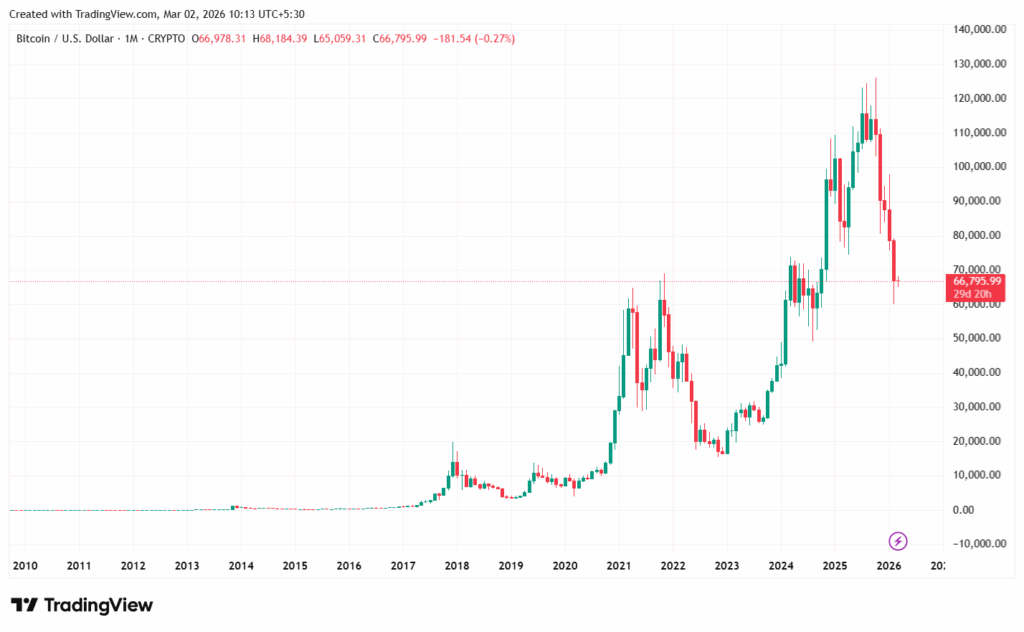
A recent analysis suggests that individuals who purchase Bitcoin and hold it for an extended period are significantly less likely to incur a loss. The research was shared by André Dragosch, Head of Research at Bitwise Europe. The dataset spans Bitcoin’s price history from July 2010 to February 2026, examining how different holding periods affect the probability of profit or loss.

Source: TradingView
The central finding is straightforward: the longer an investor holds Bitcoin, the lower the likelihood of losing money.
Key Observations: Holding Period and Risk
According to the study, investors who held Bitcoin for at least three years faced only a 0.70% chance of ending up at a loss meaning that nearly every buyer who held through that threshold eventually made money. The risk narrows further with time: over five years, the probability of a loss fell to around 0.2%, and over ten years, the data recorded no losses at all for those who maintained their position throughout the entire period.
This pattern underlines the advantage held by long-term investors sometimes referred to as “strong hands” in market parlance who have historically fared far better than those attempting to trade short-term price swings.

Short-Term Trading: A Much Riskier Proposition
By contrast, short-term trading carries substantially higher risk. Investors who bought and sold Bitcoin within a single day faced roughly a 47% chance of recording a loss. Even holding for a week or a month kept loss probabilities above 40%. Investors who held for a full year did somewhat better, but still faced approximately a 24% chance of being in the red.
These figures reflect Bitcoin’s well-documented price volatility: over short windows, price swings can be dramatic and unpredictable, making quick trades a near-coin-flip proposition.
Measuring Investor Positions: The Realised Price
Another metric used in the analysis is the “realised price” an estimate of the average price at which different cohorts of investors originally purchased their Bitcoin. By comparing the current market price against these historical averages, analysts can gauge whether a given group is sitting on a profit or a loss.
At the time of the analysis, Bitcoin was trading around $65,000 roughly 40% below its all-time high reached in January 2025. Despite this decline, investors who purchased Bitcoin three to five years earlier remained in a strong position. Their average acquisition price was approximately $34,780, meaning they were still holding gains of roughly 90%, even after the significant price pullback.
However, some analysts caution that the price could fall further in the near term, possibly toward $30,000. If that were to happen, many long-term holders would see a large portion of their gains eroded, though a number might still be close to breaking even. Such a scenario would test whether patient holders maintain their positions or begin selling.
Also Read: Bitcoin Plunges to $63K After U.S. and Israel Strike Iran
Where Newer Investors Stand
More recent buyers are in a considerably weaker position. On average, investors who have held for six to twelve months paid around $101,250 for their Bitcoin, leaving them facing losses of roughly 35% at current prices. Those who bought one to two years ago are somewhat better placed but are still down an average of around 15%.
Once again, the data reinforces the same pattern: longer holding periods have historically provided a meaningful buffer against losses during market downturns.
Price Forecasts: What Analysts Are Predicting
Looking ahead, several financial institutions and market analysts have offered forecasts for Bitcoin’s price trajectory over the coming years.
Global brokerage firm Bernstein maintains a target of around $150,000 by the end of 2026. Their analysts argue that the recent price decline largely reflects a temporary dip in investor confidence rather than any fundamental deterioration in Bitcoin’s outlook.
Standard Chartered takes a more cautious near-term view, warning that the price could fall to around $50,000 before stabilising. In their assessment, weaker demand for Bitcoin exchange-traded funds and broader macroeconomic pressures could weigh on the market in the short term. Even so, the bank still expects Bitcoin to recover and approach $100,000 by the close of 2026.
A further projection comes from Timothy Peterson, a researcher who analyses historical market cycles. Using a model based on long-run average returns, Peterson estimates that Bitcoin could reach approximately $122,000 by early 2027, with a meaningful probability that prices will exceed that level around that time.
The Bottom Line
The overall message from the data is clear. Short-term trading in Bitcoin has historically been a risky and often unprofitable activity. By contrast, investors who committed to holding their Bitcoin for several years have, in the vast majority of historical cases, come out ahead even after significant market corrections. For those considering an entry into the asset, the evidence suggests that patience may be the most important factor of all.
Written by Parvati Anilkumar