

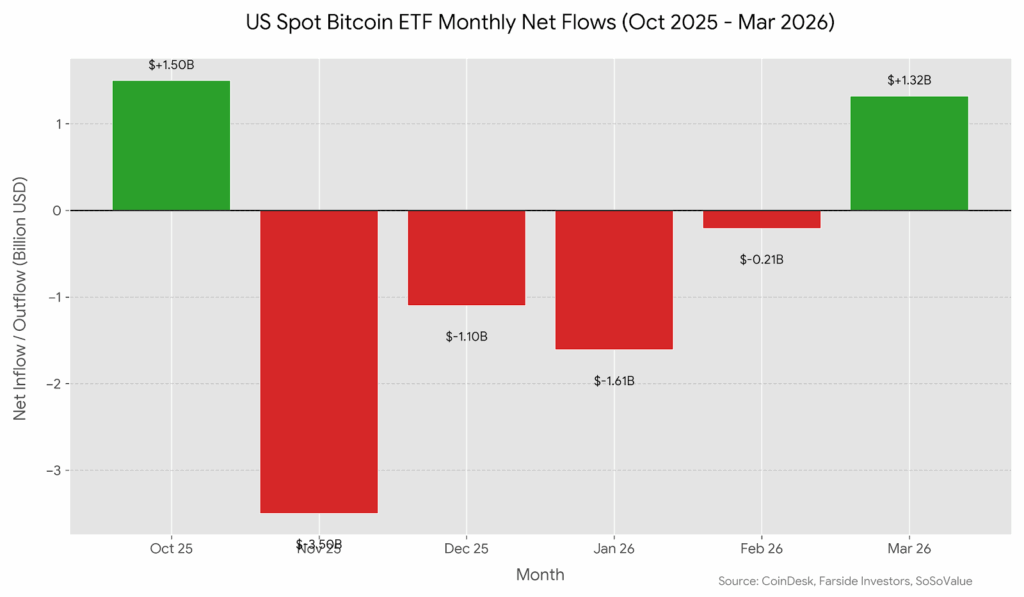
Synopsis: Bitcoin ETFs registered the first inflows in the first time after October, which is an early sign of recovery with the price stabilizing, but investor caution and market uncertainty are still on.
Months of unfavorable outflows have finally given way to positive Bitcoin ETFs, which is a change in market sentiment. This is as the prices of Bitcoin stabilize after an extended period of correction. The institutional money has made a comeback as it is a pointer of increased confidence but it is yet not indication of complete recovery.

Key Stats and Market Data
- Bitcoin ETFs brought in about $1.3 billion in inflows in March 2026, the first good month since October 2025. Before this, there was high outflow with $3.5 billion withdrawals in November.
- The price of Bitcoin that used to soar almost to $126000, has plummeted to the point of stabilization of approximately $65000-$70000.
- Newcomers have been coming in but a good number of ETF investors are still in debt, with the average entry price approximately to be $84000.
Source: SoSoValue
Market Shift After Prolonged Selling
These inflows in the funds of Bitcoin ETFs are the indication of the change of the behavior of investors who experience the pressure of selling the funds during months. The previous outflows were fuelled to a significant extent by the declining prices, macroeconomic uncertainty.
Today, with the stabilization of Bitcoin price, the investors start to re-enter the market. Stability is an important aspect, eliminates fear and promotes slow accumulation. Specifically, institutional players are more likely to wait until there is a better direction of the price before they take the risk with the capital.
Impact on Investors
Short-term traders:
- As Bitcoin gets stabilized, the prices will remain unstable in a definite range but not in a serious trend.
- The accumulation phase offers possibilities of easy trades at the expense of large breakout profits.
- Bullish confirmation is still lacking in the market. The traders should be alert because of unexpected reversals or false breakouts.
Long-term investors:
- Trading under the past high price allows the long-term investor an opportunity to buy Bitcoin at comparatively low prices.
- Rebates of the ETF inflows depict that the big investors are gradually coming back to the market.
- Short-term volatility does not have much influence on long-term investors. Instead, they emphasize on adoption, regulation and institutional participation which is good in the long term.
Also Read: ‘America First’ Crypto Program Raises Concerns Over Government Control
Advantages, Key Risks and Catalysts to Watch
Advantages
- The inflows of ETFs are an indication that the institutional participants are getting interested in Bitcoin once again.
- The fact that Bitcoin is holding in major levels reduces uncertainty. Stability is significant in the fact that it enables the investors to think of entering the market with more certainty.
- In the short term, Bitcoin is weak, but the story of adoption is very healthy. ETFs simplify traditional investors to enter the market.
Key Risks
- A large number of ETF traders joined at higher rates (approximately $80K and above). This generates pressure in selling whenever prices increase.
- Inflows have also been restored but they are not strong and consistent. Outflows in late-March indicate that confidence is not yet fully restored.
- Bitcoin would not be able to perform in case of global economic conditions like interest rates, inflation, and liquidity conditions even with inflows into ETFs.
Catalysts to watch
- The important factor is consistency- a single good month does not warrant a complete recovery.
- Renewed bullish momentum would be indicated by a powerful movement beyond large resistance levels (such as 70-75K).
- Market can be greatly affected by new rules or approvals or greater involvement by the institutions.
Outlook
Bitcoin ETF inflows represent the initial change in attitudes on the market, yet the lasting recovery is yet to be verified. Price stabilization and institutional participation is a positive development but poor momentum and macroeconomic uncertainty are major problems.

Stable inflows and breakout levels are what investors will have to have an eye on because they will be the determinant as to whether the market is going into a recovery stage or the market will keep on consolidation.
Written by Ansh Kapoor