
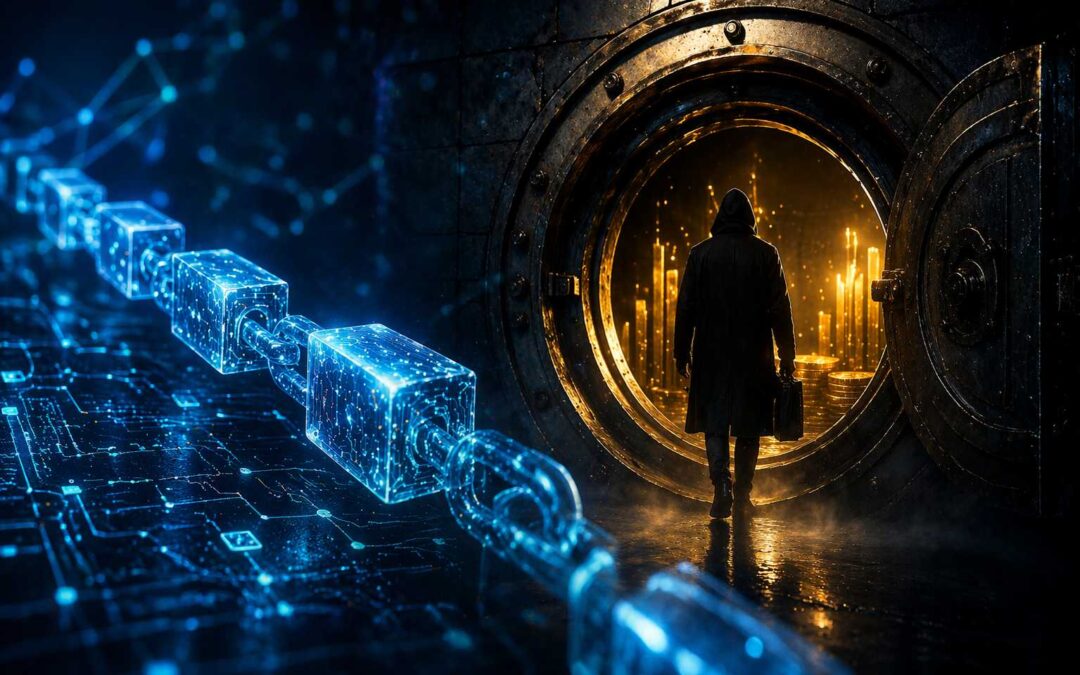
Synopsis: The key liquidity providers of crypto are shifting away from public blockchains to maintain the secrecy of their strategies which cannot be stolen by other users.
In the professional trading space, your unique “playbook”- how you time the market and execute transactions is the most valuable price of intellectual property you have. Over the last few years, blockchain-based systems boasted about their fully-transparent nature, anyone could access every transaction from its inspection until its end.

Market makers, institutions that are responsible for constant “buy” and “sell” orders that facilitate the market movement, face the issue of having their strategies copied in real time. In classical stock exchanges, the same firms use “dark pools” to ensure privacy of their deals.
The “Alpha Problem”: Why Privacy Is Needed?
The situation is obvious: when everyone sees everything you do, everyone copies you, stealing your profit. On the high speed decentralized exchanges such as Hyperliquid, market makers admit that they need to update their trading strategy every three weeks due to bots copying their actions so aggressively that their profitability (alpha) disappears completely.
Secondly, on public blockchains, it becomes easier for anyone to criticize your business. The moment market makers show the public their data of selling assets during the collapse, they are perceived as villains, despite the fact that they are just trying to manage risks.
New solutions such as GoDark- a private trading venue on solana blockchain- are being introduced to give institutions a “dark corner” in which they can operate freely from any observation on the part of the internet community.

Impact on Investors
Short-term Traders
- Hidden Liquidity: Large buy/sell orders may not be visible on the public order book, as they will be conducted in private tools. As a result, users will see sudden shifts in asset prices.
- Decrease in Copy-Trading: Popular strategies that include tracking the “whale wallets” (tracked by Arkham or DeFiLlama websites) will lose their effectiveness, as institutional players would move to a private layer.
Long-term Investors
- Institutionalization: Providing “dark pools” is considered the only thing left to attract big players in the form of Wall Street banks to conduct operations on-chain.
- Increased Stability: If market makers are willing to supply more liquidity without being “front-runned” by bots and other actors, it can mean less extreme volatility in crypto markets.
Advantages, Key Risks and Catalysts to Watch
Advantages
- Lower Trading Costs: Once market makers don’t have bots constantly targeting them to steal profits, they can start offering lower rates.
- Protection of Intellectual Property: Professional players will be able to freely implement their best AI models and strategies without being replicated by other players.
- Reduced PR Risks: With private trading options, market players will not have to worry about being perceived as villains, as people won’t be able to analyze their on-chain transactions freely.
Key Risks
- Liquidity Management: If the majority of market transactions occur within “dark pools”, it can cause public markets to be less liquid and more expensive.
- Lack of Accountability: One of the key principles of blockchain is full visibility, while the shift towards “dark pool” trading means that crypto loses its most unique trait.
- Higher Regulatory Attention: In particular, the SEC will likely consider private liquidity to violate the principle of anti-money laundering (AML).
Catalysts to Watch
- The Launch of GoDark (expected in May 2026): This platform will serve as a test ground for the popularity of the concept of private trading.
- Hyperliquid’s response: Watch out for any signs that the market leader starts to introduce “private order” mechanisms to attract market makers.
- The “Zcash Effect”: As the market makers begin requesting greater anonymity, ZK tokens and protocols will receive an unprecedented boost in their popularity.
Crypto is moving towards a hybrid approach where the settlement of assets stays on the public blockchain, but the process of executing transactions goes dark.
Written by Ansh Kapoor