
Perpetual Contracts Under the Microscope: Low Fees, High Leverage, and Round-the-Clock Crypto Derivatives Access
Fees are the silent killer of derivatives profitability. Every trader knows it, and most try not to think too hard about it.

Watch taker fees quietly chip away at your margins across hundreds of trades and the math gets depressing fast. But fees aren’t the whole story. Rigid KYC processes that hold up your first trade for days, leverage caps that box in your strategy, no sandbox to practice in before risking real capital — the onboarding experience across most derivatives platforms still leaves a lot to be desired.
Perpetual futures now dominate crypto derivatives trading. The platforms offering them keep trying to outdo each other on cost, access, and tooling — with mixed results. One exchange that’s been quietly building out its perpetual contracts product since 2020 is [BYDFi](https://www.bydfi.com/en). Operating globally and registered in Canada, the platform has grown to over 1,000,000 registered users across 190+ countries. It supports no-KYC trading — sign up with an email, start trading immediately. This makes onboarding faster for users who value accessibility and efficient account setup.
The exchange landed a multi-year deal as the Official Crypto Exchange Partner of Newcastle United in August 2025. Proof of Reserves has been audited by Hacken, with reserve levels reported above 1:1 for major assets.
So does the perpetual contracts product actually deliver? How does it stack up against the competition? Let’s dig in.

How Perpetual Futures Work — and What’s on Offer Here
Perpetual futures are derivatives contracts with no expiry date. That’s the key structural difference from traditional [futures contracts](https://www.investopedia.com/terms/f/.asp), which settle on a fixed date. Because you can hold them indefinitely, perpetuals have become the go-to instrument for active crypto traders who want continuous exposure without dealing with rollover mechanics.
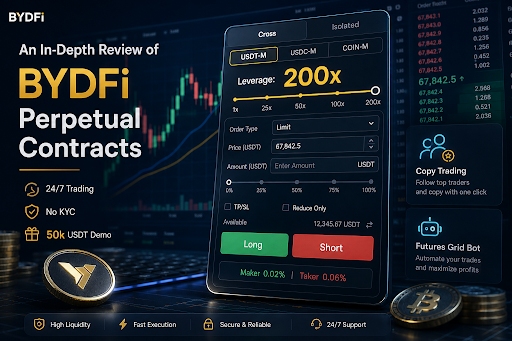
BYDFi perpetual contracts launched with flexible leverage from 1x to 200x back in August 2022. Since then, the product has expanded to support three margin denomination modes: USDT-M, USDC-M (added August 2025), and COIN-M. You pick between Cross and Isolated margin modes, which gives you granular control over collateral allocation — a setup that’ll feel familiar if you’re coming from traditional derivatives markets.
The exchange lists a broad range of perpetual trading pairs. BTC, ETH, XRP, DOGE, ADA, SHIB, SOL, BNB, MATIC, DOT, AVAX, LINK, LTC, TRX, and plenty more. Broad cross-asset coverage for derivatives traders who don’t want to hop between platforms.
The Fee Math for High-Frequency Perpetual Traders
If you trade perpetual futures at volume, you already know this calculation by heart. Paying 0.10% per side on every position means a hundred round trips costs 20% of notional volume in fees alone. That’s capital that never compounds.
BYDFi’s fees for perpetual futures start at 0.06% taker and 0.02% maker at VIP 0, dropping to 0.032% taker and 0.008% maker at VIP 6. For context, spot trading fees on the same platform sit at 0.1% taker / 0.1% maker across all VIP tiers. The perpetual futures fee structure is already more competitive at the base level than spot — a structural edge if derivatives are your focus.
How Do These Fees Compare?
Here’s how the base-tier perpetual futures fees line up against several major competitors:
| Exchange | Maker Fee (Base Tier) | Taker Fee (Base Tier) | Max Leverage | KYC Required |
| BYDFi | 0.02% | 0.06% | 200x | No |
| Binance | 0.02% | 0.05% | 125x | Yes |
| Bybit | 0.02% | 0.055% | 100x | Yes |
| OKX | 0.02% | 0.05% | 125x | Yes |
| Bitget | 0.02% | 0.06% | 125x | Yes |
Maker fees are essentially identical across these exchanges at the base tier. Taker fees vary slightly. The 0.02% maker / 0.06% taker schedule puts the platform squarely in the same range as the rest. Where it pulls ahead more clearly: maximum leverage (200x versus the 100x–125x range most competitors offer) and no-KYC access. Fair warning, though — Binance and OKX carry higher reported trading volumes, which affects order book depth and execution quality, especially on larger orders. Nominal fee schedules only tell part of the story; slippage and execution characteristics matter just as much when you’re calculating total cost.
A 7-tier VIP program knocks up to 60% off futures fees based on 30-day trading volume or asset balance. It rewards consistency rather than demanding a massive upfront commitment — a design that works better for active retail traders than the whale-only structures you’ll find on some competing platforms.
The exchange also offers TradFi perpetual contracts covering tokenized US stocks, forex, and Gold/XAUUSD, settled in USDT with no explicit trading commissions. Other costs like funding rates or spreads may still apply, so do your homework. For traders who want cross-asset exposure without platform-hopping, it’s worth a closer look.
Funding rates follow the standard 8-hour interval. Predictable, transparent. You can verify market data independently on [CoinGecko’s exchange page](https://www.coingecko.com/en/exchanges/bydfi) or [CoinMarketCap](https://coinmarketcap.com/exchanges/bydfi/), where the exchange has been listed since January 2023.
Leverage Flexibility: 1x to 200x Across a Broad Range of Pairs
Leverage ceilings frustrate experienced derivatives traders more than almost anything else. Some platforms cap you at 100x or 125x, which can box in high-conviction setups.
BYDFi leverage ranges from 1x to 200x, so you can match position size precisely to your risk appetite. The mechanics are simple: expect a price rise, go Long; expect a fall, go Short. A 1% price move at 10x leverage translates to roughly a 10% gain — or a 10% loss — on posted margin. High leverage amplifies both gains and losses. Traders may lose their margin quickly if risk is not managed properly. Leveraged trading carries substantial risk and isn’t suitable for everyone.
In December 2024, the platform upgraded its perpetuals system with three risk management features: opening new positions without unrealized profits, bi-directional long/short hedging, and shared funds in full-margin mode to reduce liquidation risk. The bi-directional hedging is especially useful if you’re running delta-neutral strategies.
Available order types include Limit, Market, Stop Limit, Stop Market, TP/SL, Reduce-Only, and TIF (GTC). Everything from basic market entries to complex conditional setups.
No-KYC Access and Fiat On-Ramps: Cutting the Onboarding Friction
Plenty of platforms still require multi-day identity verification before you can place a single trade. If you’re privacy-conscious or based in a region with limited ID infrastructure, that’s not just inconvenient — it can mean missing time-sensitive market moves entirely.
Here, you register with an email and start trading perpetual futures right away, no mandatory identity verification. Verification is optional rather than a gate on core functionality. A deliberate design choice that prioritizes accessibility. Traders should be aware that regulatory requirements for identity verification vary by jurisdiction, and accessing derivatives platforms without KYC may not be permissible everywhere.
Fiat-to-crypto access comes via One-Click Buy Crypto, Bank Transfer, Credit/Debit Card, and P2P Trading, supporting 100+ fiat currencies. The interface is available in 22 languages, and the platform app runs on iOS, Android, and APK — so you can manage perpetual positions, adjust leverage, and monitor funding rates on the go without being tethered to a desktop. New users may qualify for promotional rewards of up to 8,100 USDT, subject to terms and conditions on the platform’s website.
Customer support runs 24/7 via email and live chat.
Tools for Every Level: Demo Trading, Copy Trading, and Bots
Jumping straight into leveraged positions without practice is how accounts get blown up. Fast. A layered toolkit helps bridge the gap between theory and live execution.
Demo trading: A demo account comes preloaded with 50,000 USDT and supports USDT-M and COIN-M perpetual contracts with full functionality — the complete 1x–200x leverage range included. Setting it up took under two minutes in testing. No deposits, no verification, just immediate access to the full trading interface. Honestly, more exchanges should make this standard.
Perpetual Smart Copy Trading: Launched in August 2025, The platform’s Copy Trading feature automatically mirrors professional traders with proportional order sizing and isolated positions. The minimum entry is just $10, which makes it accessible for traders testing strategies before committing real capital. The feature lets you allocate to multiple lead traders simultaneously while keeping isolated-margin separation per copied position — a distinctive offering compared to many competitors.
Futures Grid bots: For ranging or sideways markets, Futures Grid bots automate range-bound trading on perpetual contracts. A useful complement to directional strategies when volatility dries up.
The full perpetual futures workflow is straightforward: deposit collateral, choose your margin mode, select a pair and leverage (1x–200x), place Long or Short orders, set TP/SL, and receive or pay funding every 8 hours.
Compliance, Fund Security, and Limitations
BYDFi is registered as a Money Services Business (MSB) with the U.S. Financial Crimes Enforcement Network (FinCEN) and holds membership in South Korea’s CODE VASP Alliance. Proof of Reserves has been audited by Hacken, with reserve levels reported above 1:1 for major assets. An 800 BTC Protection Fund was established in September 2025. Details on the fund’s structure, eligibility criteria, and payout conditions are available on the platform’s website.
As with any leveraged product, traders should evaluate fees, leverage, liquidity, risk-management tools, and local regulatory requirements before using any perpetual futures platform.
FAQ
What leverage is available on perpetual contracts?
Flexible leverage from 1x to 200x. Traders can adjust leverage to match their strategy, though higher settings carry proportionally greater liquidation risk. Leveraged trading isn’t suitable for all investors.
What are the trading fees for perpetual futures?
At VIP 0, fees are 0.06% taker and 0.02% maker. These drop to 0.032% taker and 0.008% maker at VIP 6, with up to 60% discount through the 7-tier VIP program.
Can I trade perpetual contracts without KYC verification?
Yes. Register with just an email and start trading perpetual futures without mandatory identity verification. Regulatory requirements vary by jurisdiction, so make sure you’re compliant with local laws.
Does the platform offer a demo account for perpetual futures?
Yes. A demo account preloaded with 50,000 USDT supports USDT-M and COIN-M perpetual contracts with full functionality, including the complete 1x–200x leverage range.
What margin modes are supported?
Three margin denomination modes (USDT-M, USDC-M, COIN-M) and two margin management modes (Cross and Isolated).
The Bottom Line
Operating since 2020 and now serving over 1,000,000 registered users across 190+ countries, the platform spot trading and derivatives products together cover a broad range of perpetual trading pairs with a copy trading feature starting at just a $10 minimum entry, carving out a niche across multiple trading styles.
Traders looking for perpetual contracts with low fees and high leverage will find a competitive starting point: maker fees from 0.02%, flexible leverage up to 200x, no-KYC onboarding, and a 50,000 USDT demo account — backed by Hacken-audited Proof of Reserves and an 800 BTC Protection Fund.
If you’re evaluating perpetual futures platforms, compare these metrics — fees, leverage range, onboarding requirements, reserve transparency — against what you’re currently using. The differences might surprise you.
