
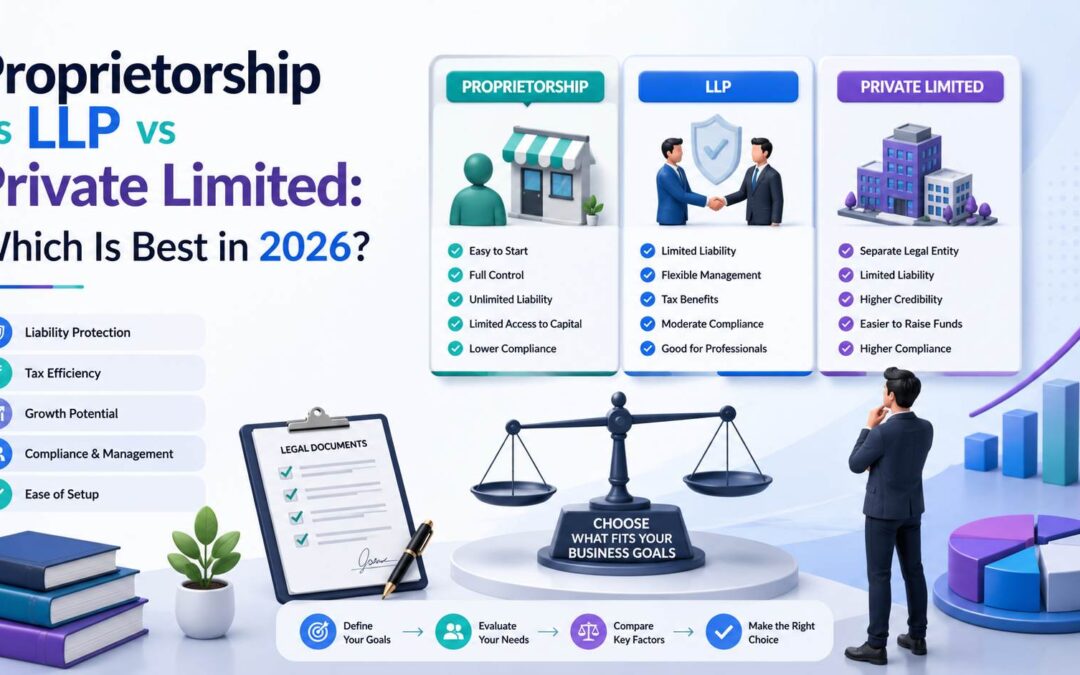
Every business begins with an idea, but turning that idea into a company starts with choosing the right legal structure.
In 2026, entrepreneurs need to consider more than just ease of registration. Tax regulations, compliance obligations, funding opportunities, and future growth plans all play a role in selecting the right entity.
The structure you choose today can affect everything from your personal liability to your ability to raise investment tomorrow. This guide breaks down India’s three primary business structures to help you identify the perfect fit for your enterprise.
1. Private Limited Company (Pvt Ltd)
The Private Limited Company remains the undisputed gold standard for scalable, tech-driven ventures and modern startups. Governed strictly by the Companies Act, 2013, it offers unmatched credibility.
- Best For: High-growth startups planning to raise Angel or Venture Capital (VC) funding, build ESOP pools to attract premium talent, or scale operations globally.
- The Advantage: It creates a separate legal entity with absolute limited liability protection, ensuring your personal assets are completely insulated from corporate debts. From a tax planning perspective, it is highly efficient at scale: under the concessional corporate tax regime (Section 115BAA), domestic companies enjoy a flat base tax rate of 22% (approx. 25.17% effective rate including surcharge and cess), which avoids the peak personal income tax brackets.
- The Catch: It carries a heavy compliance burden. Committing to a private limited company registration means managing mandatory statutory audits from year one, holding regular board meetings, and filing annual returns with the Registrar of Companies (RoC), regardless of your actual revenue or profit.
2. Limited Liability Partnership (LLP)
Regulated by the LLP Act, 2008, a Limited Liability Partnership serves as an exceptional hybrid model. It blends the structural protection of a corporation with the internal operational simplicity of a traditional partnership.
- Best For: Professional service consultancies (like IT agencies, CAs, lawyers, and marketing firms), family-managed businesses, and bootstrapped startups funding operations entirely through organic revenue.
- The Advantage: Like a company, an LLP Registration protects your personal savings by limiting your liability to your agreed capital contribution. However, its maintenance footprint is much smaller. An LLP is entirely exempt from mandatory audits unless its annual turnover crosses ₹40 lakh or capital contributions exceed ₹25 lakh, dramatically reducing recurring accounting fees.
- The Catch: An LLP cannot split its ownership into traditional equity shares. This makes raising institutional funding or venture capital nearly impossible, as investors cannot easily buy a stake. Additionally, profits are taxed at a flat base rate of 30% (plus cess and surcharges), which is higher than the concessional corporate tax rate.
3. Sole Proprietorship
A Sole Proprietorship is the oldest and most direct way to execute a business idea. There is no central corporate registry or formal MCA incorporation process; you and your business are recognised under a single PAN.
- Best For: Independent freelancers, consultants, micro-merchants, and local retailers testing a low-risk business model with minimal capital.
- The Advantage: It is incredibly cost-effective and easy to launch. You can begin operations within days using basic operational requirements, such as a GST registration or a Udyam portal registration. There are no mandatory corporate audits or annual RoC filing fees.
- The Catch: It carries unlimited personal liability. If your business defaults on a loan or loses a legal dispute, your personal property, bank accounts, and assets can be seized to settle the business’s obligations. Furthermore, equity fundraising is structurally impossible under this format.
Direct Core Comparison (2026 Metrics)
| Feature | Sole Proprietorship | Limited Liability Partnership (LLP) | Private Limited Company |
| Legal Identity | Legally identical to the owner | Separate legal entity | Separate legal entity |
| Liability Exposure | Unlimited (Personal risk) | Limited to the contribution | Limited to share capital |
| Minimum Founders | 1 | 2 | 2 |
| Headline Tax Rate | Individual Slab Rates | Flat 30% (+ Cess) | 22% Base (Effective 25.17%) |
| Annual Audit Requirement | No (Unless Tax Audit applies) | Only if Turnover > ₹40L or Capital > ₹25L | Yes, Mandatory from Day One |
| VC & Institutional Investment | Impossible | Extremely Difficult | Fully Supported & Preferred |
Which Framework Fits Your 2026 Strategy?
To finalise your direction, evaluate your commercial timeline against these three distinct paths:
Choose a Private Limited Company Registration if…
You are building a technology platform, product, or highly scalable service brand. If your path involves pitching to angel investors, securing venture capital, or issuing equity options to early hires, a private limited company registration is your only functional option. VCs require a clean, share-based structure before writing check sizes.
Choose an LLP Registration if…
You are establishing a co-founded service agency or consultancy where you plan to drive growth entirely out of business cash flow rather than equity dilution. Opting for an LLP Registration gives your firm full corporate status to lock down enterprise client contracts while completely shielding your personal assets, all without drowning your early runway in administrative overhead.
Stay as a Sole Proprietor if…
You are operating as an independent creator, solo software developer, or localised merchant. If your immediate transactional risk is manageable and your yearly profits sit comfortably within entry tax slabs, starting as a proprietor keeps things lean. You can easily transition to a corporate structure once your business lines prove profitable.
Structuring the Right Foundation
The business structure you choose will influence your operations, compliance requirements, and tax obligations for years to come. While setting up a company once involved navigating multiple intermediaries and lengthy paperwork, modern founders now have access to digital platforms that simplify the entire process.
Platforms like Razorpay Rize help entrepreneurs streamline company registration, documentation, and essential business setup requirements in one place, enabling them to start their journey on a strong and compliant foundation.
