
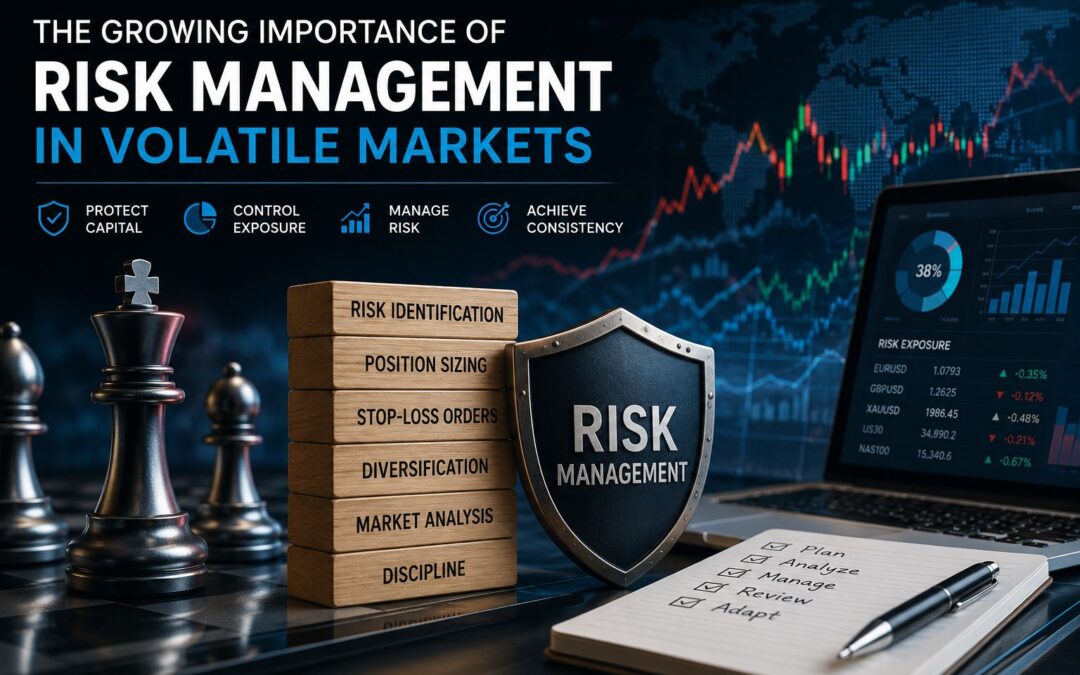
Financial markets have always involved risk, but in recent years, market volatility has become a much more significant factor for traders and investors. Economic uncertainty, inflation concerns, central bank policy changes, geopolitical events, and rapid shifts in investor sentiment can all create sudden price movements across global markets.
As a result, risk management has become one of the most important aspects of successful trading. While many traders focus on finding opportunities and identifying market trends, experienced market participants understand that managing risk is just as important as identifying potential profits.
In volatile market conditions, even well-planned trades can be affected by unexpected events. This is why modern traders increasingly place risk management at the center of their decision-making process.
Understanding Market Volatility
Volatility refers to the speed and magnitude of price movements within a market. During periods of low volatility, prices tend to move more gradually and predictably. During periods of high volatility, prices can change rapidly within minutes or even seconds.
Volatility can be triggered by many factors. Economic reports, interest rate decisions, inflation data, geopolitical developments, and unexpected news events often lead to increased market activity.
For traders, volatility creates both opportunities and risks. Larger price movements may provide more trading opportunities, but they can also increase the potential for losses.
This balance between opportunity and risk is why understanding volatility is essential for anyone participating in financial markets.
Why Risk Management Matters More Than Ever
Many new traders focus primarily on profit potential. However, professional traders often focus first on protecting capital.
The reason is simple. A trader who manages risk effectively can remain active in the market even after experiencing losses. A trader who ignores risk management may struggle to recover from a small number of poorly managed positions.
In volatile markets, protecting capital becomes especially important. Sudden market movements can quickly affect open positions, particularly in leveraged trading environments.
Risk management helps traders control their exposure and reduce the impact of unexpected events.
Rather than trying to predict every market movement, successful traders focus on creating a framework that allows them to participate in opportunities while limiting potential downside risk.
Position Sizing and Exposure Control
One of the most important elements of risk management is position sizing.
Position sizing refers to the amount of capital allocated to a specific trade. Instead of risking a large percentage of capital on a single opportunity, traders often spread their risk across multiple positions.
This approach helps prevent individual trades from having an excessive impact on overall performance.
Exposure control is also important. Traders may limit exposure to a specific asset class, sector, or market theme to reduce concentration risk.
For example, a trader heavily exposed to one currency pair may face significant risk if unexpected economic data affects that market. Diversifying exposure can help reduce this vulnerability.
The Role of Stop-Loss Orders
Stop-loss orders are among the most widely used risk management tools.
A stop-loss is designed to automatically close a position if the market moves beyond a predetermined level. This helps traders limit losses without requiring constant monitoring.
While stop-loss orders cannot eliminate risk entirely, they provide a structured approach to managing downside exposure.
Many experienced traders determine their stop-loss levels before entering a trade. This process encourages discipline and reduces emotional decision-making.
Risk Management in Leveraged Trading
Leverage can increase market exposure while requiring less initial capital. While this provides flexibility, it also increases the importance of risk management.
In leveraged markets such as CFDs and forex, relatively small price movements can have a larger impact on trading results.
This is why traders often focus on risk-adjusted decision-making rather than simply maximizing position size.
Understanding leverage, margin requirements, and market volatility helps traders make more informed decisions.
Platforms such as ScoreCM provide access to multiple financial markets, including forex, commodities, and indices. For traders operating in leveraged environments, understanding market conditions and applying effective risk management practices remains essential. More information is available at
The Importance of Market Analysis
Effective risk management begins before a trade is placed.
Many traders combine technical analysis, fundamental analysis, and market research to better understand current conditions.
Economic indicators such as inflation reports, employment data, and interest rate decisions often influence market direction and volatility.
By monitoring these factors, traders can identify periods when risk levels may be elevated.
Market analysis does not eliminate uncertainty, but it helps traders make decisions based on information rather than emotion.
Adapting to Changing Market Conditions
One of the most important aspects of risk management is flexibility.
Markets evolve constantly. Strategies that perform well during stable periods may require adjustments when volatility increases.
For example, traders may reduce position sizes, widen stop-loss levels, or become more selective when market uncertainty rises.
The ability to adapt is often what separates long-term participants from those who struggle during challenging market environments.
Rather than applying the same approach under all conditions, experienced traders adjust their risk management framework to reflect current market realities.
Building a Long-Term Trading Mindset
Risk management is not simply about avoiding losses. It is about creating a sustainable approach to market participation.
Every trader experiences losing trades. What matters is how those losses are managed.
A disciplined risk management framework helps traders remain consistent, protect capital, and maintain confidence during difficult periods.
Over time, this consistency becomes more valuable than any individual winning trade.
Conclusion
As financial markets become increasingly influenced by economic uncertainty, geopolitical developments, and rapid information flows, risk management continues to grow in importance.
Volatility creates opportunities, but it also increases potential challenges for traders. Managing exposure, controlling position size, using stop-loss orders, and understanding market conditions are all essential components of a successful trading approach.
Rather than focusing solely on potential profits, traders who prioritize risk management often place themselves in a stronger position for long-term success.
In modern markets, risk management is no longer simply a defensive tool—it is a core part of effective trading and investment decision-making.
