
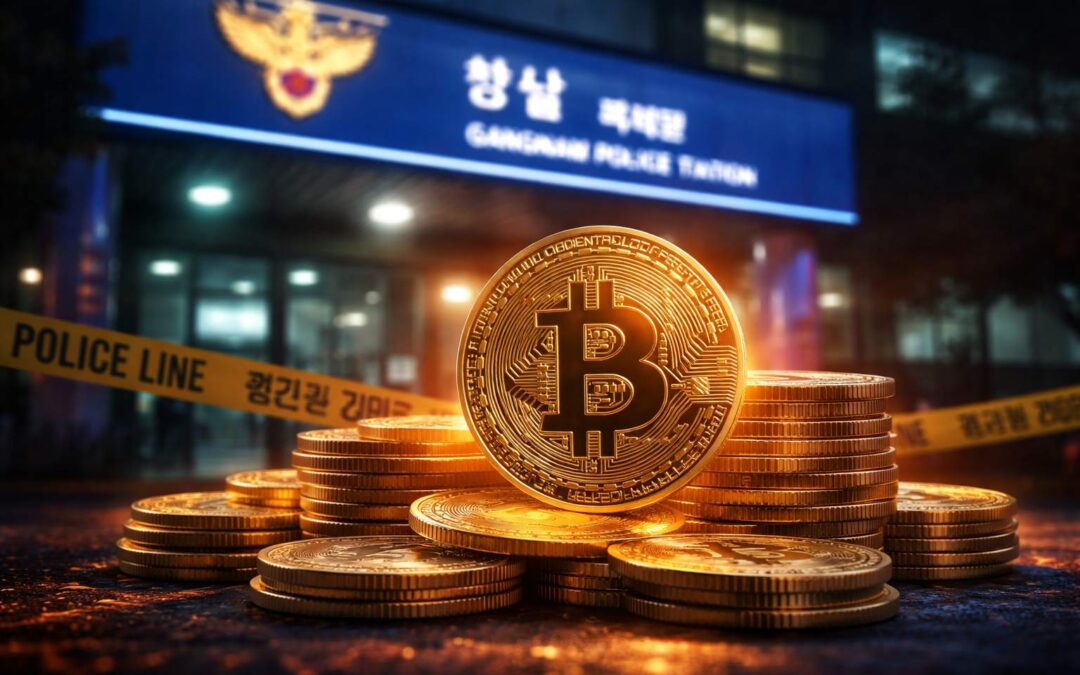
Synopsis: An audit revealed that 22 bitcoins held in cold storage at a Seoul police station had been moved without authorization. The incident has raised serious concerns about internal controls, digital-asset custody practices, and South Korea’s ability to securely manage seized cryptocurrency.
South Korean authorities are under scrutiny after 22 bitcoins (worth approximately $1.5 million) went missing from police custody in Seoul. The assets had been stored at Gangnam Police Station since November 2021 as part of a criminal seizure.

The disappearance was discovered during a routine audit of confiscated digital assets, which found that the funds had already been transferred out of the wallet. This indicates that the assets were not lost through external hacking, but were moved using valid access credentials.
The case is now being investigated by the Gyeonggi Northern Provincial Police Agency, which is examining:
- Who had access to the private keys
- When the transfer occurred
- Whether it was authorized
- Whether the transfer was conducted on behalf of another party
Cold Wallets Are Secure But Not Foolproof
A cold wallet is an offline storage device that keeps private keys disconnected from the internet, significantly reducing the risk of remote hacking.
However, the statement that cold wallets “cannot be hacked” is not entirely accurate. While they are highly secure against online attacks, they remain vulnerable to:

- Insider threats
- Physical access to the device
- Poor key management practices
- Compromised backups or passwords
In this case, the transfer suggests that someone with legitimate access to the private keys executed the transaction, pointing to a potential internal control failure rather than a technical breach.
A Pattern of Custody Weaknesses
The Seoul incident is not isolated. In August 2025, prosecutors in Gwangju reported the loss of around 320 bitcoins (valued at roughly $21 million) from seized holdings.
Investigators linked that case to a phishing attack and leaked credentials, highlighting how human-factor vulnerabilities can undermine even offline storage systems.
Together, the two cases have intensified concerns over:
- Key management procedures
- Access controls
- Segregation of duties
- Audit trails for digital assets
Legal Authority Brings New Responsibilities
South Korea’s Supreme Court ruled in January that bitcoin held on centralized exchanges can be seized under the Criminal Procedure Act, formally recognizing cryptocurrency as a seizable asset.
While the ruling strengthened enforcement powers, it also placed greater responsibility on authorities to:
- Safeguard private keys
- Implement institutional-grade custody systems
- Maintain transparent audit and recovery mechanisms
The recent losses suggest that existing infrastructure and training may not yet meet the operational requirements of digital-asset custody.
Also Read: Billionaire VC Investor Peter Thiel Dumps ETHZilla After 97% Stock Collapse. Here’s why.
Impact on Policy and Enforcement
These incidents have triggered policy discussions on how law-enforcement agencies should manage seized cryptocurrency. Key proposals include:
- Multi-signature (multisig) custody frameworks
- Hardware security modules (HSMs)
- Independent oversight and dual-control access
- Real-time blockchain monitoring of seized assets
- Specialized training for digital-asset handling
The goal is to align law-enforcement practices with institutional crypto custody standards used by regulated exchanges and custodians.
Recovery Prospects Remain Uncertain
Because blockchain transactions are public but irreversible, recovery will depend on:
- Identifying the destination wallets
- Tracing fund movement across exchanges
- Freezing assets if they reach compliant platforms
If the funds have already passed through mixers or moved to non-compliant venues, recovery may be difficult.
What Is Next?
The disappearance of 22 bitcoins from a police cold wallet shows that technical security alone is not enough.
Digital-asset custody requires:
- Strict internal controls
- Proper key governance
- Institutional security protocols
As South Korea expands its legal authority to seize cryptocurrency, these incidents highlight the urgent need to modernize custody frameworks to prevent insider risk and ensure the integrity of financial-crime investigations.
Written by Parvati Anilkumar
