
Most coverage of crypto in India stops at the 30% headline. For someone who trades often, that number hides the real problem. The tax is only one layer of what you pay. Stack the 1% TDS on every sell, the 18% GST that now sits on top of your trading fees, and the fees themselves, and an active trader can lose a large slice of every rupee that moves.

Here is the part worth your attention. Most of that stack is fixed by law and you cannot touch it. One layer is not. This article walks through the full cost of active trading in India, marks what is locked and what is yours to control, and shows the honest ways to lower the one cost you can actually move.
The three costs every Indian crypto trader pays
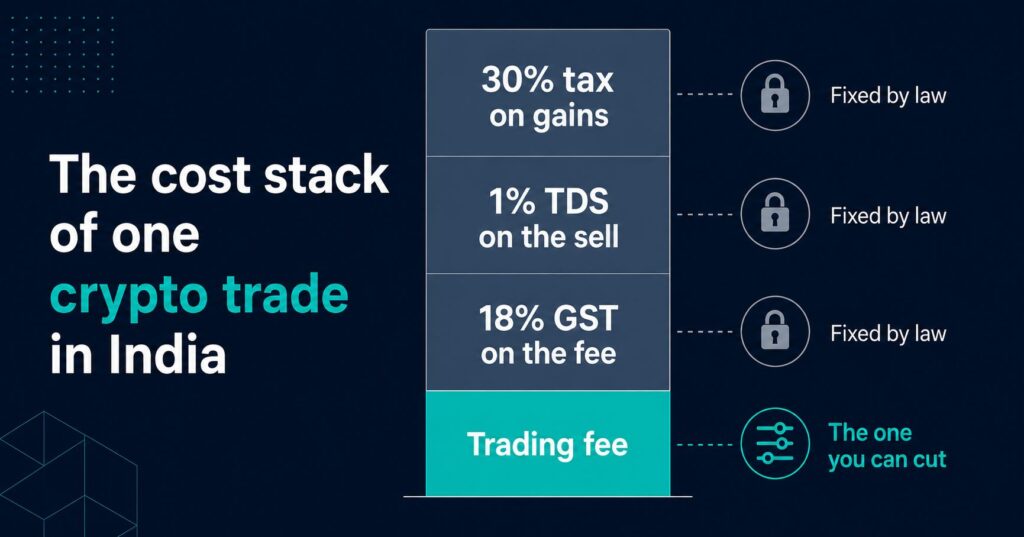
Before a single rupee of profit reaches you, three taxes and one fee come out of the picture. Knowing which is which is the whole game.
30% tax on your gains (Section 115BBH)
Profit on a virtual digital asset is taxed at a flat 30% under Section 115BBH, introduced in the 2022 Budget, plus the applicable surcharge and a 4% cess, which pushes the effective rate past 31%. It does not matter whether you held for a day or a year. You cannot claim deductions beyond your cost of acquisition.
You cannot set a loss off against any other income, not even against another crypto gain, and you cannot carry it forward (source: Income Tax Act, Section 115BBH). For a trader, that last point stings the most, because the usual move of offsetting winners with losers is simply gone. This cost is fixed.

1% TDS on every sell (Section 194S)
Under Section 194S, 1% is deducted at source on the sale value of each transfer, not on your profit, on the full amount. The threshold sits at ₹50,000 a year for most individuals and ₹10,000 for others (source: Income Tax Act, Section 194S).
Read that again, because it is the quiet killer for anyone who trades with any frequency. The 1% lands on turnover, win or lose, and it ties up capital on every exit. Run a strategy that turns over your book many times a month and the TDS alone becomes a real drag. This cost is also fixed.
18% GST on your trading fees (since 7 July 2025)
This is the newest layer and the one most traders have not fully priced in. Since 7 July 2025, an 18% GST applies to the service fee an exchange charges you, meaning the trading fee itself, not the crypto and not your gain. Exchanges serving Indian users began passing it on across spot, margin, derivatives, conversion and withdrawals. The detail that matters: this GST rides on your fee. The bigger your fee, the bigger the GST sitting on top of it.
Why active traders feel this more than holders
A buy and hold investor meets the 30% once, on the way out. An active trader meets the 1% TDS and the trading fee on every round trip, and the 18% GST on every one of those fees. Volume is the multiplier.
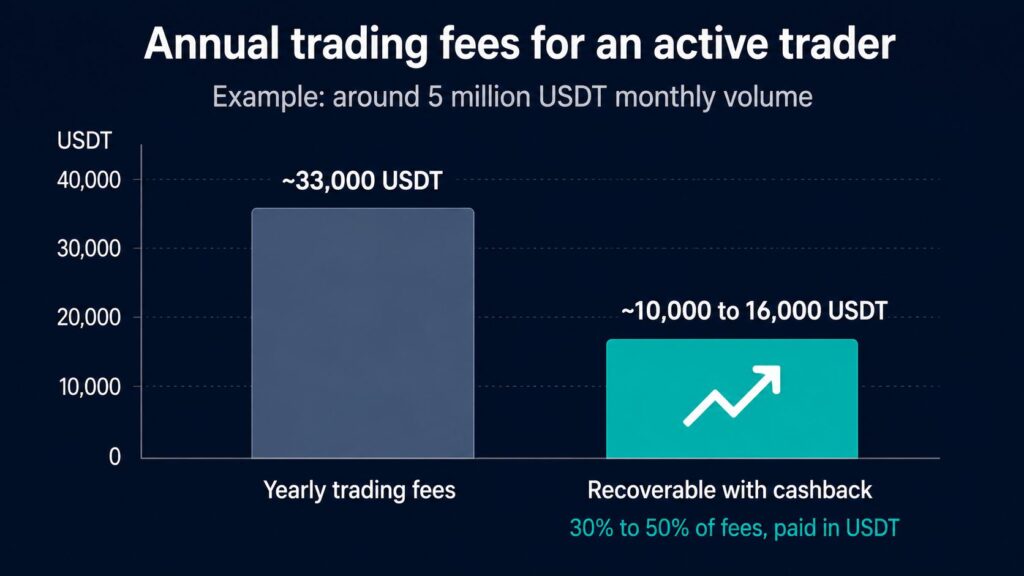
Put rough numbers on it. A trader running around 5 million USDT of monthly volume pays in the region of 33,000 USDT a year in trading fees alone, before any of the taxes. Layered together, some analyses have put the combined burden of 30% on gains, 1% TDS per trade and 18% GST on fees past 49% for active strategies (source: Analytics Insight). When close to half of your edge is going somewhere else, every controllable cost is worth a hard look.
The one cost you can actually cut
Here is the line that separates the fixed from the negotiable. The 30% tax and the 1% TDS are set by law. No service, no broker, no trick lowers them, and anyone who tells you otherwise is selling something you should walk away from.
Your trading fee is different. It is a price, not a tax, so you can both lower it and recover part of it. And when you lower the fee at the source, the 18% GST riding on it falls with it, because the GST is charged as a percentage of the fee. Lower the fee base and you cut two costs at once.
Understand maker and taker first
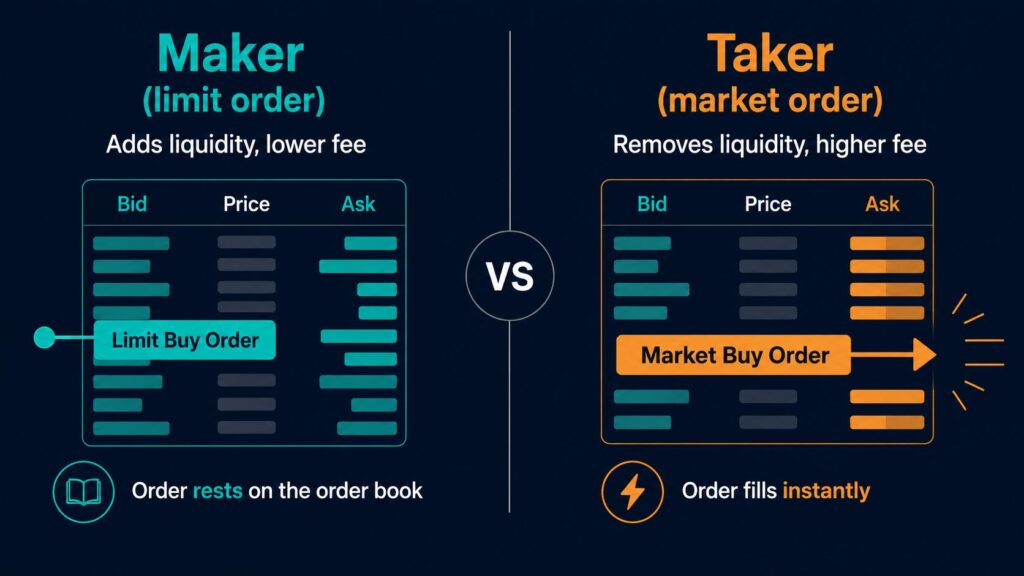
Every fee schedule splits into two prices. A maker order, usually a limit order that rests on the book and adds liquidity, is charged less. A taker order, usually a market order that fills instantly and removes liquidity, is charged more. Knowing which one you are sending is the first lever, and it costs nothing to learn.
Four honest ways to lower what you pay to trade
None of these touch your tax bill. The first returns part of the fee you have already paid. The other three lower the fee at the source, which also trims the 18% GST riding on it.
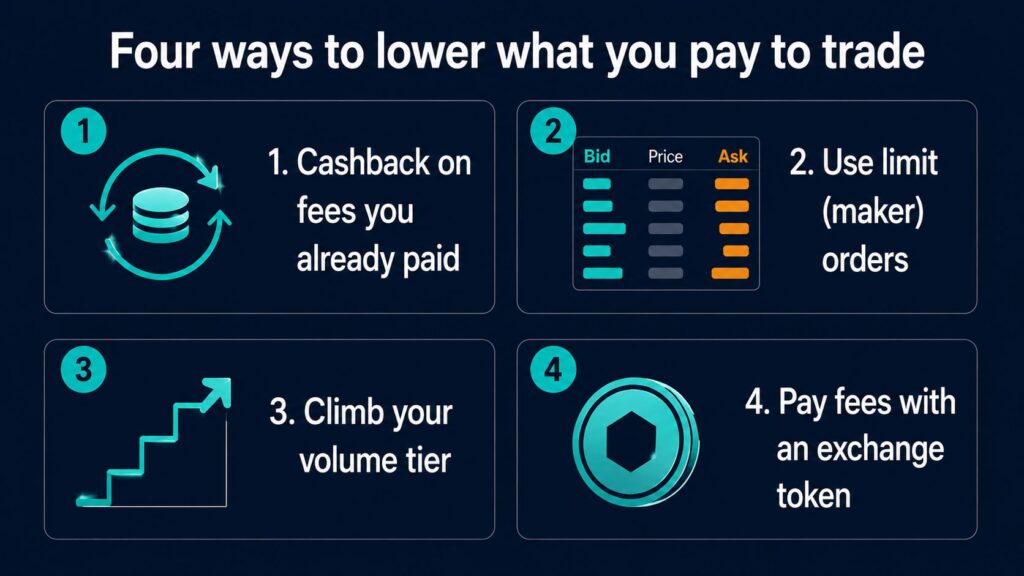
1. Get cashback on the fees you already paid
There is a category of service that returns a share of the trading fees you have already spent, paid back to you in USDT, with no need to switch exchange or change how you trade. The share is commonly 30% to 50% of your fees and it scales with your volume, so the more you trade, the more comes back.
The mechanics are simpler than they sound, and worth understanding before you trust any of them. You sign up to your exchange through the service’s referral link.
The exchange then shows your account, by its public UID, inside the partner dashboard. The service recognises your UID there and rebates a share of the fees you generate. It never sees your password, never holds your funds, and never needs trading permission on your account. It works only from your public UID.
Trade Reclaim is one service in this category, covering 10 major exchanges that Indian traders already use. On the baseline above, a trader paying around 33,000 USDT a year in fees could recover roughly 10,000 to 16,000 USDT of it. You can check the cashback rates per exchange on Trade Reclaim.
One honest caveat, because it matters. Cashback returns part of the fee you already paid. It does not refund the 18% GST that was charged on that fee at the time of the trade, and it does nothing to your 30% tax or your 1% TDS. Anyone who frames a fee rebate as a tax saving is wrong.
2. Use limit orders where you can
Routing as a maker instead of a taker drops you to the cheaper side of the schedule. You will not always be able to wait for a limit fill, but on entries and exits that are not time critical, it is money left on the table otherwise.
3. Climb your volume tier
Almost every exchange lowers your maker and taker rates as your rolling monthly volume rises. If your activity is split across two accounts or venues, consolidating it can move you into a cheaper tier sooner.
4. Pay fees with an exchange token
Several venues offer a discount when you pay fees in their own token. The discount varies by exchange, so check the current rate on the venue’s official fee page before you rely on it.
See your own fee math
Before you accept your costs as a given, it is worth doing the arithmetic on yourself. Take your average monthly volume, apply your exchange’s maker and taker rates, and you have your yearly fee burden. Apply a 30% to 50% rebate to that and you have the part you could be reclaiming. For most active traders, the number is larger than they expect, and it is the only number on the cost stack they get to change.
What you cannot cut
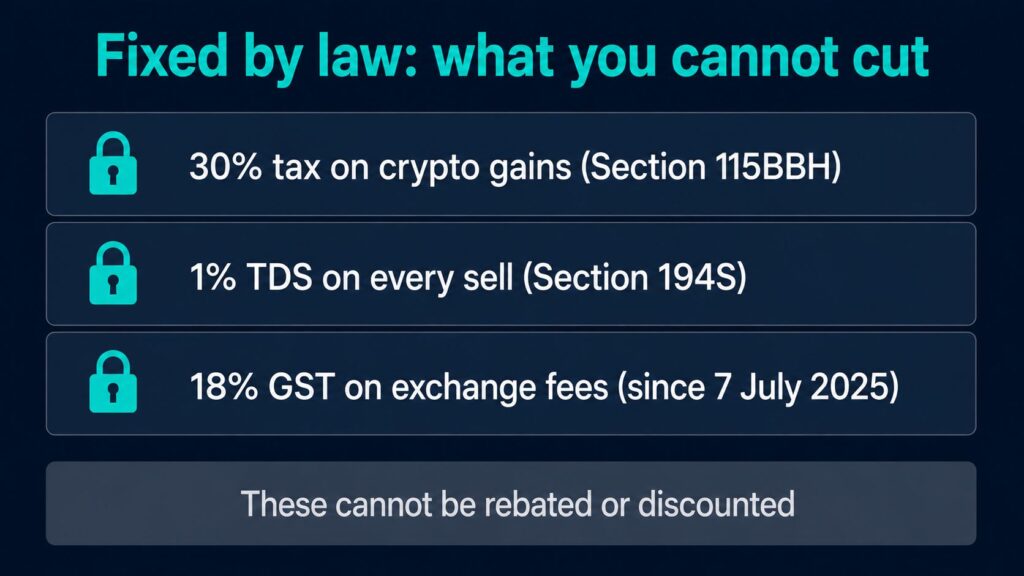
To be clear, because credibility matters more than a sale. The 30% tax and the 1% TDS are fixed and lawful, and they are not optional.
One more note that active traders should hear: some foreign exchanges have historically not deducted the 1% TDS for you, which leaves you personally responsible for deducting and depositing it, with interest and penalties under the law if you do not, and authorities are now tracking offshore activity. Lowering your fees is smart. Skipping your taxes is not, and this article is not suggesting it.
The takeaway
You cannot lower India’s crypto tax. You can lower what you pay to trade. The 30% and the 1% are written into law, but the fee, and the 18% GST sitting on it, are yours to manage.
Start with cashback on the fees you are already paying, send limit orders where you can, climb your volume tier, and use token discounts where they exist. In a market that already takes close to half of an active trader’s edge, the fee line is the one you still control. Use it.
Sources: Income Tax Act, Section 115BBH; Income Tax Act, Section 194S; 18% GST on exchange service fees in India, applicable since 7 July 2025; combined cost burden analysis, Analytics Insight;
Trade Reclaim
