

Synopsis: Bitcoin has registered the worst performance in the past six months since 2018, primarily due to macro headwinds, low demand, and sell pressure, which are affecting traders as well as investors.
The crypto market is facing a tough phase, as the price is having difficulty in rising further due to poor market conditions. According to the latest data, the cryptocurrency market is expected to face the worst six months since 2018, which leads to creating further alarm among investors.

Key Stats and Market Data
- The Bitcoin price fell near the $65000 mark due to the failure of the price to sustain above the $71000 to $72000 key resistance zone.
- Bitcoin price has registered consecutive months of weakness, which is likely to continue for the sixth month in a row, this situation last experienced in 2018.
- The market is facing low liquidity, while the data has reflected low buying as well as high selling from the whales.
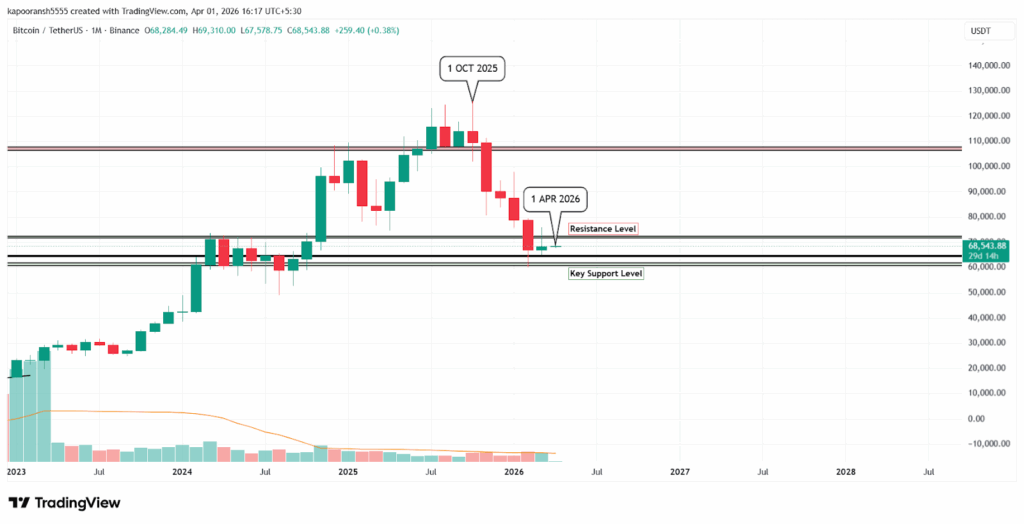
BTC/USDT Monthly Time Frame Chart
Market Weakness and Historical Context
The current trend in Bitcoin can be explained as a general slowdown in the market momentum. While the asset has been able to reach strong highs in the past, the inability to sustain the price above the key levels indicates weakness in the market. In the past, the same has been observed in the year 2018, when the prolonged pressure in the market led to a correction in the market.
One of the key factors behind the current trend in Bitcoin can be explained as the changing global financial environment. As the geopolitical environment becomes increasingly uncertain, the traditional markets are becoming less attractive from an investment perspective, which is affecting the demand for cryptocurrencies.
Further, the current technical analysis indicates a bearish formation in the short term, as the support levels are becoming resistance, it has been reflected in the current price movement of Bitcoin, which is facing rejection while moving higher in the market.

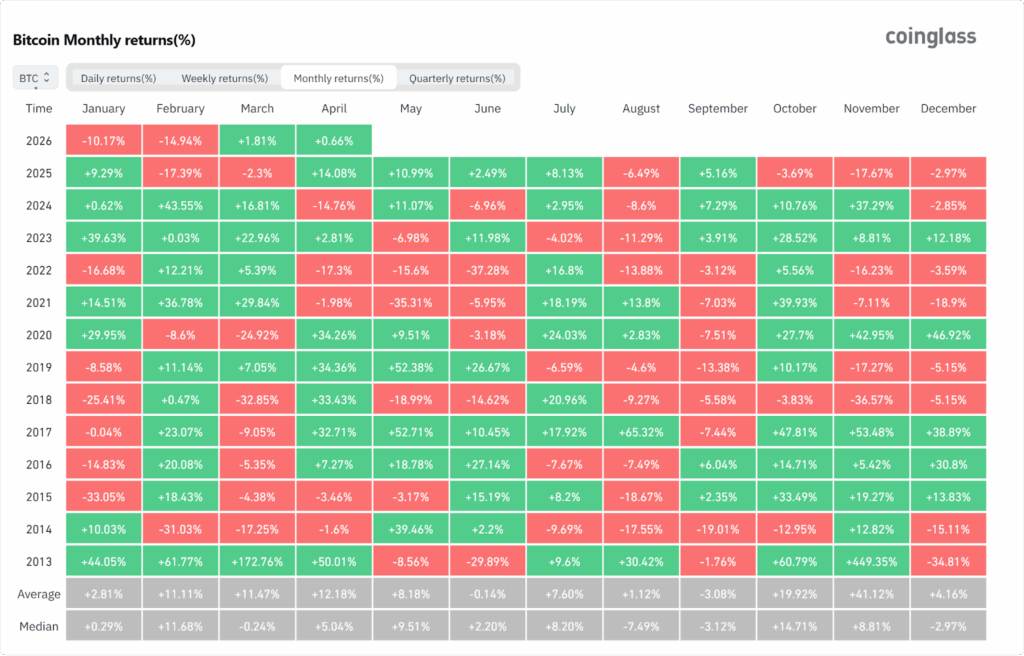
BTC/USD monthly returns (screenshot). Source: CoinGlass
Impact on Investors
Short-term Traders
- The price of Bitcoin currently faces high volatility and low trends also faces resistance between $71000 and $72000.
- As there is low buying pressure because of low liquidity, if there are any price movements, whether upward or downward, they will be sharp.
- The bearish patterns and resistance levels suggest that there might be risk of falling in the near future.
Long-term Investors
- As there has been a long period, the accumulation phase shows there might be a similar buying opportunity like 2018.
- The fundamentals remain strong, including institutional adoption, investments, and scarcity.
- Macro-driven cycles shows there needs to be improvement in global liquidity and stability for long-term growth, it still needs to be addressed.
Also Read: Morgan Stanley Enters Bitcoin ETF Race with Low Fees
Advantages, Key Risks and Catalysts to Watch
Advantages
- The accumulation phase gives opportunity for long-term investors to accumulate Bitcoin by providing lower prices.
- Weak markets eliminate weak hands and speculation, leading to a healthier and more sustainable market structure.
- Fundamentals remain strong like Bitcoin remains scarce, decentralized, and continues to gain adoption institutions.
Key Risks
- Large holders selling Bitcoin leads to lower prices and further selling pressure.
- Macroeconomic risks may reduce demand for Bitcoin such as interest rates, global tensions.
- Poor Liquidity means large holders not demanding much it may result in sideways or lower prices.
Catalysts to Watch
- Lower interest rates boost the liquidity by attracting fresh capital into crypto markets.
- Fresh Investment from Exchange-Traded Funds (ETFs) and large holders may boost the price of Bitcoin.
- Bitcoin seasonal and historical trends see positive price momentum during strong months like April.
Outlook
The weakness seen in the Bitcoin markets is temporary and does not indicate a structural problem. Even though the overall uncertain environment and low demand are impacting the markets, historical analysis indicates that the markets may improve after a prolonged correction. The levels and institutional flows are important for the next move. Investors are advised to be cautious for the short term while maintaining a longer-term focus on growth potential.
Written by Ansh Kapoor