
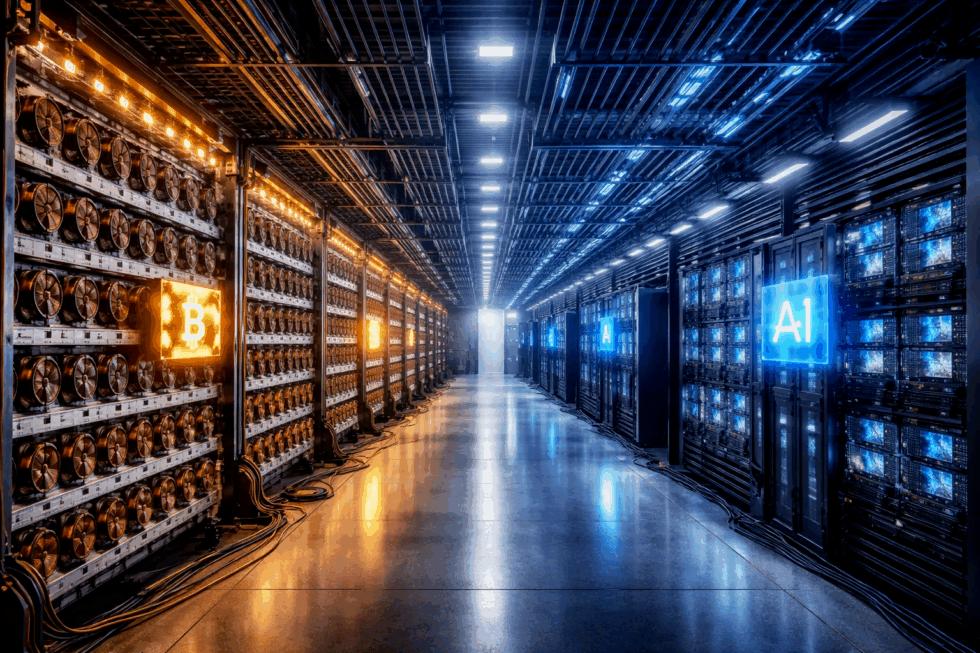
Synopsis: Bitcoin miners, battered by post-halving price slumps and high costs, are pivoting to lucrative AI/HPC contracts, transforming data centers into stable revenue powerhouses amid crypto volatility.
Bitcoin miners are facing one of their toughest periods in recent years, pushing many operators to rethink their business models. Falling Bitcoin prices, rising energy costs, and shrinking rewards have combined to squeeze margins, accelerating a strategic shift toward artificial intelligence (AI) and high-performance computing (HPC).

Bitcoin Price Slump Adds to Mining Stress
Bitcoin’s price fell to around $90,400 on January 11, 2026, marking a roughly 28% decline from its October 2025 peak near $126,000. The drop has intensified pressure on miners already struggling with elevated operating costs.
The strain became more pronounced after the 2024 Bitcoin halving, which reduced block rewards to 3.125 BTC. While energy prices have remained stubbornly high, mining revenues have declined, making traditional Bitcoin mining increasingly uneconomical for many operators.
In contrast, AI and HPC companies are offering stable, long-term contracts for the same data-center infrastructure, prompting miners to pivot in order to survive.
Mining Difficulty Falls, but Economics Remain Harsh
Bitcoin’s network mining difficulty declined about 2.6% to roughly 146 trillion in early January, marking the first downward adjustment of 2026. While this provided marginal relief, broader economics remain challenging.

Hash price a key profitability metric fell below approximately $35 per petahash per second per day in November 2025, well below the around $40 many miners require to break even. Industry estimates suggest the all-in cost to mine one Bitcoin often ranges between $70,000 and $100,000, depending on energy prices and hardware efficiency.
As losses mount, smaller miners have shut down rigs or sold Bitcoin reserves. Riot Platforms, for example, sold about $200 million worth of BTC to shore up liquidity and fund expansion into AI-related ventures.
Also Read: Hundreds of Wealthy Investors Are Using Crypto to Buy Real Estate in Europe
Major Mining Firms Accelerate AI Transitions
At least nine publicly listed Bitcoin miners have announced full or partial pivots toward AI and HPC. These include Core Scientific, Riot Platforms, IREN, TeraWulf, CleanSpark, Bitfarms, Bit Digital, MARA Holdings, and Cipher Mining.
Bitfarms has outlined plans for a largely full transition toward HPC by 2027. CEO Ben Gagnon has noted that while Bitcoin mining can still be profitable, HPC generates significantly higher and more stable returns per unit of energy over longer periods.
Miners already control valuable assets large-scale power contracts, advanced cooling systems, and purpose-built data centers making them well-positioned to host AI workloads. In many cases, AI contracts pay three to four times more per kilowatt than Bitcoin mining and can deliver very high operating margins under long-term agreements.
Analysts See AI as the Primary Valuation Driver
Analysts increasingly view AI as the main value driver for diversified mining firms. Bernstein analysts estimate that approximately 86% of Core Scientific’s enterprise value is now tied to AI and HPC, with Bitcoin mining accounting for just around 14%.
According to CoinShares, public mining companies have announced over $40 billion in AI and HPC-related contracts. For many operators, Bitcoin mining revenue could fall below 20% of total revenue by late 2026, with AI hosting filling the gap.
While challenges remain including debt burdens, execution risks, and competition in the AI data-center space analysts argue that the pivot materially improves cash-flow stability and valuations.
From Crypto Miners to Digital Infrastructure Providers
Bitcoin miners once focused almost exclusively on crypto rewards. Today, many are evolving into digital infrastructure providers, leveraging their power capacity to support the rapidly growing AI sector.
Companies such as CleanSpark and MARA Holdings have moved quickly to secure multi-year AI hosting agreements with major cloud and AI firms, including Amazon and CoreWeave.
The 2024 halving initially squeezed margins, and Bitcoin’s subsequent price decline worsened conditions. Difficulty adjustments offered only limited relief. As a result, miners have sold assets, consolidated operations, or exited the industry entirely.
AI, however, offers a clearer path forward transforming mining sites into GPU-powered data centers with more predictable, long-term revenue. As demand for AI infrastructure accelerates, miners with access to low-cost and renewable energy stand to benefit the most.
For now, AI is stabilizing balance sheets amid crypto volatility. While risks persist, the opportunity is substantial. Bitcoin may recover in future cycles, but in 2026, AI has become the lifeline keeping many miners afloat.
Written By Fazal Ul Vahab C H
