
Synopsis: US captures Venezuelan President Maduro, revealing Venezuela secretly holds over $55 billion in Bitcoin acquired through sanctions evasion, gold sales, and oil deals effectively becoming world’s fourth-largest holder.
The weekend capture of Venezuelan President Nicolás Maduro by US forces has thrust cryptocurrency into an uncomfortable spotlight. While oil markets tumbled to four-year lows, a more startling revelation emerged from intelligence reports. Venezuela has quietly amassed a massive Bitcoin reserve estimated at over $55 billion making it one of the world’s largest cryptocurrency holders.

This shadow reserve rivals the holdings of major institutional players like MicroStrategy and BlackRock. However, the regime built this treasure through sanctions evasion, gold liquidations, and oil deals settled in crypto. The story reveals how digital assets became weapons of financial warfare rather than tools of economic freedom.
The $55 Billion Bitcoin Shadow Reserve
Intelligence reports indicate Venezuela accumulated its Bitcoin stash through two primary channels. First, the regime liquidated gold reserves from the Orinoco Mining Arc starting in 2018. They converted approximately $2 billion worth of gold into Bitcoin when prices averaged $5,000 per coin. This single move netted around 400,000 BTC, now worth roughly $37 billion at current prices.
Second, Venezuela forced oil buyers to settle transactions in Tether (USDT) to bypass sanctions. The regime then converted these stablecoins into Bitcoin, recognizing that Tether can freeze addresses. From 2023 to 2025, crude oil sales generated another $10-15 billion in Bitcoin value.
Mining seizures from 2023-2024 added approximately $500 million more. Moreover, the total haul spans from 2018 to 2026, placing Venezuela’s Bitcoin holdings between $56-67 billion. This translates to over 600,000 BTC twelve times larger than Germany’s 2024 sale that crashed markets.

Market Impact and Supply Shock
The seizure fundamentally alters Bitcoin’s supply dynamics for 2026. Currently, Venezuela ranks as the fourth-largest Bitcoin holder globally. Only Satoshi Nakamoto, BlackRock, and MicroStrategy control more coins.
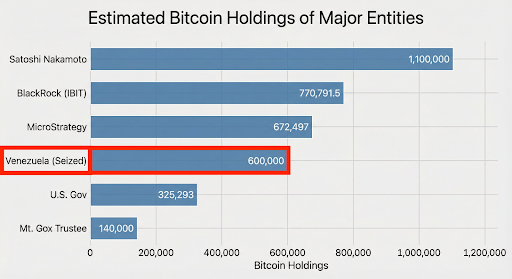
Germany’s liquidation of 50,000 BTC in 2024 triggered a 15-20% market correction. Venezuela’s stockpile is twelve times that size. Yet surprisingly, crypto markets remain stable, with Bitcoin and Ethereum each gaining about 1%.
Three scenarios could unfold from here. The “Frozen Asset” scenario involves lengthy litigation with creditors and legal battles. The coins get locked in Treasury escrow for 5-10 years. This effectively removes 3% of circulating supply from markets, supporting higher prices.
The “Strategic Reserve” option sees President Trump ordering permanent retention. This also locks up supply and supports bullish sentiment. The “Fire Sale” remains unlikely given Trump’s pro-Bitcoin stance.
Crypto’s Dual Role in Venezuela
Cryptocurrency has served Venezuela for years as a sanctions workaround. In 2018, Maduro launched the Petro a state-backed cryptocurrency tied to oil reserves. The project failed spectacularly despite initial hype.
Nevertheless, stablecoins emerged as de facto dollar substitutes for everyday commerce. Citizens rely on these digital assets for basic transactions amid currency collapse. The bolivar’s hyperinflation made toilet paper and corn flour more valuable than official currency.
“Crypto and stablecoins have long played a dual role in Venezuela,” explains Ari Redbord of TRM Labs. “They function as an essential financial rail for civilians in a fragile economy.” However, state actors exploit these same channels to circumvent sanctions.
What Comes Next
Federal prosecutors focus on narco-terrorism charges rather than cryptocurrency violations. The superseding indictment makes no mention of digital assets. Yet the absence doesn’t diminish crypto’s role in Venezuela’s financial ecosystem.
Three signals will reveal coming changes. First, stablecoin demand and pricing shifts indicate stress in traditional payment channels. Rising local premiums suggest increased crypto reliance for cross-border settlement.
Second, activity consolidates around fewer exchanges and OTC brokers under pressure. Third, network behavior adapts with increased wallet rotation and fragmented routing.
“After military action, things move faster and become more fragile,” Redbord notes. “When traditional trade channels are disrupted, networks turn quickly to alternative money movement methods.”
The revelation of Venezuela’s Bitcoin hoard marks a watershed moment. Digital assets designed for transparency became tools of opacity. A technology meant to democratize finance enabled authoritarian evasion of international law.
For crypto markets, the outcome depends on US handling of seized assets. A strategic reserve benefits prices through supply reduction. Immediate liquidation risks market chaos. Either way, Venezuela’s shadow reserve demonstrates cryptocurrency’s uncomfortable duality serving both liberation and oppression depending on who controls the keys.
Written By Fazal Ul Vahab C H
