
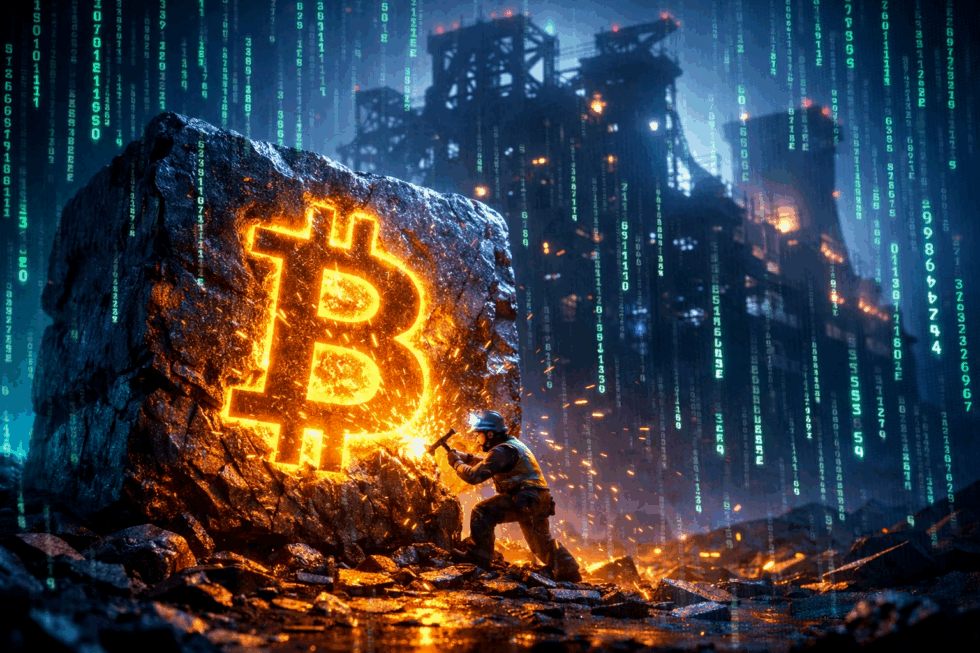
Synopsis: On January 13, 2026, a lone Bitcoin miner won big via Solo CKPool. They got a full ~$300K block prize despite tiny odds in a huge network. Let’s dive into the specifics.
On January 13, 2026, a solo Bitcoin miner successfully claimed a full block reward worth nearly $300,000 a remarkable feat in a network dominated by industrial mining operations. Although large mining farms produce most blocks, independent miners still manage occasional wins. How does this happen despite astronomically low odds?

What Just Happened on January 13?
A solo Bitcoin miner using the Solo CKPool framework mined a full block on January 13, 2026, earning the entire block subsidy and transaction fees roughly $300,000 at Bitcoin prices near current levels.
This outcome highlights how even tiny participants still have a chance however small to beat the odds because every hash attempt on Bitcoin has a non-zero probability of success.
The Block Reward Today
After the Bitcoin halving in April 2024, miners now receive 3.125 BTC per block plus transaction fees. This reward will stay at 3.125 BTC until the next halving expected in 2028, when it will decline to 1.5625 BTC.
Bitcoin produces roughly 144 blocks per day as part of its ~10-minute block cadence.

Why Solo Wins Are Still Possible
Bitcoin’s total hashrate is over 1 zetahash per second, making the network extremely competitive. A small setup such as a 6 TH/s machine represents a vanishingly small fraction of total hash power, giving it only slim chances of finding a block on any given day.
Still, Bitcoin mining follows a Poisson process: every hash attempt is independent. So while one small miner might expect to wait thousands of years for a block in isolation, when thousands of independent rigs operate globally, the aggregate chance that someone wins becomes non-negligible.
Solo Mining: How It Works in 2026
Solo CKPool
Solo CKPool isn’t a typical mining pool instead, it lets individual miners submit work as if they were mining solo without running a full Bitcoin node themselves. If a connected miner finds a block hash, the full reward goes to that miner’s address (minus a typical 2 % fee). According to public stats, Solo CKPool has over 20 000 users contributing hash power in an idle/connected state.
Also Read: Crypto Investor Commits $200 Million to MrBeast’s Beast Industries for DeFi Platform Launch
Alternative Tools
Public Pool setups and open-source solo-mining tools exist that allow hobbyists to mine against the Bitcoin network without joining large shared pools, but they require more technical setup.
Recent Solo Mining Wins Examples
While tracking services vary, many notable rare solo block victories have occurred:
- A solo miner using CKPool mined block 927,474 and earned around $284,000.
- Another miner solved block 913,593, earning about $347,980 with ~200 TH/s.
- Hobby-level setups (~6 TH/s) have also found blocks, beating odds near 1 in 180 million on a given day.
These rare outcomes are often described as “winning the lottery” of Bitcoin mining.
Solo Mining Odds
Independent mining is difficult because success probability scales with hashpower relative to the network:
- A rig with tiny hashpower has extremely low daily odds often cited as around 1 in 30 000 to 1 in 180 million.
- Even a miner with 1 PH/s of hashpower still has only modest annual prospects in solo mode compared with pooled mining, where returns are steady.
In contrast, pooled mining rewards participants proportionally, smoothing out the luck factor.
Why Do Hobbyists Still Try Solo Mining?
Solo mining is akin to a high-variance lottery ticket: years of nothing could end in a single big reward. For hobbyists with low operational costs and no need for steady income, that gamble can be enticing. Meanwhile, industrial miners focus on predictable revenue streams from large-scale pooled operations to cover power costs, equipment amortization, and debt.
These solo wins underscore a fundamental property of the Bitcoin protocol: no matter how large the network grows, every participant’s hash has a chance however tiny to find a block. Very few miners do succeed this way today, but when they do, it reaffirms Bitcoin’s permissionless nature.
Written By Fazal Ul Vahab C H
