
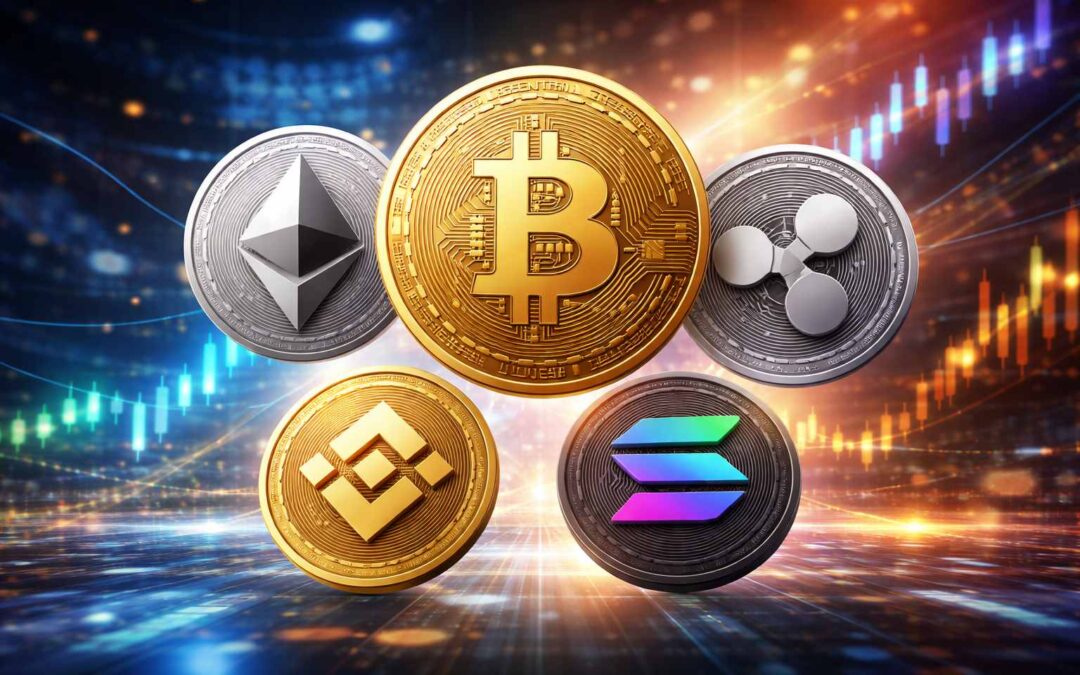
Synopsis: The cryptocurrency market continues to evolve rapidly in 2026, with established players maintaining dominance while newer innovations reshape the ecosystem. Below is a structured look at five major cryptocurrencies investors are closely watching this February, along with their key advantages and risks.

The crypto market has grown significantly since the launch of Bitcoin in 2009. Today, thousands of digital assets exist, but only a handful dominate in terms of market capitalization, adoption, and ecosystem development.
Here are five major cryptocurrencies that investors often consider due to their scale, adoption, and long-term relevance
1. Bitcoin (BTC)
Overview:
Launched in 2009 by the pseudonymous Satoshi Nakamoto, Bitcoin is the first and largest cryptocurrency by market capitalization. It is often referred to as “digital gold” due to its fixed supply of 21 million coins and store-of-value narrative.
Advantages
- Widely recognized and trusted digital asset
- Strong institutional adoption, including ETFs in multiple markets
- Highly decentralized network
- Most secure blockchain by hash rate
Disadvantages
- Uses Proof of Work (PoW), which is energy-intensive
- Limited smart contract functionality compared to newer blockchains
- Price remains highly volatile despite maturity
2. Ethereum (ETH)
Overview:
Launched in 2015 by Vitalik Buterin and others, Ethereum introduced smart contracts — self-executing programs on the blockchain. It powers a vast ecosystem of decentralized finance (DeFi), NFTs, and decentralized applications (dApps). Ethereum transitioned from Proof of Work to Proof of Stake (PoS) in 2022.

Advantages
- Largest smart contract ecosystem
- Dominant platform for DeFi and NFT projects
- Strong developer activity
- Energy-efficient after the PoS transition
Disadvantages
- Network congestion during high demand
- Gas (transaction) fees can spike significantly
- Faces competition from faster, lower-cost blockchains
3. XRP (Ripple)
Overview:
XRP is the native token of the XRP Ledger, designed to facilitate fast and low-cost cross-border payments. Ripple, the company associated with XRP, aims to improve global financial infrastructure.
Advantages
- Transactions settle in seconds
- Very low transaction costs
- Partnerships with financial institutions
Disadvantages
- Criticism over centralization concerns
- Regulatory scrutiny in the U.S. (Ripple faced an SEC lawsuit beginning in 2020; partial legal clarity emerged in 2023, but regulatory developments continue)
- Strong dependence on institutional adoption
Also Read: Google Cloud Flags North Korea-Linked Crypto Malware Campaign
4. BNB (Binance Coin)

Overview:
Launched in 2017 by Binance, BNB began as a utility token for discounted trading fees but has since expanded into powering the BNB Chain ecosystem, including DeFi and gaming applications.
Advantages
- Utility across the Binance ecosystem
- Used for trading fee discounts, staking, and token launches
- Strong ecosystem activity
Disadvantages
- Closely tied to Binance’s regulatory and business performance
- Concerns about centralization
- Regulatory risks surrounding crypto exchanges
5. Solana (SOL)

Overview:
Solana is a high-performance blockchain designed for scalability. It combines Proof of Stake with a unique mechanism called Proof of History, allowing high throughput and low latency.
Advantages
- High transaction speed
- Very low transaction fees (often fractions of a cent)
- Growing DeFi, NFT, and gaming ecosystem
Disadvantages
- History of network outages in prior years
- Faces competition from Ethereum and other Layer-1 blockchains
- Ecosystem maturity still evolving compared to Ethereum
Final Thoughts
Each of these cryptocurrencies serves a different purpose within the broader digital asset ecosystem:
- Bitcoin is often viewed as a store of value.
- Ethereum dominates smart contracts and DeFi.
- XRP focuses on cross-border payments.
- BNB powers a major exchange ecosystem.
- Solana emphasizes speed and scalability.
Investment decisions should depend on your risk tolerance, time horizon, and portfolio diversification strategy. While Bitcoin is generally considered relatively less risky within crypto, all digital assets remain volatile and speculative.
As always, conduct thorough research and consider regulatory, technological, and macroeconomic risks before investing.
Written by Parvati Anilkumar
