
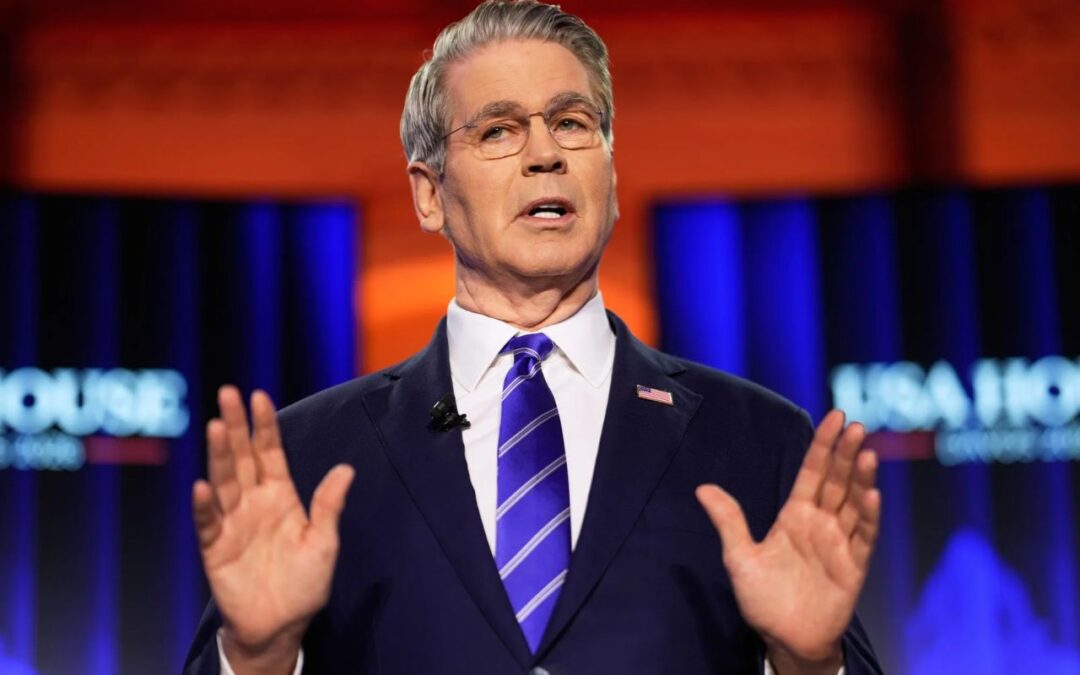
Synopsis: Treasury Secretary Bessent confirms U.S. government won’t rescue Bitcoin during market downturns, rejecting bailouts and clarifying that seized crypto holdings don’t constitute taxpayer investments or support.
The United States government has sent a clear message to crypto investors: it will not step in to rescue Bitcoin during market turmoil. On Wednesday, February 4, 2026, U.S. Treasury Secretary Scott Bessent reiterated this position during a congressional hearing, making explicit that no government support would be available for cryptocurrency markets.

His comments came as Bitcoin traded around $73,000–$76,000 amid significant market weakness. The cryptocurrency had fallen sharply from its highs, with investors watching closely for any hint of government intervention. However, Bessent made it clear that such help will not come.
A Tense Exchange in Congress
The hearing took place before the House Financial Services Committee, where lawmakers discussed financial risks, banking regulations, and market stability as part of the Financial Stability Oversight Council’s (FSOC) 2025 Annual Report review.
During the session, California Representative Brad Sherman a long-time cryptocurrency critic questioned Bessent sharply. Sherman drew comparisons to the 2008 financial crisis and asked whether Bitcoin could seek similar government rescue measures. He directly asked if the Treasury or other agencies had the power to “bail out” Bitcoin or direct banks to purchase crypto assets.
Bessent first requested clarification, then responded firmly: “I am Secretary of the Treasury. I do not have that authority, and as chair of FSOC, I do not have that authority either.”

Sherman continued pressing, asking whether banks could be ordered to buy Bitcoin or Trump-linked tokens. Bessent again rejected the idea, emphasizing that private banks make their own investment decisions. The exchange ended without any sign of compromise.
No Orders to Banks, No Taxpayer Support
Bessent explained that the Treasury cannot direct banks to purchase Bitcoin and cannot invest taxpayer money in cryptocurrency assets. He stressed that the government has no legal power to influence markets in this manner.
The Treasury Secretary clarified the important distinction between seized assets and public investments. The government currently holds Bitcoin confiscated from criminal cases through law enforcement actions. “These are government assets,” Bessent stated, noting that approximately $500 million in seized Bitcoin had grown to more than $15 billion in value.
When Sherman questioned whether this still counted as public money, Bessent disagreed, explaining that seized assets belong to the government through forfeiture but are not taxpayer investments made through appropriations.
Therefore, the Treasury’s role remains limited to holding these seized assets. It will not use them to support prices, nor will it buy or sell to manage markets. Washington, Bessent made clear, will stay on the sidelines.
Strategic Bitcoin Reserve with Clear Limits
Bessent’s remarks also reflect policy established under President Donald Trump. In March 2025, Trump signed an executive order creating a Strategic Bitcoin Reserve. However, this reserve operates under strict limitations: it only includes Bitcoin acquired through asset seizures or budget-neutral methods.
Budget-neutral methods do not involve new government spending. Instead, they could involve converting existing assets for example, exchanging petroleum reserves or precious metals for Bitcoin. Critically, the government cannot purchase Bitcoin directly from open markets using taxpayer funds.
Many cryptocurrency supporters expressed disappointment with these restrictions. They had hoped for large government purchases that could support prices. In August 2025, Bessent confirmed on social media that Treasury was “committed to exploring budget-neutral pathways to acquire more Bitcoin to expand the reserve,” but he has consistently emphasized the strict legal and budgetary constraints.
The reserve remains largely symbolic rather than actively managed. It treats Bitcoin as a stored asset resulting from law enforcement activities, not as an investment tool or price-support mechanism.
Also Read: ‘Big Short’ Investor Michael Burry Links Bitcoin Crash to $1 Billion Precious Metals Sell-Off
Market Context and Investor Reactions
The hearing occurred during a particularly difficult period for cryptocurrency markets. Bitcoin had fallen sharply from its highs above $126,000 in 2025. On the day of the testimony, February 4, 2026, Bitcoin traded in the $73,000–$76,000 range, down approximately 3% on the day and roughly 16% for the year.
Market sentiment had weakened considerably, with more than $6.6 billion in liquidations occurring since late January. Fear levels reached extreme lows as investors grappled with macroeconomic uncertainty, concerns about Federal Reserve policy, and a partial government shutdown that delayed economic data releases.
Investors followed Bessent’s words closely. Many had hoped for signs of government support or intervention. Instead, they received a clear warning: the government will not rescue falling cryptocurrency prices.
On social media and in market commentary, users reacted quickly. Some noted the irony of profitable seized holdings assets worth $500 million that had grown to over $15 billion being held but not deployed. Others warned that markets could face additional pressure without government backing.
Analysts, however, said the message brings clarity. It removes uncertainty about potential hidden bailouts or secret support mechanisms. Firms and investors now understand the boundaries: they must rely on private capital and market forces, not public assistance.
Implications for U.S. Crypto Policy
Bessent’s testimony represents one of the strongest official statements yet on U.S. Bitcoin policy. He rejected bailout proposals without hesitation and defended the limited role of the Treasury in cryptocurrency markets.
The government will continue to hold seized Bitcoin from criminal forfeitures. However, it will not manage cryptocurrency prices, instruct financial institutions, or deploy tax revenue for market interventions. Responsibility for gains and losses remains squarely with investors and markets.
This policy also sends a message internationally: the United States will not lead in building global cryptocurrency reserves through active market purchases. Instead, the focus remains on developing regulatory frameworks and controlling financial risks.
For ordinary users and investors, the message is straightforward: Bitcoin remains a high-risk asset without government safety nets. Future price movements will depend entirely on market forces supply, demand, institutional adoption, and macroeconomic conditions not government intervention.
As cryptocurrency markets navigate continued volatility, the Treasury Department’s position is now unambiguous. Washington has drawn a clear line, and that line explicitly excludes bailouts, market support, or taxpayer-funded cryptocurrency purchases. In an era of unprecedented government involvement in various sectors of the economy, cryptocurrency remains firmly in the domain of private markets and individual risk.
For better or worse, the fate of Bitcoin and other digital assets will be determined by market participants, not by federal intervention.
Written by Fazal Ul Vahab C H
