

Synopsis: Visa-issued crypto card spending surged 525% in 2025, led by EtherFi’s $55.4 million. Rising stablecoin usage signals crypto’s shift into mainstream everyday payments.
Cryptocurrency payments are breaking into everyday life at unprecedented speed. Visa-issued crypto cards recorded explosive growth in 2025, with spending surging 525% compared to the previous year. The sharp rise signals that digital assets are moving from niche technology to mainstream payment tools.

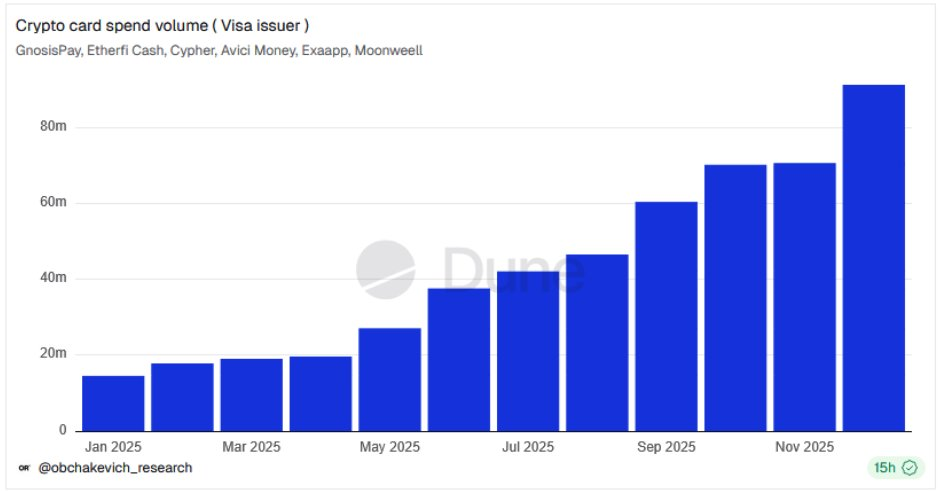
Data from Dune Analytics reveals net spending across six crypto cards jumped from $14.6 million in January to $91.3 million by December. These cards, offered through partnerships between Visa and blockchain projects, are transforming how consumers use cryptocurrency for daily purchases.
Crypto Card Market
Among all Visa-backed crypto cards, EtherFi’s offering emerged as the clear leader. The platform recorded $55.4 million in total spending throughout 2025, substantially outpacing its nearest competitor.
Cypher claimed second place with $20.5 million in annual transactions. The remaining cards from GnosisPay, Avici Money, Exa App, and Moonwell showed smaller but steadily climbing volumes.
The gap between EtherFi and competitors highlights how quickly certain platforms can capture market share in emerging payment categories. Moreover, these figures demonstrate that crypto users are actively seeking convenient ways to spend digital assets.

Polygon researcher Alex Obchakevich noted the data reveals both rapid user adoption and strategic importance. Crypto and stablecoins now play significant roles within Visa’s broader payments ecosystem. The rising spend volumes suggest crypto has evolved beyond experimentation into routine financial use.
Visa Expands Stablecoin Infrastructure
The payments giant is positioning itself for accelerated growth in 2026. Visa now supports stablecoins across four different blockchains, expanding accessibility for diverse users. Recent months have seen intensified partnership activity and infrastructure development. Visa aims to improve access to stablecoin products for both retail consumers and institutional clients.
In mid-December, Visa launched a dedicated stablecoin advisory team. The new unit focuses on helping banks, merchants, and fintech firms deploy stablecoin-based products. This initiative underscores Visa’s belief that blockchain-based settlement is becoming increasingly relevant to global payments.
As a result, programmable money features are attracting serious attention from traditional financial institutions. The advisory team represents Visa’s commitment to bridging crypto technology with conventional payment systems.
Stablecoin Market Reaches Record Heights
Beyond Visa’s crypto cards, the broader stablecoin market experienced remarkable expansion in 2025. Transaction volumes hit record levels as institutional and retail adoption accelerated simultaneously.
Data from payments platform Bridge shows total stablecoin transaction volume surpassed $2.5 trillion. Overall supply reached all-time highs, driven largely by Tether’s USDT expansion.
Chainalysis data reveals the scale of monthly activity. Between June 2024 and June 2025, USDT processed over $1 trillion in transactions each month. The peak came in January 2025 with $1.14 trillion in monthly volume.
USDC also demonstrated heavy usage, with monthly transactions ranging from $1.24 trillion to $3.29 trillion. Notable spikes occurred late last year, reinforcing the combined dominance of USDT and USDC.
Together, these two stablecoins form the backbone of global crypto infrastructure. Their consistent high volumes reflect growing trust in stablecoin technology for cross-border transactions and everyday payments.
Other Up-and-Coming Stablecoins
However, the stablecoin market shows signs of diversification despite this dominance. Chainalysis identifies rapid growth among smaller tokens including EURC, PYUSD, and DAI.
EURC’s monthly volume jumped dramatically from approximately $47 million to over $7.5 billion within one year. PYUSD also expanded steadily during the same period. These emerging stablecoins serve more specialized use cases and geographic markets.
Analysts interpret this trend as evidence that stablecoins are diverging by geography and function. Different tokens cater to specific regulatory environments, currencies, and business needs. Nevertheless, overall adoption continues accelerating across all categories.
The sharp rise in crypto card spending reveals how linking digital assets to familiar payment rails drives mainstream adoption. Users appreciate the convenience of spending crypto through traditional payment networks without technical complexity.
As Visa strengthens its stablecoin infrastructure and partnerships, 2026 could see even faster growth. The combination of established payment networks and crypto flexibility appears to be one viable path toward mass acceptance.
Financial observers expect continued expansion as more platforms launch crypto-linked cards. The 525% growth in Visa-issued crypto card spending provides clear evidence that consumer demand exists for seamless crypto payment solutions.
Written By Fazal Ul Vahab C H
