
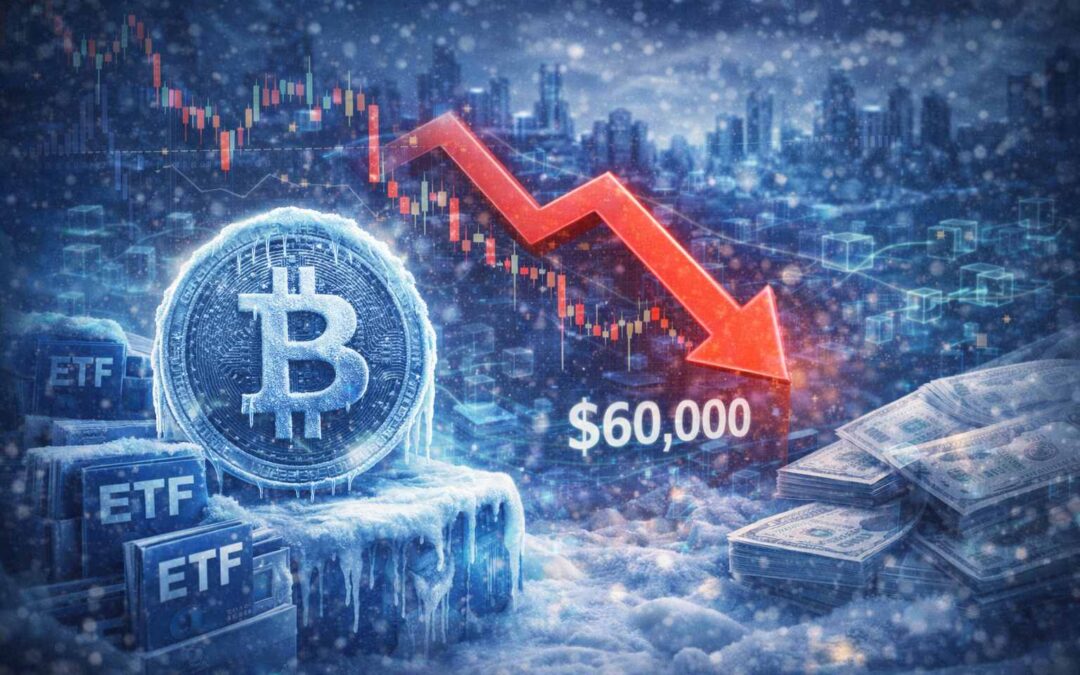
Synopsis: Bitcoin’s sharp correction from 2025 has raised concerns of a crypto winter, with ETF outflows and macroeconomic factors causing renewed volatility for investors seeking to reshape market dynamics for traders and investors.
Bitcoin’s sharp correction from 2025 has raised concerns of a crypto winter, with ETF outflows and macroeconomic factors causing renewed volatility for investors seeking to reshape market dynamics for traders and investors.

The recent decline of Bitcoin has sparked renewed discussion about whether the market has entered another “BTC winter” which refers to an extended period of falling prices, weak market sentiments, and decreased trading volumes. However, unlike previous “winters” the market is now more institutionalized which includes ETFs, liquidity and global macroeconomic factors.
Key Stats and Market Data
- Bitcoin has lost 40-50% of its value since it was trading at an all-time high of $126,000 in October 2025.
- The value of the asset has fallen below $60,000 several times in February 2026.
- Recent reports have shown substantial outflows of ETFs. This is a sign of investors withdrawing their investments from the crypto market.
The previous bear markets for Bitcoin have been quite harsh, with drops of approximately 85% in 2014-2015 (from $1,200 to below $200), about 84% in 2018-2019 (from $19,000 to around $3,200), and close to 75% in 2022 (from $69,000 to roughly $15,500).
Why the 2026 Downturn is Different
A crypto winter is essentially a bear market in digital assets that is characterized by significant price declines over an extended period of time. The previous crypto winters were largely influenced by internal factors in the cryptocurrency space.
The 2026 winter is unique in that it follows Bitcoin’s prices can be characterized as moderate compared to past market cycles. Although there have been increases in value, they have been less pronounced compared to previous cycles, followed by a long consolidation phase.

Recent figures have indicated that there have been continuing net outflows from major Bitcoin ETFs, but this is largely a tactical move by institutional traders and does not indicate a flight from the asset class as a whole. As Hougan, CIO of Bitwise, comments, “Many of the outflows that we’re seeing look to be pretty short-term in nature.”
How the Current Crypto Winter Differs
Previous winters were dominated by retail traders and crypto specific exchanges. Today, the Bitcoin market is part of a more evolved financial system with ETFs, derivatives, and institutional flows.
This means macro drivers like interest rate expectations, weakness in the equity market, and risk off sentiment across the world have now become major drivers of the price action in the Bitcoin markets. In other words, the Bitcoin market has become integrated with the traditional markets.
Impact on Investors
Short Term Traders:
- ETF flows and macro news can trigger sharp intraday moves.
- Break below psychologically important levels like $60,000 can accelerate liquidations.
- Traders need to track traditional financial metrics as well as on-chain data.
Long-Term Investors:
- Crypto winters have historically normalized excessive leverage and speculations.
- Reset valuation to normal levels.
- They have also provided accumulation opportunities before new growth cycles.
Yet as institutional investors enter the market, Bitcoin is becoming more correlated to the real world. Long-term investors will need to take macro and regulatory environments into consideration.
Also Read: Mexican Billionaire Ricardo Salinas Hit by $400M ‘Perfect Fraud’ Bitcoin Heist
Key Factors to Watch
Major tailwinds
- Institutional infrastructure via ETFs
- Historical recovery patterns from deep corrections.
- Increasing global adoption of digital assets.
Key Risks
- Continued ETF outflows.
- High leverage ratios in derivatives markets.
- Monetary policy uncertainty.
Upcoming catalysts
- Interest rate decisions from central banks.
- Regulatory announcements impacting crypto markets.
- ETF flows to be reported in the coming quarters.
Outlook
Cryptocurrency winters have always come after an explosive run and high levels of leverage in the market. While they have always been challenging, they have also set the stage for the next bull cycle.
This crypto winter, in 2026, is different in its nature, with the market being more sensitive to macro conditions as institutional involvement increases.
In contrast to the previous crypto-led downturns, the current cycle is being increasingly driven by institutional flows of capital, risk sentiment, and monetary policy conditions, which indicate that the length of this cycle and the process of recovery will be driven as much by global financial conditions as by crypto-related factors.
Written by Ansh Kapoor