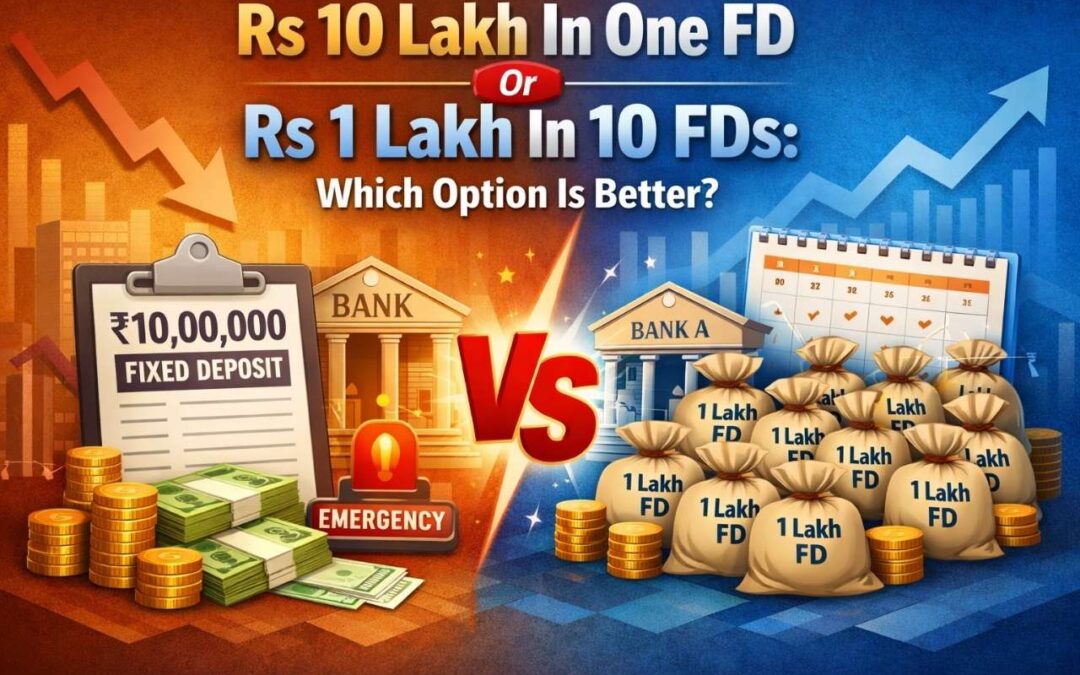
Synopsis: One FD or many? The answer can decide how much tax you pay, how fast you access cash, and how protected your money really is. Before locking ₹10 lakh into a single deposit, read what most banks won’t tell you.
When you have ₹10 lakh ready to invest, the instinct is to just open one big Fixed Deposit (FD) and be done with it. But when it comes to a healthy maintenance of personal finance, simplicity can sometimes be expensive.
Splitting that amount into ten ₹1 lakh FDs or even three or four smaller ones is a method used by many advanced investors to gain control over their cash. Here is a critical look at which path is more fruitful for your long term investment, your taxes, and your peace of mind.
The Single FD Option (₹10 Lakh in One Account)
This is the simplest and hassle free approach. You open one account, track one maturity date, and wait for the final corpus.
The Pros
- The simplicity behind this is that you only have one document to manage and one entry to make when filing your Income Tax Returns (ITR).
- Some banks offer a Bulk Rate (usually for amounts over ₹2 crore, but some smaller banks have tiers starting at ₹10–25 lakh) that might be 0.10% to 0.25% higher than standard rates.
- If you need a large loan against your FD, it is easier to process a single application against one large collateral.
The Cons
- The major con is the poor liquidity. If you need just ₹50,000 for an emergency, you usually have to break the entire ₹10 lakh. This triggers a premature withdrawal penalty on the whole amount and not just for the part you need.
- The Deposit Insurance and Credit Guarantee Corporation (DICGC) only insures up to ₹5 lakh per bank. This means that from your ₹10 lakh in one bank half of your money is technically uninsured.
Also read: 5 Best Credit Cards for Utility Bill Payments That Offer Maximum Cashback and Rewards (2026)
The Multiple FD Option (₹1 Lakh in 10 Accounts)
This move involves splitting your corpus into smaller units and is often spread across different tenures or even different banks.
The Pros
- If an emergency hits at some unwanted time, you can close just one FD of ₹1 lakh. The remaining ₹9 lakh continues to earn interest without any penalty and interruption.
- If you spread these 10 FDs across two or three different banks (e.g ₹5 lakh in Bank A and ₹5 lakh in Bank B), your entire ₹10 lakh becomes 100% government-insured.
The Cons
- The administrative hassle can play a big role. Managing 10 different maturity dates and keeping track of 10 digital or physical certificates can be tedious.
- Smaller amounts rarely qualify for special higher interest slabs that banks occasionally offer for larger deposits.
A Direct Comparison Table at a Glance
| Feature | Single ₹10 Lakh FD | Ten ₹1 Lakh FDs |
| Emergency Access | Must break entire amount causing High penalty | Break only what you need thus low penalty |
| RBI Insurance | Only ₹5 Lakh is protected | Up to ₹10 Lakh protected (if split) |
| TDS Impact | Highly likely (Bank cuts 10% tax) | Avoidable (if spread across banks) |
| Management | Usually Easy | Difficult and Lengthy |
| Interest | Locked into one rate | Can Ladder (mix of short and long term) |
Is There a Middle Ground?
Opening 10 separate FDs is often too much work for the average person. Instead of 1 or 10, the most balanced way to approach is the 4-Deposit Split:
- Split the ₹10 Lakh into 4 FDs of ₹2.5 Lakh each.
- Spread it across 2 Banks, meaning put two FDs (₹5 lakh total) in one bank and the other two in a different bank.
- Remember to vary the Tenures. Set one for 1 year, one for 2 years, and two for 3 years. This process is called Laddering.
This gives you the safety of full insurance, the flexibility to break a small portion if needed, and much less paperwork than managing 10 accounts
Concluding Words
If you are someone who has a separate emergency fund and values time over managing everything till the core then a single FD is fine. However, for most Indian households, splitting the FD is taken as a smarter move.
The main distinction is that splitting the fund protects you from bank risks, lowers the immediate bite of TDS, and makes sure that a small financial crisis doesn’t affect your long-term savings goals.