Synopsis: This article contains detailed information of Bengaluru’s most costliest redevelopment plan of constructing a 17.01km corridor signifying its technology and innovation backbone.
According to the recent survey, 35% of Bengaluru’s main carriageway and 20% of its service roads are in a distressed manner. This resulted in the development of Bengaluru’s infrastructure to avoid its major drawback i.e. traffic.
In mid-January 2026, a plan of ₹450 crore revamp of the Outer Ring Road (ORR) between the Silk Board Junction and the KR Puram was approved by the Technical Advisory Committee (TAC). This happens to be Bengaluru’s costliest revamp project until date.
This project includes the redevelopment of both the main carriageway and the service roads, costing it up to ₹26.47 crore per kilometer, making this the most expensive road redevelopment in the city.
This lane is split into two different packages : Silk Board to Iblur Junction (5.44km) and Iblur Junction to KR Puram (11.57km). This is a complete lane re-development of a 17.01km corridor.
The TAC has cleared the project approval to bring a metro line along with flyover, roads to be widened and a separate lane for the cycle riders and a pedestrian walk lane to be created accordingly.
Details of the plan
Every single detail on that lane is approved to be redeveloped within the deadline pushed to March 2030. A complete development includes a huge expense to be covered for all all the years they consider to finish it by.
This project has been taken under the maintenance clause of 10 years.
- This route has a narrow road along with the service road. So the department has decided that the bus stop will be removed for the road widening project and shifted to the next nearest stop from there. They approved this to create at least one additional traffic lane.
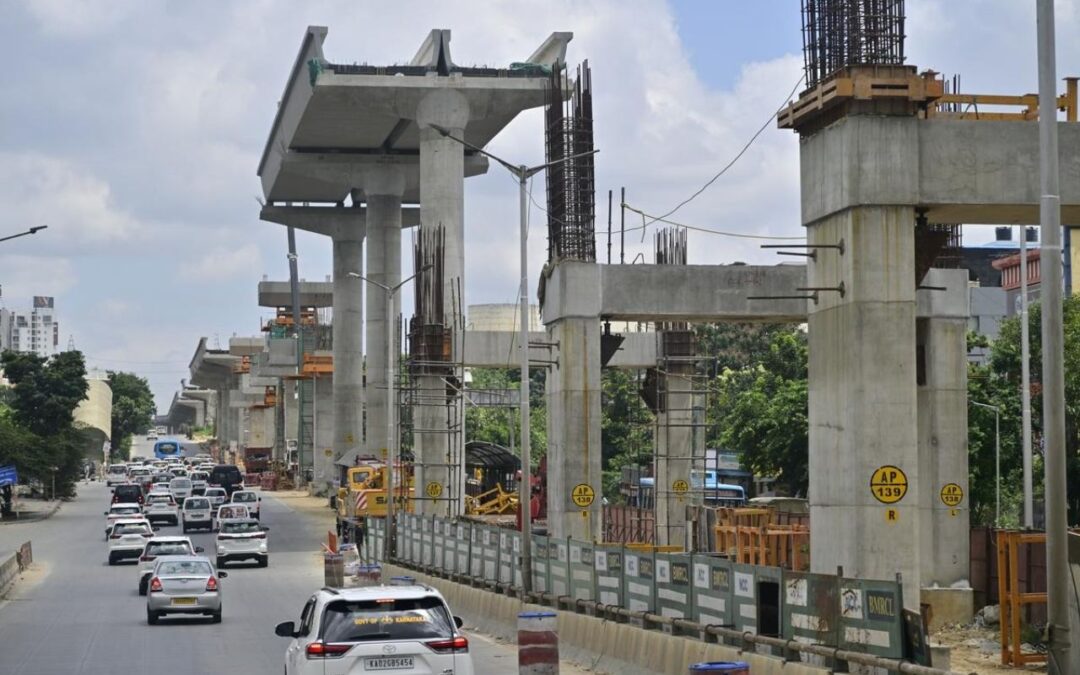
- They have agreed on a full fledged new metro lane for this route of 19.75kms. This blue line goes through 8 different stops (4+4). It is announced that this metro plan will be completed by December 2026.
- This Junction passes through major places such as HSR, Agara, Iblur and Marathalli, forming the backbone of the Bengaluru’s technology so far allowing the normal locals of 6.45 Lakh among which 3.38 Lakh commuted with their own vehicle.
- Along with this there have been plans of creating a separate lane for the pedestrian walk and the cycle tracks in this lane making it sufficient for all the users.
- The Stone Matric Committee(SMC) have issued the installation for the street lighting surfacing the flyover and the quality of construction of the bridge at Doddanekundi railway crossing and relocating the temple near that to install a service road for widening.
Methodology Used
Widening the road does not include recreating the road from scratch but instead they have a methodology used for the same in full depth reclamation.
A special machine called Reclaimer is used to break down the damaged road and create a new layer beneath it. This material is done on spot (in-situ) with certain binding agents such as cement or bitumen emulsion instead of removing materials from the site.
This creates a strong layer for the base. After the mixing, this is again compacted properly to make it firm and ready for the new layers of the road surfacing. This method is used instead of the traditional method of reconstructing the roads.
Also Read: Top 7 Indian States With the Highest Infrastructure Spending in the Last 5 Years
Updated Acquisition List
The Bengaluru’s South and East city corporations interact with the Bangalore Development Authority(BDA) to create a new updated acquisition list for the construction of the flyover, metro, installation of modern lighting beneath the metro flyovers and conducting the feasibility assessment on the construction of the bridges.
The Technical director is instructed to coordinate with both Bengaluru East and South corporations to obtain the contribution of 50% of project cost transferred by these corporations to ensure the deposit of this contribution.
The Bengaluru Smart Infrastructure Limited(BSMILE) is the state government’s special purpose vehicle used for the implementation of this project.
TAC pointed out that ORR stretch was developed 10 years ago but only the overlay of this stretch has been looked at since then. Due to other important developmental works such as Metro, BWSSB, and other utilities, the base has been left untouched for so many years which caused many damages.
Since the road is being redeveloped comprehensively, it was suggested that the service road be completed at the final stage i.e. after the redevelopment of the main carriage road.
Conclusion
The main cause of this revamp was because of the flooding on roads due to heavy rainfall and causing trouble to people. The TAC performed the necessary structural assessment for the same three years ago.
Thus, Bengaluru being India’s innovation and Technological backbone has just agreed to make the most innovative redevelopment project by TAC as Bengaluru stands second in traffic congested city in India.
Written by Ananya Bharadwaj