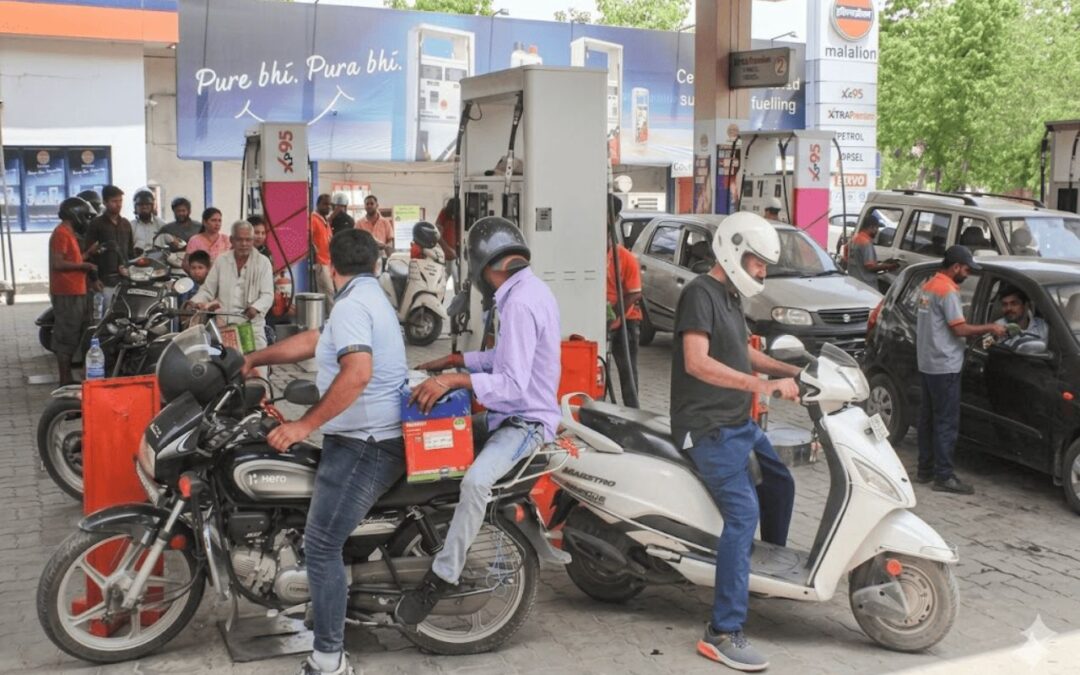
Synopsis: Indian government has reduced excise duty by ₹10 per litre on both petrol and diesel with immediate effect. This decision has been taken in response to the steep and rapid rise in international crude oil prices due to Gulf conflict. This article explains how India is able to keep fuel prices stable and control inflation in the country.
The global oil market is under severe stress due to the escalating US–Iran conflict and disruptions in the Strait of Hormuz, through which nearly a fifth of global oil passes. In a matter of weeks the Crude prices surged from $70 per barrel to nearly $122, marking an increase of almost 75%. For an import dependent country like India which heavily relies on overseas crude oil a sudden spike in the price poses significant risks. However, unlike other countries where fuel prices have risen by 40%, the Indian government has taken a deliberate policy to shield consumers from this volatility. To achieve this the government has cut excise duties on petrol and diesel by ₹10 per litre, choosing to absorb the financial burden rather than let inflation affect the consumers.
Fuel Pricing in India
In India, fuel price is structured in a way that the government can keep the prices almost the same during the time of crisis.
- Base price (crude oil + refining + dealer margin)
- Central excise duty
- State VAT
When crude oil prices rise globally the government cuts excise duty to absorb the shock. Fuel taxes are a major source of revenue for the government. Cutting the excise duty means short term revenue loss but the government thinks for the long term economic stability, lower inflation supports growth. When the central government cuts excise duty even the state governments are often encouraged to reduce the VAT as well. Excise duty cuts are not permanent, they are carefully timed and used only during high global price hikes, they are reversed when the crude oil prices are stabilised.
Why India Cuts Fuel Taxes
1. Controlling Inflation: Fuel prices directly affect the cost of production, increase cost of transportation and logistics will increase the overall price levels in the economy. To avoid inflation the government intervened and cut the excise duty. In March 2026 , India cut the excise duty by ₹10 per litre on petrol and diesel.
2. Fuel as a Daily Essential: In a country like India where there is income inequality a small change in fuel price will affect most of the Indian household’s daily budgets, small business and daily commuters. Cutting taxes ensures that consumers are not fully exposed to global price shocks.
3. Protecting Economic Growth: When the inflation is high the purchasing power of the consumer drops, people stop spending and growth in the economy slows down. By cutting the taxes the government ensures:
- The market maintains its demand
- Supports Business
- Prevent economic slowdown
Also read: World’s 8 Vital Oil Chokepoints That Could Disrupt Global Trade Anytime
How India is Still Keeping Fuel Price Stable
1. Diversified Crude Sourcing: India is one of the largest Importers of crude oil in the world. Due to the US-Iran Conflict the Strait of Hormuz is blocked which supplies one-fifth of the world’s oil trade. India sources oil from 40+ countries, reducing dependency on any single region. This diversification helps India avoid sudden supply shocks and maintain stable domestic pricing.
2. Strategic Reserves: India has built a strong reserve to handle disruptions, reserves act as a buffer giving the government the time to respond without immediate price hikes. Currently India has 60 days of crude oil supply secured during this crisis. The total storage capacity, up to 74 days of demand.
3. Strong Diplomacy and Global Positioning: India has maintained balanced diplomatic relations with major oil-producing nations, including both Western countries and nations like Russia and Iran. This enables India to:
- Access to discounted crude oil
- Stable supply agreements
- Flexibility during global conflicts
India’s neutral foreign policy plays a key role in energy security.
Balancing Growth and Stability
The current fuel tax cuts are not just about managing today’s crisis, they reflect how India is adapting to a world where the crude oil market is increasingly shaped by geopolitical uncertainties. Conflicts from trade route blockage are making oil price more volatile and unpredictable, This means fuel pricing is not just an economic issue but a strategic policy tied to national stability.
Another important dimension is the shift in fiscal strategy. Instead of maintaining rigid tax structures, India is increasingly using flexible taxation as a counter-cyclical tool. This indicates a move toward more dynamic policymaking, where fiscal decisions are aligned with global conditions rather than fixed revenue targets.
Fuel prices have risen by 30 to 50 per cent across South and South-East Asian countries, 30 per cent in North America, and 20 per cent in Europe since the start of the West Asia crisis. Since then, India has held the line. That stability carries a fiscal cost, but the Government has chosen to bear it.
Conclusion
The current oil shock caused by geopolitical issues and disruptions in trade flows could have been severe for the country. However, the timely reduction in excise duty has ensured that the country’s consumers are protected, inflation is controlled and sustains economic growth.
Written by Shrikara K