
Synopsis: The residential market in Bangalore is showing a paradox, demand is falling while the property prices are rising. This article reveals the reasons to better understand this phenomenon.
India’s whole residential landscape is in a rebalancing phase, and Bengaluru is at an interesting point. As per Magic Bricks reports, despite a 1.9% QoQ dip in demand, the average residential prices rose 0.8% QoQ, and from ₹9,029 per sq. ft. in Q1 2024 to ₹12,899 per sq. ft. in Q1 2026, which is an impressive 43% appreciation in 2 years.
Why Demand has softened
- Weak Capital Markets- Due to volatile financial markets, the investors are now cautious in purchasing real estate temporarily to safeguard liquidity.
- Geopolitical Scenarios- Geopolitical Middle East tensions have created anxiety among the tech dependent workforce in Bengaluru, slowing down the demand for long-term real estate purchase.
- Affordability Issue- The demand for homes below 1.5 Cr is almost 65%, but the supply of homes are pricier creating an affordability gap.
Bengaluru Residential Market: Price vs Demand
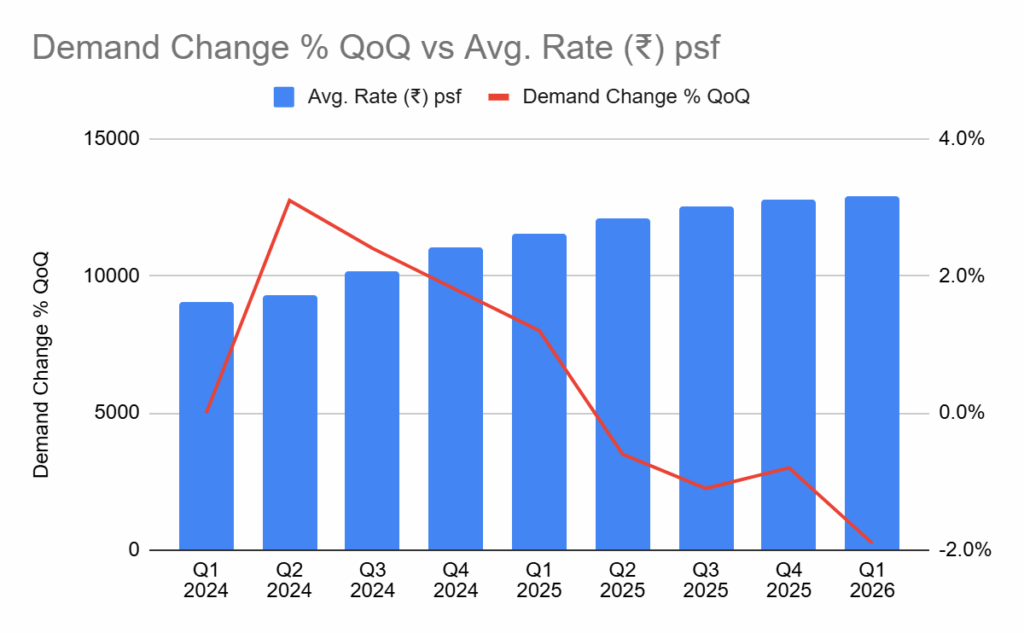
Source: Magic Bricks Bengaluru- Prop Index Jan-Feb-Mar 2026 Report
Factors Influencing the Rise in Property Prices
1. Developer Pricing
Developers maintained the price despite the falling demand, and they have confidence in the long-term housing demand. This has resulted in 14.1% YoY at India level, with Bengaluru positively contributing to it.
2. Supply for Premium Homes
The supply in Bengaluru grew by 7.1% QoQ and 22.3% YoY, with expansion in only the higher value or premium homes. As the demand for affordable homes are increasing the supply for premium homes are increasing the average prices of the affordable homes as well.
3. Shift Towards Larger Homes
3 BHK units have demands of 48% and the supply is 51%. Units sized between 1,250 to 2,000 sq ft lead with a 43% share in both demand and supply. This preference for larger, higher-priced configurations is naturally elevating average market prices across the city.
4. Majority of Tech-Led Workforce
Bengaluru’s strong employment ecosystem of IT firms, GCCs, and startups continues attracting a skilled, high-income workforce, sustaining housing demand from the buyers and investors. This employment cohort puts a consistent pressure on property prices even during periods of demand softness.
5. Demand for Ready-to-Move Segment
The Ready-to-Move segment recorded a 1.8% QoQ price growth in 2026. Buyers are actively prioritising completed inventory and are paying a premium for it. Hence, keeping prices elevated in the market. The Under-Construction segment, in contrast, saw a marginal dip of 0.2% QoQ.
6. Price growth in All BHK Categories
On a YoY basis, for 1 BHK homes the demand rose at 28.2%, followed by 3 BHK at 11.2%, Above 3 BHK the demand rose at 9.5%, and 2 BHK at 8.8%. This price growth across all the BHK categories reflects price discipline across all housing configurations.
7. Infrastructure Development
Ongoing projects like the PRR and STRR are improving connectivity and unlocking peripheral corridors, directly appreciating property values. This is reflected in premium pricing across the top micro-markets including, Whitefield at ₹13,800 per sq. ft, Bellary Road at ₹13,300 per sq. ft, Thanisandra at ₹12,500 per sq ft, and JP Nagar at ₹12,800 per sq ft.
8. Administrative Reforms
Faster e-Khata processing and digital land records are reducing administrative delays and improving transparency. These reforms are lowering the risk premium and encouraging investors to transact at prevailing prices rather than pushing for discounts.
9. Sustained Two-Year Price Appreciation
From Q1 2024 to Q1 2026, the average residential prices rose nearly 43%, moving from ₹9,029 per sq ft to ₹12,899 per sq ft. This sustained growth is backed by a strong supply pipeline, consistent end-user demand, and rapid urban expansion which reflects deep structural strength in Bengaluru’s residential market that is insulating prices from short-term demand fluctuations.
All in all
Bengaluru’s price resilience amid falling demand is a reflection of disciplined supply-side strategy, structural lifestyle shifts, and robust infrastructural developments. As infrastructure matures and employment remains strong, prices are likely to hold firm, making the city an enduring destination for both end-users and investors.
Written by Jahnavi