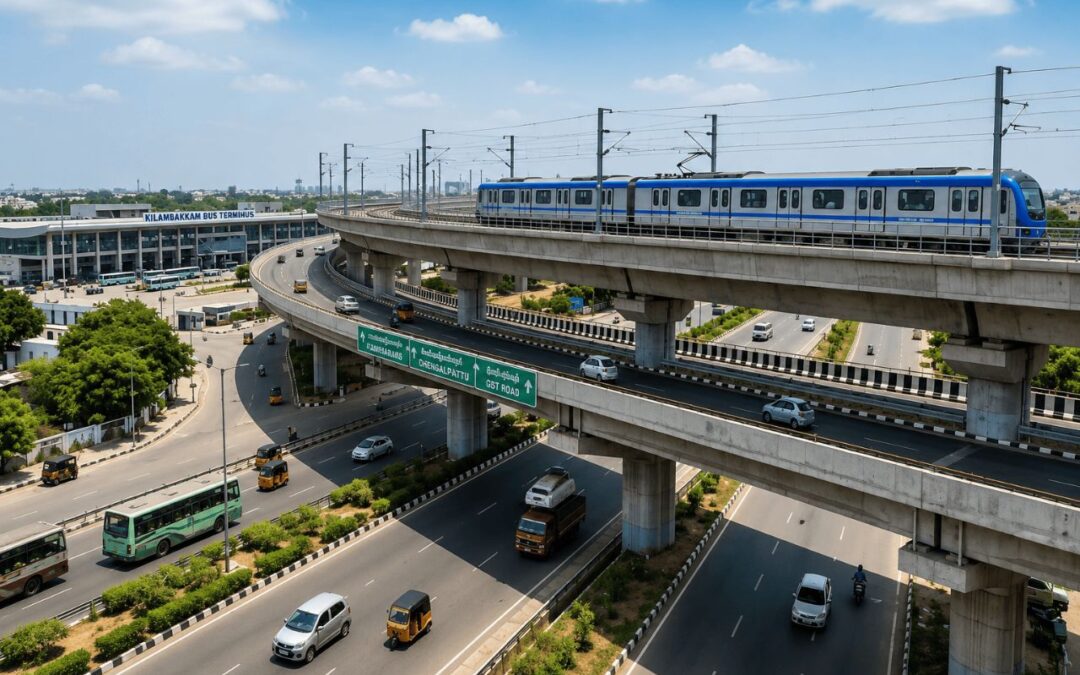
Synopsis: Tamil Nadu plans a 18.4-km long double-decker corridor with a six-lane elevated road and a metro train running above it on the GST Road. This article discusses the details, growth potential of areas around, and connectivity.
The Tamil Nadu government has planned a double-decker road and metro corridor line to enhance connectivity over the Kilambakkam Elevated Road. The project will also help to relieve traffic congestion, improve the accessibility of the Kilambakkam bus terminus, and facilitate the urban and real estate development of Chennai’s southern suburbs.
Project at a Glance
The Tamil Nadu government has planned a double-decker transport corridor passing through the busy GST Road connecting Kalaignar Centenary Bus Terminus (KCBT) at Kilambakkam to Chettipunniyam near Mahindra World City, which is 18.4-km-long. The project will be the longest dual carriageway transportation route in India.
The corridor is designed to accommodate both road and metro traffic on the same viaduct, with the upper level dedicated to the metro rail line and the lower level to the road. The corridor is designed with six lanes of roadway on the lower level, and a metro rail line on the upper level, sharing the same viaduct. The metro corridor is designed to be an extension of the Chennai Metro Blue line that will connect Chennai International Airport with Kilambakkam and eventually with Chettipunniyam in seamless manner, additionally integrating with Kalaignar Centenary Bus Terminus, suburban rail system and city bus system.
The state government along with the National Highways Authority of India (NHAI) are working on restructuring the Detailed Project Report (DPR) with the intention of designing the elevated road to accommodate the metro viaduct. This would remove the need for future reconstruction, and cut down on traffic disruption during metro construction.
Why is Tamil Nadu planning a double decker metro corridor?
The southern suburbs of Chennai have seen a sudden surge in residential, commercial and industrial growth, including areas like Kilambakkam, Vandalur, Guduvanchery, Maraimalai Nagar and Mahindra World City, which has resulted in a huge rise in the number of people travelling in and out of these areas every day.
- Kilambakkam Bus Terminus is one of the largest bus terminus in South India, which covers an area of 88.5 acres and connects to the long-distance buses in southern districts of Tamil Nadu. But the road connectivity to the terminal has been an issue which has led to congestion in GST Road.
- High volume of traffic on GST Road (NH-32) 32: A major arterial road in Chennai carrying thousands of private vehicles, buses, freight vehicles and traffic going to and from the airport everyday. The overall travel time between Tambaram and southern suburbs has increased during the peak hour.
- Need for an integrated transport infrastructure: The government is proposing to build an elevated road and a metro corridor at the same time. This holistic solution avoids acquisition of extra space, decreases construction expenses, and obviates the city’s disruption of traffic while the work is underway.
- Future proofing of Chennai’s transport network: Tamil Nadu has designed the Elevated Road to be built on a metro line from the start, thereby avoiding the need for future changes in the roadway, and providing a transport corridor that will meet the city’s future needs.
- Enhancing economic and real estate Growth: better connectivity is anticipated to further bolster access to key employment centers, educational institutions, industrial parks, and residential townships along the GST Road corridor, enabling increased urban development in South Chennai.
Connectivity improvements
- The planned corridor will enhance the connectivity and facilitate a seamless road and metro network between South Chennai’s major residential, commercial and industrial hubs, providing a significant boost to GST Road (NH-32).
- The metro extension will facilitate direct connectivity between Kalaignar Centenary Bus Terminus (KCBT) at Kilambakkam and the suburban rail and Chennai Metro, helping to streamline Kalaignar Centenary Bus Terminal connections with long-distance buses.
- Key localities to benefit: Tambaram, Perungalathur, Vandalur, Kilambakkam, Urapakkam, Guduvanchery, Potheri, Maraimalai Nagar (Mahindra World City), Chettipunniyam (Mahindra World City).
- This will provide direct metro connectivity to main destinations like Chennai International Airport, Guindy, Alandur, Little Mount, Nandanam, Teynampet, Government Estate, Chennai Central from the southern suburbs when it is integrated with the Chennai Metro Blue Line.
- The project will also be expected to improve multimodal connectivity between the national highways, metro, MTC buses, omnibus, and suburban rail and will create a single transport ecosystem for lakhs of people to commute to and from the city more quickly and conveniently.
Real Estate Impact Along the Corridor
Better metro connectivity and shorter commute times will help promote residential demand and commercial development.
Conclusion
The plan for the double-decker metro line over the elevated Kilambakkam road could change the connectivity scenario of South Chennai. The project can be seen as a way to reduce traffic congestion, increase connectivity, and enhance the long-term development of the urban and real estate sectors along the road and metro network.