
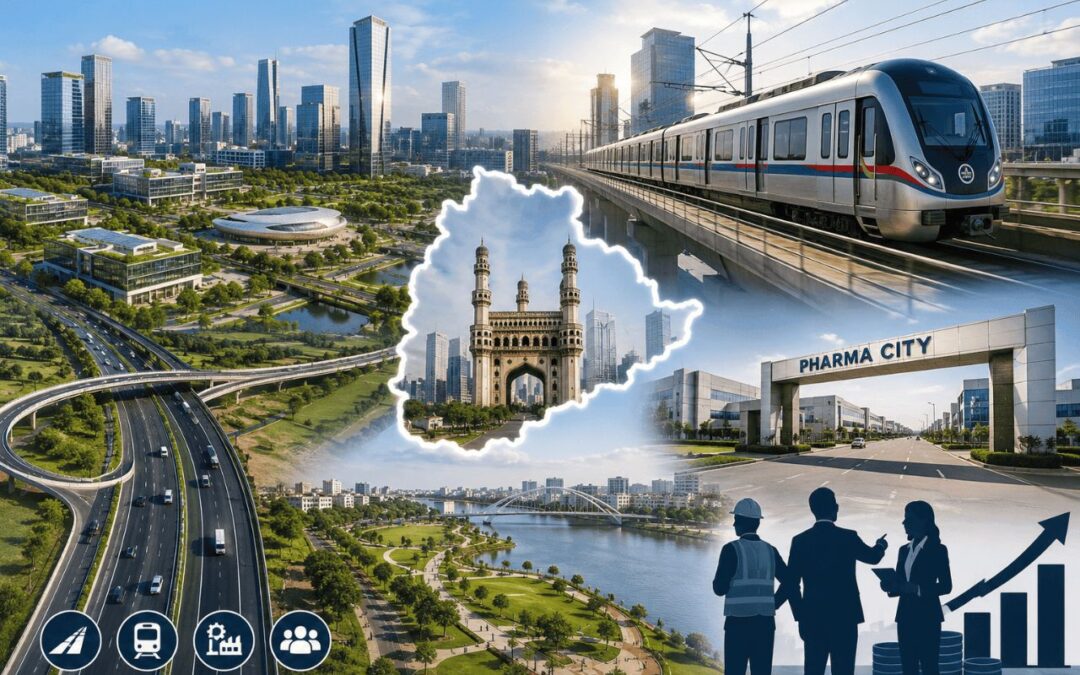
Synopsis: The article dwells into the five transformative projects that are shaping Telangana’s future of development, such as smart cities, metro expansion, industrial and infrastructure corridors and their contributions to connectivity, investment and long term growth.
With a combination of its ambitious mega projects, Telangana is fast emerging as one of India’s greatest investment and infrastructure hubs. These projects will help improve the connectivity, investment, employment and shape the urban and industrial development of Hyderabad.
1. Bharat Future City
Planned to be India’s first smart city of the new generation where sustainability, innovation and advanced technology are leading the way. It will bring together industrial, commercial, residential and recreational areas under a single master plan.
Key Highlights
- Encompassing an area of 30,000 acres in the 765 sq. km FCDA planning area in Rangareddy district
- It is a future-oriented integrated smart city consisting of residential, business and industrial districts.
- The focus areas are: Artificial Intelligence (AI), Clean Technology, FinTech, Life Sciences, Advanced Manufacturing and Electronics and Innovation.
- Designed using sustainable mobility, digital governance and green infrastructure, as well as climate-resilient urban planning.
- Designed to be a hub for high-value industries, jobs and investment from around the world.
- A balanced environment of working, living, learning, healthcare, recreational and open green spaces.
Location & Connectivity
- It is situated in Rangareddy district to the south of Hyderabad.
- The FCDA jurisdiction covers 7 mandals, 56 revenue villages and almost 1.89 lakh acres (765 sq. km).
- Close to the Outer Ring Road (ORR) and the proposed Regional Ring Road (RRR).
- Connectivity to the Rajiv Gandhi International Airport.
- Plans for the future integration with the metro system, high speed transport corridors and smart mobility infrastructure.
2. Hyderabad Metro Rail Phase II
The project will introduce almost 76 km of additional metro lines on various corridors and further extend access to the metro to the fast-growing areas. On completion, it will help Hyderabad grow significantly in urban mobility while enhancing the city’s overall future growth.
Key Highlights
- A new metro network of 76 km on various corridors.
- Includes the highly expected Airport Metro that will link Raidurg and Rajiv Gandhi International Airport.
- Extend metro connectivity to new emerging areas such as Kokapet, Financial district, Patancheru, Hayathnagar and Future city.
- Will decrease road traffic and private vehicle usage.
- Commercial and residential development around metro stations.
- Anticipated to enhance the last mile connectivity and shorten travel time within the city.
Location & Connectivity
- Serves western, eastern, northern and southern Hyderabad.
- It connects with the Airport Metro corridor which gives direct access to the Rajiv Gandhi International Airport.
- Links with key employment centres such as HITEC City, Financial District, Kokapet and Gachibowli.
- It interconnects with the existing metro network, MMTS, buses and key road corridors such as Outer Ring Road (ORR).
- Will enhance connectivity between the old city of Hyderabad and new developments like Future City to facilitate an evolved urban development.
3. Regional Ring Road (RRR)
The Regional Ring Road (RRR) is an expressway with access controls on one side, surrounding the city of Hyderabad outside the present Outer Ring Road (ORR). The RRR is planned to link the national and state highways, which will enhance regional connectivity, alleviate congestion in the urban area of Hyderabad and open new corridors for the development of industries, logistics and urban development in the state.
Key Highlights
- 340-km access-controlled ring road around Hyderabad.
- The project is split into two parts to be implemented in phases: Northern and Southern.
- It connects major highways including NH-44, NH-65, NH-163, NH-765 and NH-167.
- Expected to be the driving force for the development of industrial parks, logistics hubs, warehousing clusters and satellite townships.
- It will ease freight traffic, minimize heavy vehicle movement in the city of Hyderabad.
- Designed as an impetus to sustainable development of the region outside the city.
Location & Connectivity
- Out of the current Outer Ring Road (ORR) of 158 km.
- Passes through towns like Sangareddy, Narsapur, Toopran, Gajwel, Yadadri, Choutuppal, Ibrahimpatnam, Amangal, Chevella and Shankarpally.
- Connects with a number of National Highways, State Highways and major radial roads.
- Will improve connectivity with Hyderabad Airport, Bharat Future City and Pharma City and other industrial corridors.
4. Musi Riverfront Development
The Musi Riverfront Development Project is an urban renewal project with the goal of revitalizing the Musi River in Hyderabad, which is 55-km long. The project aims to restore the river’s ecological health and to enhance the flood management, sewage treatment, urban infrastructure and public spaces.
Key Highlights
- 55 km long Musi River in Hyderabad.
- Concentrates on river restoration and flood protection, and environmental restoration.
- Planning for river front promenades, parks, a road for cycling, and public space.
- Prevention of untreated sewage entering the river by construction and upgrading of sewage treatment plants (STPs).
- Lakes, nalas and green buffers in the Musi basin have been restored.
- Contains urban redevelopment, enhancement of drainage systems, and climate resilient planning.
Location & Connectivity
- Spreads across Musi river, extending the areas of Hyderabad in Eastern and Central parts of the city.
- Connects to current road transport systems and bridges and adapts to future road transport infrastructure.
- Allows for redevelopment within surrounding residential / commercial neighbourhoods.
- In addition to Hyderabad’s overall urban infrastructure initiatives, such as Metro Phase II and enhanced road infrastructure connectivity.
5. Hyderabad Pharma City
Hyderabad Pharma City is a mega integrated pharmaceutical manufacturing city on the outskirts of Hyderabad. It is expected to enhance the status of Telangana as the top pharmaceuticals and life sciences hub in India.
Key Highlights
- Spread over an area of 19,000 acres, it is one of the largest integrated pharma parks in the world.
- Specially designed for the Pharmaceutical, Biotechnology, Medical Devices, Vaccines, APIs (Active Pharmaceutical Ingredients), Bulk Drug Manufacturing industry.
- Designed in conjunction with the common effluent treatment plants (CETPs),, utilities, testing facilities and logistics infrastructure.
- R&D centres, innovation hubs, skill development facility and industrial support services.
- It is anticipated to draw in substantial domestic and international investments and create thousands of jobs which will create a ripple effect of jobs.
Location & Connectivity
In the vicinity of Rangareddy district in Hyderabad. It is strategically located near the Rajiv Gandhi International Airport, which helps in the export of pharmaceutical products in a quick manner. The Outer Ring Road (ORR), major NHs and the proposed Regional Ring Road (RRR) are connecting it. Takes advantage of the existing Genome Valley, research institutions and life science ecosystem in Hyderabad.
Effect of the Mega Projects on Telangana
- Improve connectivity by strengthening Hyderabad Metro Phase II, Regional Ring Road (RRR) and new radial roads to make regional connectivity easier and faster.
- Bring in investment in industries like IT, AI, life sciences, pharma, manufacturing and logistics, from both the domestic and international market.
- Large-scale jobs via cities, business districts, research centres and infrastructure initiatives.
- Industrial development through enhanced pharmaceutical manufacturing, advanced manufacturing, warehousing and logistics ecosystem.
- Urban expansion outside the boundaries of Hyderabad by Bharat Future City and new satellite growth corridors.
- Expand demand for residential, commercial and mixed use projects in the vicinity of key infrastructure corridors.
Conclusion
These five mega projects will shape the future of Telangana by improving the connectivity, investment, job creation, and sustainable urban and industrial development. As they move forward, the state has a great opportunity to become one of the biggest economic and innovation hubs of India.