
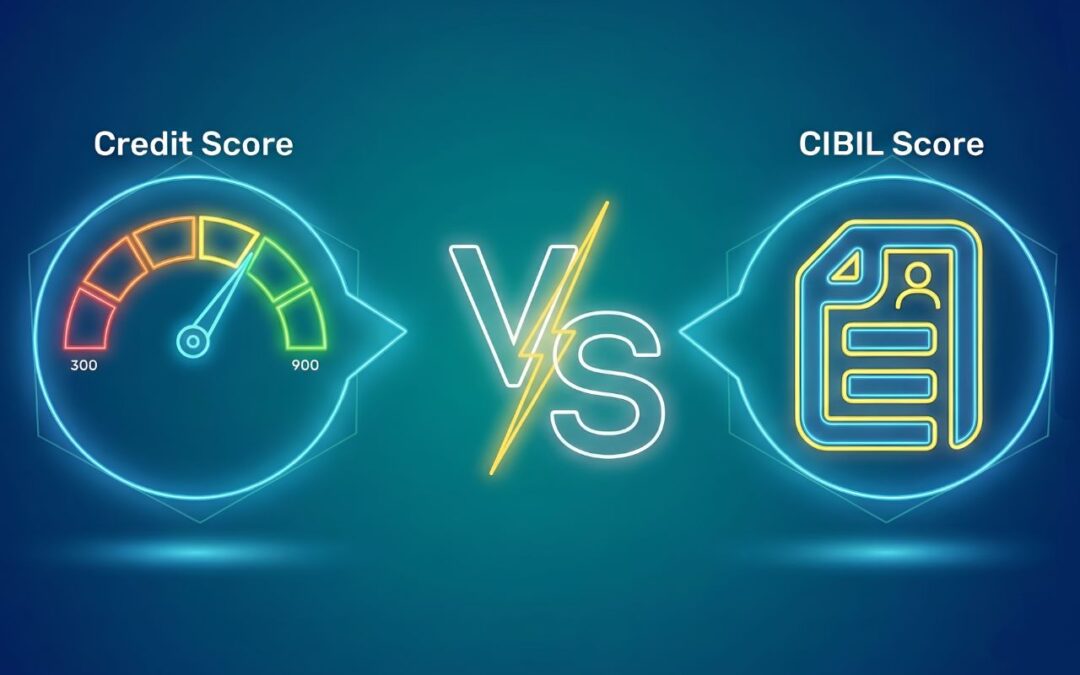
Synopsis: A credit score and a CIBIL score may seem similar, but they’re not exactly the same. This article breaks down their basic differences so you know why both matter when applying for credit cards.
Both the terms Credit Score and CIBIL Score are frequently used interchangeably within the financial system. Though both represent a numerical assessment of an individual’s creditworthiness, it is important to have a precise understanding of their differences.
Read on to get an analytical breakdown of the key differences between these two concepts.
What is a Credit Score?
A Credit Score is a three-digit number that is usually between 300 and 900 and it represents your overall financial behaviour. It analyses how responsibly you borrow, spend, and repay money.
Lenders such as banks, NBFCs, and credit card issuers rely on this score to understand how risky it may be to lend to you. A higher score suggests that you manage credit responsibly and a lower score may indicate past delays, high debt and others.
In India a Credit Score is created by any of the four RBI-licensed Credit Information
Companies (CICs):
- TransUnion CIBIL
- Experian
- Equifax
- CRIF High Mark
Practical scenario: When you check your credit score on apps like Google Pay, Paytm, Paisabazaar, or BankBazaar, they don’t calculate the score themselves. They simply show the score fetched from one of the official credit bureaus – CIBIL, Experian, Equifax, or CRIF High Mark.
What is a CIBIL Score?
A CIBIL Score is a specific type of credit score ranging between 300-900 that comes only from TransUnion CIBIL, India’s oldest and most established credit bureau.
While India has four RBI-licensed bureaus, CIBIL became popular early on because banks and lenders widely adopted it.
Over time, the term “CIBIL Score” became so common that many began using it as a synonym for credit score, even though it is technically just one bureau’s score.
When a bank says “Minimum 750 CIBIL Score required”, they are referring specifically to the score generated by TransUnion CIBIL.
Practical scenario: You can check your CIBIL Score too through apps and websites but you will only see your actual CIBIL Score if the platform is partnered directly with TransUnion CIBIL.
Also Read: How Credit Card Issuers Make Money in India: From Fees to Interest and More
The Fundamental Difference
| Feature | Credit Score | CIBIL Score |
|---|---|---|
| Category | General term for scores from any bureau | Score generated ONLY by TransUnion CIBIL |
| Provider | Any RBI-licensed CIC: TransUnion CIBIL, Experian, Equifax, CRIF High Mark | Exclusively TransUnion CIBIL |
| Range | Generally 300-900 (varies slightly) | 300-900 |
| Calculation | Different models used by each bureau | CIBIL’s own scoring model |
Does Difference Between Credit and CIBIL Score Matters?
While both are identical, the key difference lies in scoring models and lender usage. Many banks and loan entities heavily rely on CIBIL score, especially for hefty loans as the CIBIL (TransUnion CIBIL) is the most widely used and trusted credit bureau in India.
Hence it is widely recognized and often prioritized for loan approvals.
However, the use of other bureaus (Experian, Equifax, CRIF) has also increased.
These entities also provide scores so slight variations in reported scores are normal due to differences in data and scoring models. Lastly, it depends on the financial institutions and credit card issuers regarding which modules they go with.
Written by Kenbi Riba