
Synopsis: India and Russia aims to achieve their ambitious $100B trade target as President Putin visits India, over the next 5 years, focussing on key sectors including energy, defense, infrastructure, and technology.
Every trade agreement involving India and Russia has an underlying strategic plan tailored for India. The Indian government has now made a strategic list of 300 items that it will use to close the huge trade deficit with Russia. With an ambitious goal of reaching $100 billion in trade between the two countries by 2030. Currently, we import massive amounts of oil and defense equipment, which is over $63 billion, but our exports are a meager $4.8 billion. Because we know that India acts as a “processing hub”.
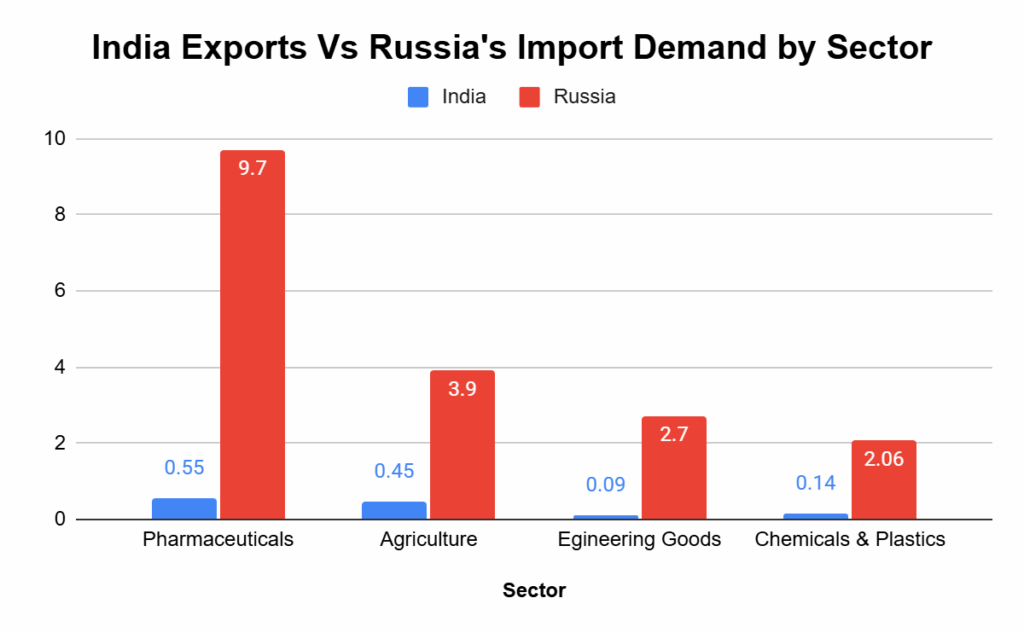
Top 6 Growing Sectors in Focus are
1. Engineering Goods & Machinery
- The Gap: India exports just $90 million, while Russia’s import demand is $2.7 billion.
- Top Imports: high precision machinery, like CNC machines from Germany/ Japan, aircraft engines, and specialized steel alloys.
- Why: In many cases, the domestic industrial sectors of India depend on the high-tech machinery that is imported to be installed in the factories producing the engineering components that are the cheapest.
- Instance: Military gear comprising S-400 systems, Sukhoi jets, and nuclear power plant parts such as Kudankulam.
- Major Exports: Drive shafts, gears, bearings, shock absorbers, and engine maintenance kits.
2. Pharmaceutical
- This sector represents a classic “value Chain” trade where India imports raw materials and exports the finished product.
- The Gap: India exports $546 million, but the Russian market demand is a massive $9.7 billion.
- Top Imports: Active Pharmaceutical Ingredients (APIs) and Key Starting Materials (KSMs) like Penicillin G, Metformin, and Chemical intermediates.
- Why: Approximately 70% of India’s APIs come from China because they are cheaper to produce there at scale.
- Top Export: Finished formulations such as Generic antibiotics, painkillers, cardiovascular drugs, etc.
3. Chemicals & Plastics
- The Gap: India supplies $135 million versus a $2.06 billion demand.
- Top Imports: Methanol, acetic acid, and Crude Oil
- Why: India does not have enough domestic natural gas and oil to produce these basic chemical building blocks in the quantities that are needed
- Top Exports: Dyes, pigments (Titanium Dioxide), and agrochemicals (pesticides).
Also read: Top 8 Investment Corridors in India Set to Deliver High Growth by 2030
4. Agriculture & Processed Food
- India is the world’s largest importer of Edible Oils.
- The Gap: Current exports are $452 million against a $3.9 billion demand.
- Top Imports: Sunflower Oil and Palm Oil
- Why: India’s domestic production of oilseeds cannot meet the demand of its 1.4 billion population. We import over 60% of our edible oil needs.
- Top Exports: Tea, spices, Grapes, Bananas, Rice, and ready-to-eat snacks.
5. Electronics
- India is strongly reliant on importing Electronic Components and semiconductors. However, the country is now promoting domestically manufactured semiconductor electronics by establishing its own fabrication plants. It is expected to take 5-10 years for the industry to mature and stabilize.
- Top Imports: Printed Circuit Boards, Semiconductor & Chips, Camera Modules & Displays
- Why: India can put together phones of brands such as Apple and Samsung, but still doesn’t have the necessary infrastructure to produce the minuscule high-tech chips and components that are already installed in them. 40% of the components are imported from China.
- Top Exports: Telecom equipment, consumer electronics, and power electronics like transformers, switchgears, and control panels for electricity grids.
6. Textiles & Apparel
- Western fashion brands have exited Russia, creating a massive empty shelf space that Indian brands are rushing to fill.
- Top Imports: Polyester and Nylon yarn (often from China/ Vietnam) because India’s domestic production focuses more on Cotton. And high-speed knitting and weaving machines.
- Why: To produce high-quality, durable “fast fashion” clothing that the world wants.
- Top Exports: Readymade Garments and Winter wear.
- During geopolitical tensions, a significant agreement was reached with India being one of the very few neutral states that had the manufacturing standards to provide compatible technology.
Valuable Information for Investors
- Mid-Caps Are the Ones to Look At: Large-cap corporations usually have a great deal of exposure to the US/EU and may be hesitant to conduct trade with Russia due to the risk of secondary sanctions. Thus, mid-cap and small-cap firms that deal in engineering and chemicals will be more and more willing to take this Russian demand.
- Payment Mechanism: Keep an eye out for the developments in the “Rupee-Ruble” trade settlement mechanism. In case it gets facilitated, it will be the beginning of the re-rating of these export sectors on a grand scale.
- Logistics is a Crucial Factor: The Chennai-Vladivostok Maritime Corridor is being put into service to reduce shipping time. The logistics companies that are working on this route will see their profits increase directly due to the higher trade volume.
Conclusion
This is not a temporary spike but rather a structural change. The $100 billion target implies that there would be a 20x increase in these particular export sectors. Investing in the Engineering, Pharma, and Chemical exporters could be a wise decision for the next 5 years.
Written by Yatheendra N