Synopsis: Bharatmala and Sagarmala are India’s dual mega infrastructure drives for the development of highways and ports in India. We examine how PM Gati Shakti platform mobilizes the intersection of road and port infrastructure and transforms certain Tier-3 towns into high-yield investment frontiers.
The flagship infrastructure projects in India, the Bharatmala Pariyojana and Sagarmala Programme, are a national effort to aim at decreasing the logistics expenses of the country by 2030. This efficiency improvement in the structure is the improvement behind the record of 825 billion exports attained by the country in FY25, and systematically driving up high-paying investment prospects in upgraded highway networks, modernized port infrastructure, and new coastal economic zones.
There are separate ministries that are smoothly woven together and unified by the PM Gati Shakti National Master Plan. These projects guarantee an end-to-end supply chain between the manufacturing clusters and the global markets leading to more exports and economic growth of the country.
Overall Comparison: Bharatmala Pariyojana and Sagarmala Programme
| Aspect | Bharatmala Pariyojana | Sagarmala Programme |
| Focus | 34,800 km highways, economic corridors, expressways | Port modernization, CEZs, coastal/inland waterways |
| Ministry | Road Transport & Highways | Ports, Shipping & Waterways |
| Investment | ₹6.92L Cr total; ₹4.72L Cr spent (68%) | ₹5.79L Cr outlay; ₹1.4L Cr (262 projects) + ₹2.4L Cr PPPs |
| Progress | 26K km awarded, 19.8K km built (Feb 2025) | 839 projects; Sagarmala 2.0 eyes ₹12L Cr by 2035 |
| Export Role | Hinterland-to-port roads (30-40% faster trucks) | 118% coastal shipping growth (35% cheaper EXIM) |
| Investor Play | Corridor warehouses, MMLPs, roadside retail | Port-adjacent industry, cold chains, shipyards |
A Factory-to-Port Ecosystem
- Bharatmala inland role as an arterial: Systematically links cargo originating in major interior manufacturing zones, such as electronics assembly units in Uttar Pradesh, mineral mines in Rajasthan and agricultural processing facilities in Madhya Pradesh, with coastal ports through 18 specific port connectivity projects with a total length of 424 km (189 km of which have been commissioned thus far).
- Role of the maritime terminus – Sagarmala: Makes the waterfront an efficient part of the production system by expanding the rail-road port connections, deep-sea drafts to accommodate mega-container ships and the strategic location of the Coastal Economic Zones (CEZs) to ensure the exporters location plans have production facilities on-site, customs clearance and direct loading into the ships under compact, high-efficiency precincts.
PM Gati Shakti geospatial platform eradicates the past departmental silos:
- Ensures highway alignments accurately coincide with port accessways, inland depot of containers and Multi-Modal Logistics Parks (MMLPs) to provide seamless modal transfers.
- Achieves 30-50% total logistics cost savings, which is proved by the infrastructure optimization studies by EY.
- Allows landlocked manufacturers to get to strategic ports, such as Mundra, Jawaharlal Nehru Port Trust (JNPT) and Chennai 1-2 days earlier as compared to the old routes.
- Promotes the switching of bulk commodities (coal, cement, agri-products) to much less expensive coastal shipping and inland waterway networks.
- Will save more than ₹35,000-40,000 crore of the total Indian trade ecosystem.
Export Performance Acceleration
Current trade statistics confirm the infrastructure-export correlation: the value of merchandise exports in April-August 2025 amounted to 349 billion, indicating a growth rate of 6.18 percent annually, and cumulative amounts in October were estimated at $492 billion against the backdrop of ongoing tariff pressure on its markets in the world. The official reviews prepared by the Ministry of Commerce may be directly traced to the effects of the convergence in Bharatmala-Sagarmala with the explicit contributing factors being this resilience.
The main beneficiaries of the sector are:
- Electronics (15-20% export growth): Noida-Gurugram clusters in manufacturing of components benefit Bharatmala corridors to move goods fast to Ennore-Chennai port facilities where finished consumer electronics are shipped out.
- Petroleum Products (The top export category in India): pounds of oil terminals Working on Sagarmala, supported by the Bharatmala pipeline accompaniment corridors, get a logistic cost reduction approximately 25 percent of the overall logistics cost.
- Cars and Parts: The flagship project of the Delhi-Mumbai Expressway -Bharatmala- enables the just-in-time delivery to the Mundra Port in order to export in a time sensitive manner to North American and European markets.
- Agri-Processing and Food Products: Sagarmala inland waterways and corridor-based MMLPs will facilitate faster transportation of perishable goods between central India and Vizag-Paradip, which will make the cold-chain exports feasible significantly in a material way.
- Textiles and Engineering Goods: Eastern Special Economic Zones combine spinning and cloth production hubs in Odisha-Uttar Pradesh with coastal distribution points of apparel and capital goods EXIM.
Also read: 15 Mega Infra Projects Under PM Gati Shakti That Will Transform India by 2028
New Opportunities in Tier-3 Cities
Stakeholders in the construction frontrunners (Rajasthan: 2,241 km open, 95 percent execution); (Maharashtra: 1,837 km) in the support of the freight superhighway and JNPT-dominated logistics respectively; (Uttar Pradesh: 1,854 km) as North India electronics export hub are all now in place.
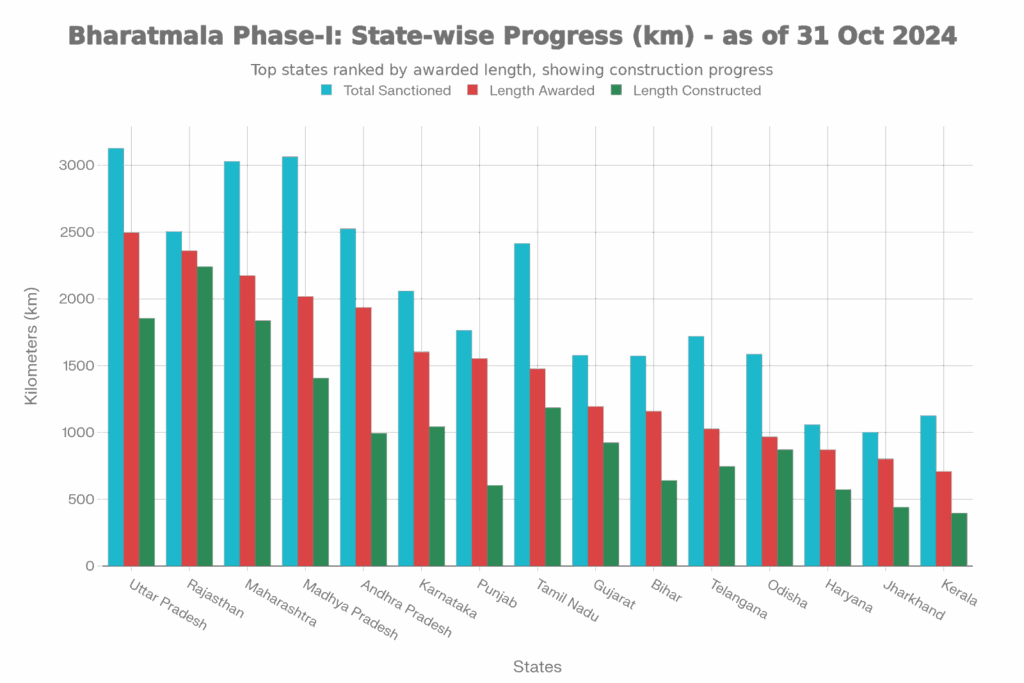
| State | Km Built | Investment Angle |
| Rajasthan | 2,241 | Warehousing REITs |
| Maharashtra | 1,837 | JNPT logistics |
| Uttar Pradesh | 1,854 | Electronics parks |
| Gujarat | 923 | DMIC + Mundra CEZ |
States that are catching up: Kerala with 396km and Bihar with 641 km as port links completed.
Also read: Emerging Tier-3 Cities Leading India’s Next Industrial Expansion in 2026
Undervalued Tier-3 Micro-Markets Growth Potential
In addition to saturated metros, some Tier-3 sites on the confluence of corridors-ports have 20-40% potential land value growth as of 2028
- Pithampur, Madhya Pradesh (1,112 km built): referred to as the Detroit of India, this automotive hub is enjoying the effects of the expansion of Indore airport, Bharatmala MMLPs, and access to Western Dedicated Freight Corridor-induced yield compression due to the soaring level of organized retail and 3PL demand is beneficial to this automotive cluster (Pithampur).
- Hosur, Tamil Nadu (near 826 km network): Electronic fabrication center in Bengaluru-Chennai corridor-Ennore port crossroad, with underestimated industrial land available to add multinational capacity.
- Bhadrachalam, Telangana (319 km progress): AgrfVir-inland waterway (Sagarmala) meeting emergent highway connectivity places this node on agri-processing acceleration in rice, spices and plantation exports.
- Dhamra, Odisha (537 km built): New deep-draft port complexes combined with mineral freight corridors from steel and coal logistics parks are trading at 40 percent valuation discounts of Vizag standards.
- Kutch Hinterland, Gujarat: The Bharatmala road extensions to Mundra CEZ expansions can accommodate solar manufacturing and the development of bulk export infrastructure.
- Moradabad, Uttar Pradesh: Clusters of brassware and handicraft exports are getting prime western port access through the completion of AgraLucknow Expressway.
The entry yields on these micro-markets are also better (22-25) than on metro saturation (15-18) and the capital appreciation of the same is 30% as e-commerce, FMCG and export-based units grow after infrastructure has been matured.
Formative Investment Recommendations
- Corridor-Centric Logistics Infrastructure: Build or purchase Grade-A warehousing and MMLPs near the interchanges in Uttar Pradesh-Rajasthan, where there is 100 basis points between institutional yields of renting to e-commerce and FMCG absorption.
- CEZ-Related Industrial Developments: Development of electronics and automotive parks in Mundra-Ennore precincts, projected to increase 20%+ rental escalation with sustained growth in export volumes of the product
- Integrated Infrastructure Vehicles: Invest in REITs and Infrastructure Investment Trusts (InvITs) that consolidate highway-to-port asset portfolios, which are best placed to generate high internal rates of return in 2030 internal rates of return appear to be the optimal positioning of REITs and InvITs in the marketplace.
Strategic 2030 Perspective: 1 Trillion Export Paradigm
The success of 8-9% logistics-to-GDP ratio opens up 200-300 billion of annualized export capacity growth. Tier-3 convergences including Pithampur-Dhamra will initiate cycles of asset re-rating with 20-30% of uplifts in valuations. The upcoming Sagarmala 2.0 ₹12 lakh crore investment cascade requires active positioning to get structural alpha.
Written by Jayanth R Pai