Synopsis: This article examines the major financial scandals that have impacted India’s public banking sector, which tells you the amounts recovered, unrecovered, and the cumulative interest and principal involved.
The Union Finance Ministry has just made a report to the Lok Sabha which states that the amount owed by the fugitive economic offenders to the public sector banks has reached a total of Rs 58,082 crore, including Rs 26,645 crore as principal dues and Rs 31,437 crore as accumulated interest till October 31, 2025. The government effort to catch and prosecute these fraudsters is still ongoing since only 33% of the total amount has been recovered till now.
The Most Wanted Financial Criminals in India
Under the Fugitive Economic Offenders Act of 2018, a total of 15 persons have been declared as Fugitive Economic Offenders (FEOs). Out of these, nine are directly associated with massive financial embezzlements that have been perpetrated against state-owned banks. This list is topped by such well-known personalities as liquor magnate Vijay Mallya, diamond dealer Nirav Modi, his uncle Mehul Choksi, and the Sandesara family.
Vijay Mallya: Due to Kingfisher Airlines unable to survive because of overdue loans, He is now among the few with one of the biggest debts in the world. The State Bank of India has filed a claim against him for the principal amount of Rs 6,848.28 crore, plus interest, which amounts to Rs 11,960.05 crore. His last ditch legal appeal against extradition in the UK was turned down in 2020, but the actual transfer has been delayed because of a “confidential legal matter” which the British authorities have described generally believed to be an asylum application.
The latest event was the visit of the officials from the Crown Prosecution Service of Britain to New Delhi’s Tihar Jail in September 2025 for the purpose of examining whether the conditions there conform to the legal standards of extradition.
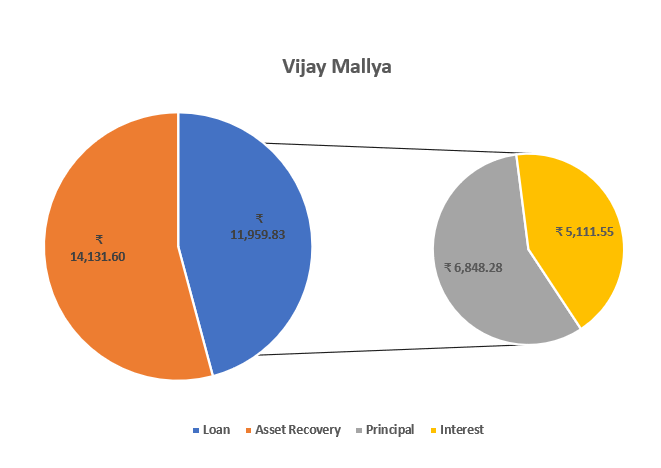
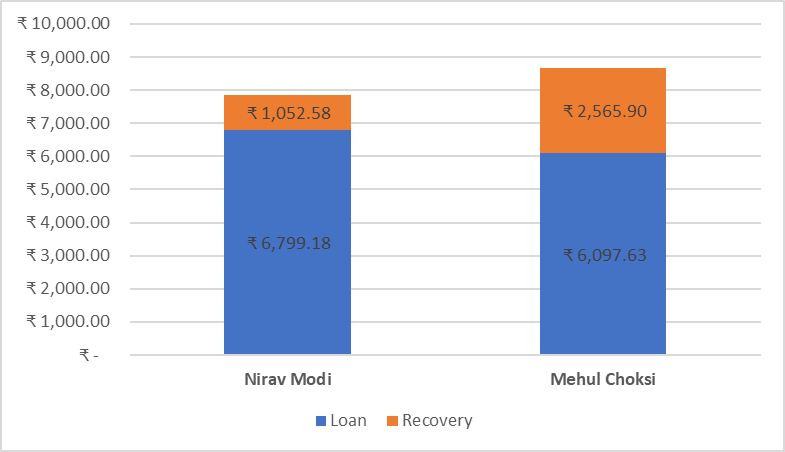
Nirav Modi: The main architect of the Punjab National Bank (PNB) scam amounting to Rs 13,850 crores, has an outstanding debt of over Rs 7,800 crores in principal alone. The largest single item is Rs 6,799.18 crores under the category of ‘non-borrowal fraud’ of PNB. Modi is still held in the UK, and a UK court has granted his application to reopen his extradition case, claiming risk of being interrogated in India.
Mehul Choksi: The man who was supposedly another figure involved in PNB fraud was arrested in Belgium in April 2025 as a direct result of India’s extradition request. A Belgian court endorsement for his extradition was made in October 2025, asserting that the charges against him are serious enough to warrant the action. In fact, Indian authorities even supplied photographs of Mumbai’s Arthur Road Jail as a way to counter fears regarding the prisons’ living conditions.
Also read: India’s 6 Best Mobile Banking Apps for 2025 — Find Out Which One Is the Safest
Asset Recovery
According to Finance Minister Nirmala Sitharaman’s statement to Parliament in December 2024, the ED has restored assets worth Rs 22,280 crore to victims and rightful claimants. The breakdown includes
| Fugitive | Assets Restored (in Crore) |
| Vijay Mallya | ₹14,131.60 |
| Nirav Modi | ₹1,052.58 |
| Mehul Choksi | ₹2,565.90 |
The Sandesara Settlement
In a surprising twist, the Supreme Court of India in November 2025 conditionally agreed to quash all criminal proceedings against the Sandesara brothers if they deposit Rs 5,100 crore as full and final settlement with lender banks. The Sandesara family, through companies like Sterling Biotech, Sterling SEZ, and Sterling Global Oil Resources, owed over Rs 5,383 crore to a consortium of banks led by Andhra Bank.
The government has already recovered Rs 4,700 crore from Sandesara-linked entities since 2018, including attachments of assets worth Rs 14,500 crore in India and abroad, oil rigs, ships, and aircraft in Nigeria. Lender banks independently recovered Rs 1,192 crore through Insolvency and Bankruptcy Code (IBC) proceedings. In case the brothers adhere to the court’s deadline of December 17, 2025, the amount they would have paid would be more than the original debt.
Banking Scams Keep Happening
The government is still trying to catch the criminals who fled the country, but the banking frauds inside India are a major problem. The RBI’s Annual Report 2024-25 states that the total amount involved in banking frauds increased from Rs 12,230 crore in FY24 to Rs 36,014 crore in FY25, which is a 194% rise. Public sector banks accounted for Rs 25,667 crore, or more than 71% of the total fraud value.
In response, the Reserve Bank of India (RBI) has formulated new anti-fraud measures, one of which is the linking up with the Financial Fraud Risk Indicator (FRI) system of the Department of Telecommunications. This integration allows for the detection of questionable transactions in real-time. The mentioned technology has been embraced by prominent banks such as HDFC, ICICI, PNB, and digital payment solutions like PhonePe and Paytm.
Conclusion
The chase of fugitive economic offenders by the Indian government is fairly one of the hardest tasks to deal with in terms of financial governance in the country. The recovering amount so far is Rs 19,187 crore which is a very small portion of the Rs 39,000 crore outstanding. The accomplishment of recent extradition moves, especially involving Mehul Choksi in Belgium and continuous pressure on the UK over Vijay Mallya, indicates that global collaboration is slowly but surely producing results.
Written by Yatheendra N