Synopsis: Understanding the Indian real estate market 2026, trends and changes, which includes the residential and commercial segment, logistic and industrial segment, and investment landscape.
India’s real estate sector remained strong through 2025, driven by robust economic growth, supportive government policies, and rising investor confidence. As India enters 2026, the sector has moved beyond recovery into a phase of structural maturity. Improved affordability, growing buyer confidence, and steady demand which is creating long-term stability and growth.
The Residential Segment
India’s residential real estate market in 2026 shows a thought-out correction instead of a crisis, with housing sales in the top eight cities dropping by 14% from 303,000 units in 2024 to 261,000 due to the lack of affordability.
However, the impact of the decline in volume is less than the value growth, as the sales are expected to reach ₹6.65 lakh crore in FY26, which is a 19% rise fueled by branded developers and price appreciation.
The high-end housing, plotted developments, gated villas, and projects focused on wellness. Keeps the wealthy buyers coming, while fractional ownership is making it easier to access. Secondary and tertiary cities such as Ahmedabad, Surat, Coimbatore, and Jaipur are becoming the new growth centers with their infrastructure improvements, premiumization, and increasing mid-segment house prices backing them up.
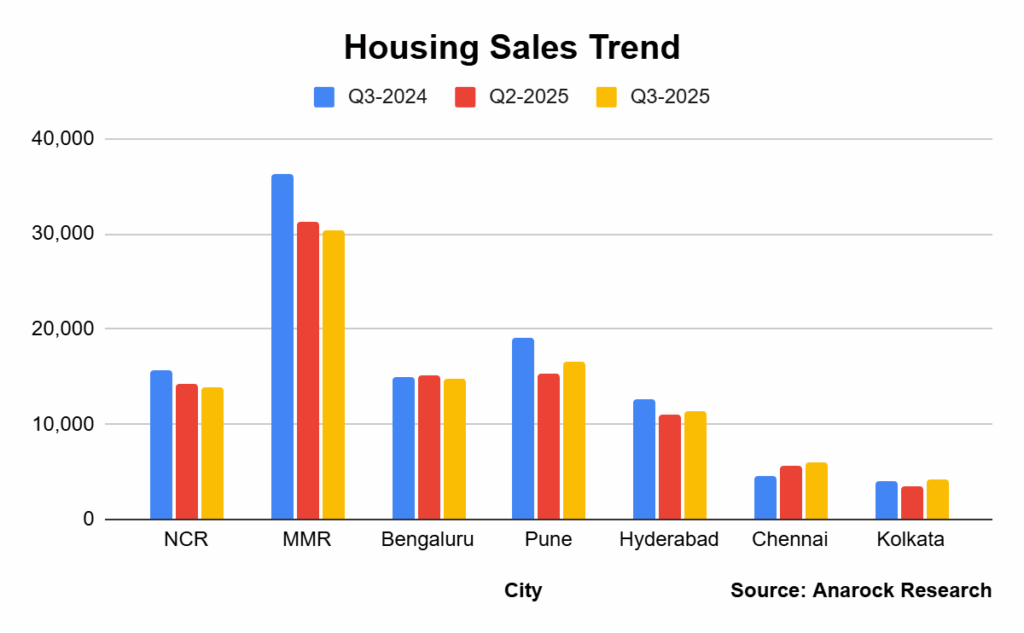
The Mumbai Metropolitan Region continues to be the leader in the residential property market with the highest share of 31% in total sales, followed by Pune with 17% of sales in the country, and NCR and Bengaluru, each with 15% of sales, thus making up the total figure.
If we compare the figures this year with last year, Chennai is the only city that has done well, with a 33% rise against Q3 2024 due to good project completions and the low prices offered to both end-users and investors. Kolkata was able to improve its position by 4% year-on-year, as it was continually well-liked in the affordable and mid-range housing segments.
On the contrary, the other five cities went through a decrease in demand, with MMR down by 16%, Pune by 13%, and NCR and Hyderabad both experiencing a drop of 11% in demand, as high property prices continued to be the main factor hindering buyer affordability.
The Office Segment
The Indian office real estate market 2026 is going to be a period of total rebirth, transitioning from being a mere supplier of corporate space to a strategic investment category for world-class multinational corporations and GCCs. The GCCs, which experienced a boom in 2025, are projected to account for 40-50% of the demand for Grade A offices this year, amounting to 30-35 million square feet of leasing.
The metropolitan cities such as Bengaluru, Hyderabad, Pune, and NCR are anticipated to occupy 62-68 million sqft together in the year 2026, which represents an increase of 12% compared to the previous year. Bengaluru is the top city with 20-22 million sqft of new office space, followed by Hyderabad with 12-14 million. The rental rates of top-notch properties are, however, forecasted to rise by 7.5-9% per year as the rates of expensive Grade A spaces continue to decline.
Flexible workspaces, including co-working and managed offices, Grade A Offices have become the norm, expected to comprise 20% of leasing, which is a result of the tenant’s preference for shorter contracts and hybrid-fit solutions.
Technology and sustainability are changing the face of offices, and with AI-based planning, IoT, and green certification, up to 90% of the new supply will be considered. The SEBI’s decision to treat REITs as equity instruments starting from January 2026 is a significant factor in luring institutional capital investment, with major REITs predicting a 10-12% rise in dividends.
Also read: South Indian Cities Dominate 64% of GCCs in India: Here’s the List
The Logistics and Industrial Segment
India is going to see a revolutionary change in the year 2026 and will come to the next level of industrialization with a whopping 55 million sqft absorption ahead of the office space in terms of growth. The three structural drivers behind this rise are Production Linked Incentive schemes, the booming of e-commerce and quick commerce networks, and the “China+1” supply chain strategies.
Manufacturers such as Foxconn and Tesla’s vendors setting up operations in Chennai, Ahmedabad, and Guwahati have contributed to the substantial manufacturing-led demand. Furthermore, large transactions surpassing 200,000 sqft are anticipated to make up 40–50% of the demand to the extent of proving the intended corporate growth.
E-commerce and hyperlocal quick-commerce are also very strong, as they need an extensive micro-warehouse network to support 10-minute deliveries. Grade A logistics facilities with cold-chain and solar infrastructures are renting out at ₹45-55 per square foot in the best locations, showing 12-18% yearly growth.
Investment Landscape
REITs and fractional ownership have made it possible for more people to invest in real estate. The Indian REIT market is valued at ₹1.66 lakh crore at the moment, which has resulted in the appreciation of unit prices by 25-50% and profit growth by 40-50%. The 2026 reclassification by SEBI as equity instruments for institutional investors is widening the inflow of such investors, and the projected capital deployment stands at a whopping $7.2–7.8 billion, which is a 28% increase year over year.
Conclusion
India’s real estate market classes in 2026 are already enjoying the benefits of a structural growth phase with such a phase in which disciplined execution and quality assets get the upper hand over the volume alone. Housing markets are becoming more or less the same all over the country, while the commercial, logistics, and other developments are growing fast because of better infrastructure, expansion of GCCs, and more FII’s coming in.
Written by Yatheendra N