
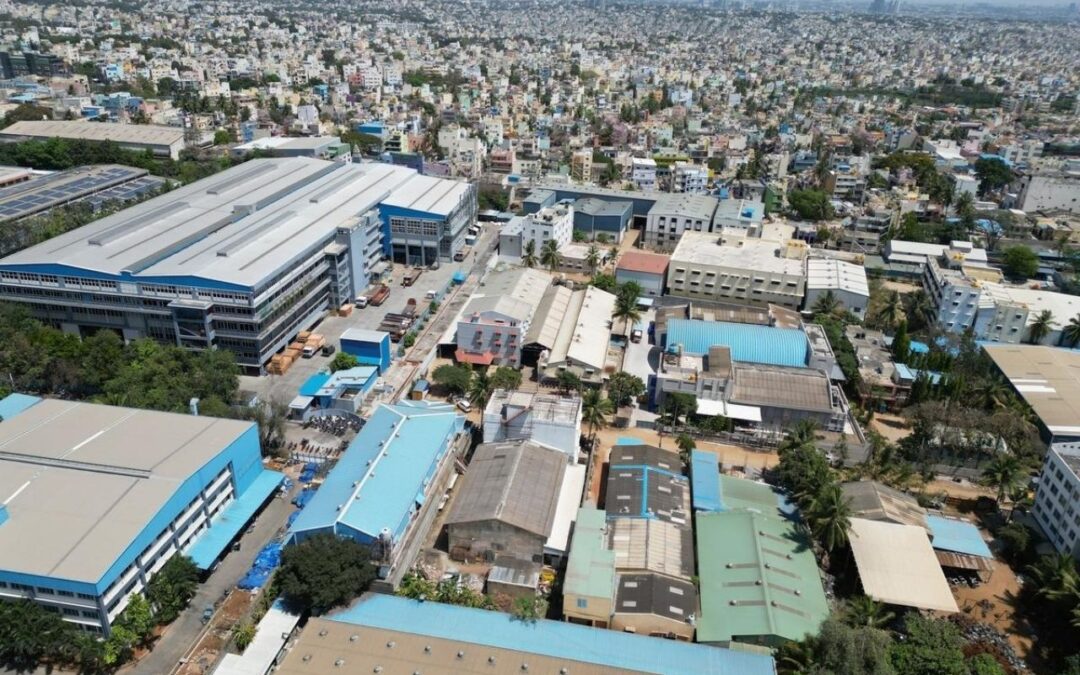
Synopsis: This area is one of Bengaluru’s oldest and the largest industrial hub, which after getting the SIR status have been turned to a organised industrial township, enhancing infrastructure and fueling demand for mid-income housing.
The Peenya Industrial Area is recognized as one of the most extensive manufacturing ecosystems in Asia, covering an area of 4,000 acres in the northwestern part of Bengaluru, and consisting of nearly 13,000 MSMEs employing about 1.3 million people in total. It was established as an industrial corridor in the late 1970s. It has grown to become the backbone of the manufacturing sector in India, with a turnover of ₹35,000 crores annually. This area was officially declared a Special Investment Region (SIR) by the Karnataka government in June 2025.
Sector Diversification and Industrial Maturity
The industrial area is famous for engineering and electrical products like CNC machine tools or die casting LPDC, fabrications, HPDC, GDC dies & moulds, transformers, motors, and generators, textiles (silk), hydraulics, machine tool industries, and rubber molding industries. The industrial area was developed in the late 1970s.
Some of the most prominent Indian companies, such as 3D Concept Tooling (P) Ltd., Sandur Fluid Controls Pvt Ltd, Jain Trade Center, Siddhivinayak Industries, Alfeni Metarc Ltd., Mangalam Creations, Cooltronics, BPE BioTree (P) Ltd., Kardex Remstar, Wipro Technologies, ABB, and Onnet Systems India, have already opened their factories in the Peenya Industrial Area. For the last few years, industries in this area have been gradually relocating to the northern outskirts of Bangalore due to the adverse effects of pollution from these factories on nearby residential areas.
Current Market Position and Competitive Landscape
As of 2025, Peenya operates as a sophisticated industrial ecosystem rather than a simple manufacturing zone. Approximately 50% of Peenya’s workforce is women, almost double the national MSME average of 20-25%, indicating that the area plays a significant role in providing formal manufacturing jobs for the underprivileged. A lot of suppliers in Peenya are already part of the global value chains from different sectors such as automotive, aerospace, consumer electronics, and industrial equipment.
Real Estate Pricing Dynamics
Peenya is the most expensive area of the Bengaluru industrial zone, and the real estate in Peenya is valued really high till the end of October 2025. At present, the industrial sheds and warehouses are rented out at rates ranging between ₹28 and ₹35 per sqft. The presence of top-notch manufacturers, the density of suppliers servicing over 8,000 operational units, and the access to logistics are excellent.
Let’s compare with other Industrial areas in Bengaluru
| Industrial Zone | Rental Rate (per sq ft) | Primary Industries | Metro Connectivity |
| Peenya Industrial Estate | ₹28-35 | Engineering, Manufacturing, Auto Components, MSMEs | Green Line |
| Whitefield Industrial Corridor | ₹24-32 | E-commerce, Light Assembly, Tech Services, Warehousing | Purple line |
| Bommansandra Industrial Area | ₹22-28 | Electronics, Automotive Components, Heavy Manufacturing | Yellow line |
| Nelamangala Industrial Corridor | ₹15-20 | Logistics, 3PL, Light Manufacturing | Planning to expand the green line |
Peenya’s premium rental is a great opportunity for growth-stage manufacturers and specialized engineering firms, as it opens the door to proven supply chains and high-quality, skilled workers.
The Special Investment Region Designation
Peenya was conferred the status of Karnataka’s 18th Special Investment Region (SIR) on June 11, 2025, as per the 2022 Act. The governance changed from decentralized boards to a centralized KIADB-led structure that facilitated land management, approvals, and revenue collection.
One of the provisions of the SIR model is that 70% of the property tax revenue has to be reinvested back in the region, which is a way of ensuring sustainable infrastructure funding and accountability. This was the case for many years, as Peenya’s growth was limited, although it was economically important due to the barriers that were around it.
Environmental Challenges and Regulatory Imperatives
- Peenya’s industrial development has brought about a major environmental issue, namely the pollution problem, with a CEPI score of 65.11, which places it 32nd among the most polluted areas of India.
- Industrial pollution is a major problem in this area, as about 334 of the 2100 industries are in the red category and 473 in the orange category, i.e., they are the biggest contributors to air and water nuisance. Air quality is often above national standards, while almost 90% of groundwater samples contain heavy metals and are thus unfit for drinking. Furthermore,
- SIR’s new regulations have made it compulsory to have stricter environmental clearances and to upgrade the infrastructure simultaneously; however, 25–30% of MSMEs are said to have no certified pollution control systems, mainly due to the financial and compliance difficulties they face.
Investment Framework and Risk Assessment
- Warehousing: It is a direct exposure to production and the demand for 3PL, with the rental yield of 6-8% on gross real estate value, ₹28-35 per sq ft rental on properties of ₹4,000-6,000/sq ft asset cost. Historically, depreciation of infrastructure has reduced yields to 5-7%, although SIR-driven improvements should return to 7-9% in the medium term.
- Residential Adjacency: It is an indirect exposure through properties in Hebbal, Yeshwanthpur, and Thanisandra that will be aided by Peenya housing demand for workers and infrastructure spillovers. Combining rental yields of 4-6% with capital appreciation of 8-11% per annum gives a total return of 12-17%, which is significantly higher than Bengaluru’s average of 8-12%.
- Logistics Hubs: The facilities are specialized and include cold-chain, bonded warehouses, and just-in-time component distribution. They serve Peenya manufacturers and airport-linked supply chains, with the yields of 7-10% reflecting the premiums of operational complexity.
Conclusion
Peenya has grown into an important industrial estate in Asia. It has a long history of manufacturing, perfect supply chains, and a highly skilled and mixed-gender workforce. Besides, being a special economic zone has made the area more attractive; coupled with the metro, the rising demand for residential and logistics in North Bengaluru suburbs now opens a unique opportunity where industrial, warehousing, and residential real estate can simultaneously multiply their returns over the next 5 to 7 years.
Written by Yatheendra N