
Synopsis: In 2025, the Union government cleared ₹1 lakh crore to boost deep tech sectors. Cities such as Bengaluru and Hyderabad are already far ahead in AI, semiconductors, quantum, robotics, and advanced manufacturing. This article explains how Tier-2 and Tier-3 cities are gearing up to participate in the deep tech growth story.
The Union government has cleared ₹1 lakh crore RDI (Research and Development Innovation) Fund, approved in July 2025 and launched in November 2025, to boost a private sector-driven R&D ecosystem, focusing on deep-tech sectors like AI, clean energy, and biotechnology. Deep Tech is not limited to major cities, but is spreading to Tier-2 and Tier-3 cities too. Global capital like Nvidia, Qualcomm Ventures and coalition of US-India VCs have promised USD 1.85 billion through India Deep Tech alliance. IIT Bombay, SINE launches India’s Incubator-linked Deep Tech VC fund worth ₹250 crore.
Funding in Deep techs
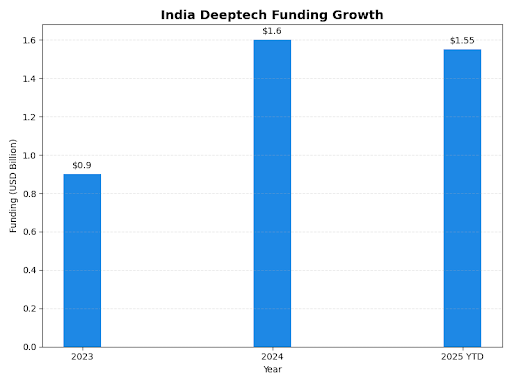
Deep Tech funding increased twofold to USD 1.06 billion across 137 rounds by July 2025, and grew at an annual rate of 78 percent to reach USD 1.6 billion in 2024. Venture capital firms such as Speciale Invest are raising a ₹1,400 crore Growth Fund II, specifically designed to help deeptech startups bridge the gap from prototype to production.
Domestic VCs such as IvyCap and SeaFund have launched ₹250 crore Fund II vehicles focused on seed-stage investments, while international funds are targeting Series A to C rounds through the government-backed Deeptech Fund of Funds via SIDBI. At the state level, Tamil Nadu has introduced a ₹100 crore policy initiative as a stimulus for deeptech development.
Tier 2 Cities Leading Adoption
Coimbatore leads with EVs and ER&D of 21% CAGR and forms the basis of college of engineering and GCC expansions. Infovalley Industry offers Infosys/TCS cybersecurity centers and data facilities, which attract low-attrition talent, in Bhubaneswar. Mangaluru is a leader in AI/gaming through state AI CoEs with a focus on coastal retention.
| City | Core Deeptech Areas | Key Anchors |
| Coimbatore | EVs, ER&D | Colleges, 21% CAGR |
| Indore | SaaS, EdTech | Policies, 40-60% savings |
| Bhubaneswar | Cybersecurity, data centers | Infovalley, TCS/Infosys |
| Mangaluru | AI/ML, legal-tech | AI facilities |
| Jaipur | Fintech, BPO | SEZs, NCR access |
- Indore is a city thriving on SaaS/EdTech start-up incentives
- Jaipur is a city developing fintech in Mahindra SEZs
- Kochi city is developing GCC/AI in Kerala Mission with 200+ companies.
Also read: How India’s Data Center Landscape Will Transform Over the Next 10 Years
Statewise Ecosystems
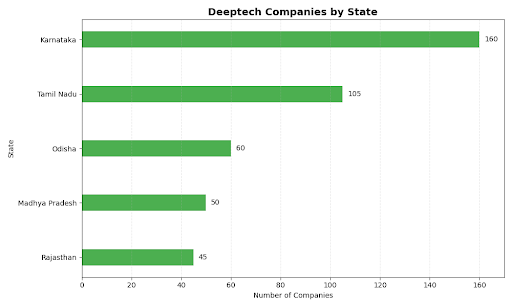
Tamil Nadu has more than 100 companies in EVs, AI, and semiconductors, and Coimbatore has a CAGR of 21% based on engineering talent and 355+ GCCs in Chennai. Karnataka has the highest number of space tech and robotics companies (160 plus); Bengaluru hits 120 startups in incubation and Mangaluru 40 in AI and gaming.
Bhubaneswar in Odisha serves 60 cybersecurity businesses through Infovalley with TCS and Infosys as anchors. Indore in Madhya Pradesh is fueling 50 SaaS and EdTech companies with cost advantages of 40-60, and Jaipur in Rajasthan is advancing 40 or more fintech companies in the SEZ.
Government Policies
The India Deeptech Report 2025 prepared by Kae Capital has put into the limelight the Rs 10,000 crore SIDBI Deep Tech Fund of Funds, a bridge between seed and Series A funding, and a remedy to 70 percent metro concentration. Anusandhan National Research Foundation (ANRF) sets up AI, quantum, and biotech R&D at Rs 50,000 crore in five years, 70% of which is to be matched privately to increase India’s spending to 0.7 of GDP.
IndiaAI Mission offers a computer infrastructure and datasets of 10,370 crore, running 300+ AI-deeptech startups. The state initiatives involve the Rs 100 crore policy of Tamil Nadu on 100 TRL-based projects and the Elevate strategy of Karnataka that seeded 25% of the 2024 non-metro deals.
Deeptech Risks
According to Kae Capital reports, 53 percent of founders face difficulties in accessing funds despite strong sector enthusiasm, while 44 percent cite market readiness challenges, primarily due to pricing constraints and OEM adoption barriers. These risks are compounded by long development cycles, talent shortages in quantum and AI, and India’s low R&D spending at 0.64 percent of GDP compared to global benchmarks, contributing to nearly 6,300 startup shutdowns by the end of 2025.
Scalability is further constrained by inadequate Tier-2 city infrastructure and weak intellectual property enforcement. However, policy initiatives such as procurement pilots and test beds aim to mitigate these challenges.
Government Schemes
Smart Cities Mission, PM Gati Shakti, and Startup India move 48 percent of Tier-2/3 based DPIIT startups. Programs such as ISM and India Deep Tech Alliance pledging $1 Bn to commercialize IP at a time when the GDP spends less than 1% on research and development are accelerating IP commercialization.
Conclusion
The emerging cities in India make the country the exporter of deeptech globally, which is in line with the 2047 vision of Modi, and is based on decentralized innovation and long-term investments. Nashik agro-tech and Pune SaaS will enhance this transition by 2026 because the agro-tech will guarantee a resilient growth outside the metros.
Written By Jayanth R Pai