
Synopsis: India’s luxury housing market is set for another strong year in 2026. It is so majorly because of rising high-income buyers, NRI investments, and a clear tilt toward premiumisation. The overall housing volumes may have softened but homes of higher value continue to dominate with a handful of cities accounting for the bulk of this growth.
India’s residential real estate market is on the verge of a major transition where the sector is no longer driven by sheer transaction volumes but by value concentration at the top end. Data from JLL shows that homes priced above ₹1 crore accounted for over 50% of total housing sales in 2024 which rose further to approximately 63% in 2025, even as overall housing sales saw a marginal decline.
This divergence between volume and value shows that India’s housing demand is becoming increasingly premium. Developers are prioritizing high-margin luxury projects and the share of affordable housing continues to shrink.
At the same time, the demand for such projects is also constantly on the run. High-net-worth individuals, senior professionals, and NRIs are some of the major factors behind the demand. In several large projects, NRIs now contribute close to one-third of total sales and reinforcing the role of global capital in India’s real estate cycle.
Top Cities at the Forefront of Luxury Housing Growth
Mumbai
Mumbai still continues to anchor India’s luxury housing market due to its pricing power and limited supply. Property registrations rose 8% year-on-year in early 2026 and stamp duty collections increased by over 20%. This sheer numbers alone reflects a rise in ticket sizes rather than transaction volumes. Some of the redevelopment projects also unlock premium inventory and sustained demand from financial sector professionals. Thus, Mumbai remains a high-value market where luxury housing is in the path of positive growth.
Delhi NCR
Delhi NCR especially Gurugram has emerged as the fastest growing luxury housing region. Price growth of nearly 19% has been recorded with strong traction in the ultra-luxury segment (₹10 crore and above). The rise of branded residences along with improved infrastructure such as the Dwarka Expressway and strong corporate income growth are accelerating demand. Unlike Mumbai, NCR combines both scale and expansion; this is a key growth engine.
Bengaluru
Bengaluru’s luxury housing market is driven by end users rather than speculation. This is also backed by the IT sector where the city has recorded steady price growth of around 10 to 12% annually. The demand is concentrated in Whitefield, Sarjapur, and North Bengaluru, with a visible shift toward villa communities and low density housing. This makes Bengaluru a stable luxury market.
Hyderabad
Hyderabad is quickly scaling as a high growth luxury housing market with price appreciation of around 12 to 13%. The city benefits from strong IT demand and comparatively lower entry prices. The premium developments in Gachibowli, HITEC City, and the Financial District are attracting both investors and end-users and it is positioning Hyderabad as a market with high potential.
Share of Luxury-Segment vs Mid-Segment
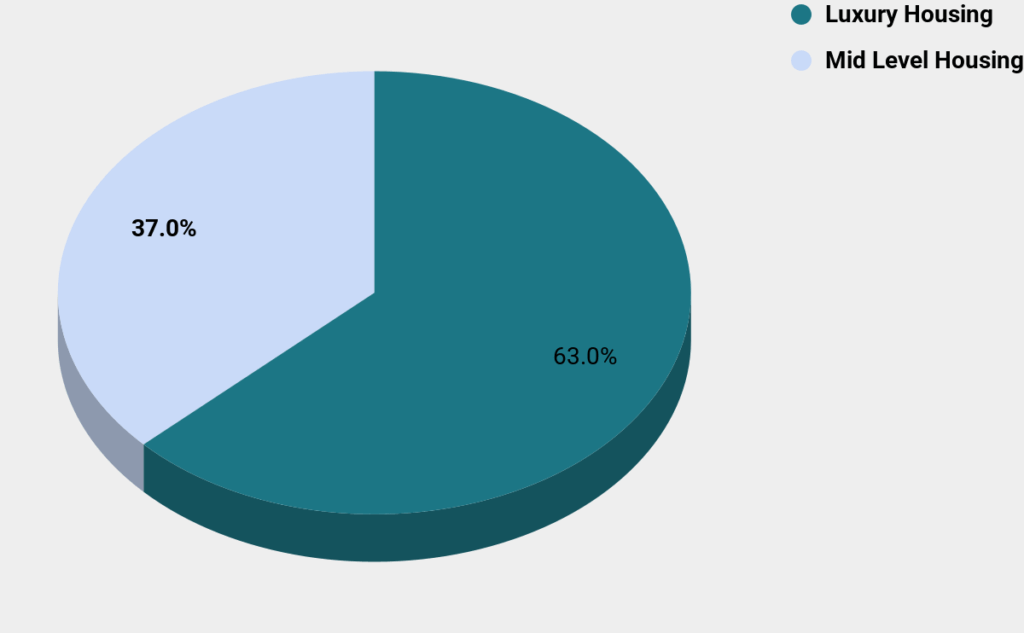
Note: The data and figures are taken from the Report of JLL
What Is Behind the Luxury Housing Boom
- The growth of luxury housing in India is at its highest peak because of the investors as well as demands within the country. Many developers are on a path where they are focusing more on premium projects due to higher margins. The affluent buyers are also treating the real estate segment as one of the stable investment assets.
- The rise of branded residences has also changed the usability of these buildings. Now the premium estates are turning luxury housing into a service-led offering that combines hospitality, exclusivity, and design. At the same time, strong NRI participation is adding liquidity and supporting demand in high-value projects.
- In contrast, the affordable housing segment has seen a decline in share which further boosted the shift toward premiumisation.
Conclusion
Luxury housing in 2026 is a concentrated and selective market. Major cities of the country like Mumbai and Delhi NCR are dominating in value and scale. Additionally Bengaluru and Hyderabad are following with a steady growth backed by the growth of income. Lastly, Pune and Ahmedabad are emerging as secondary markets which are being pushed by lifestyle upgradation and affordability. The broader shift is clear: India’s housing market is no longer about volume but it is about the value it brings.
Disclaimer: All data and numbers are based on publicly available reports and industry sources. These sources include JLL, Anarock, TOI and ET reports. The figures are indicative and may vary across reports and time periods.
Written by Kenbi Riba