
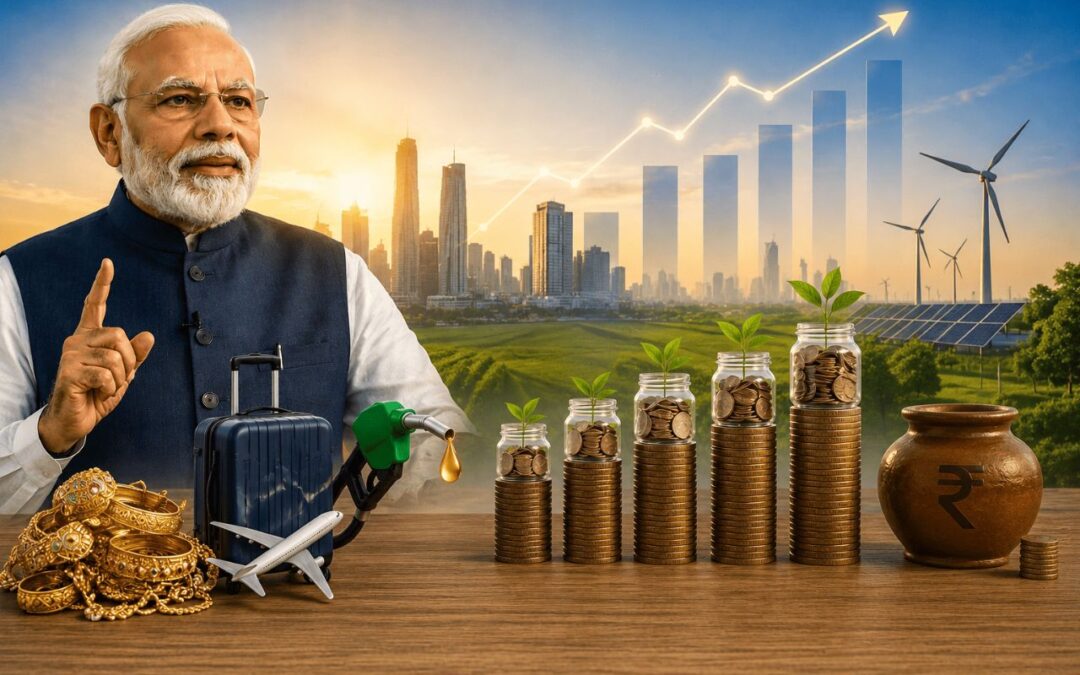
Synopsis: Addressing a public meeting in Hyderabad on May 10, PM Modi urged citizens to adopt Swadeshi measures to protect India’s economy amid the West Asia crisis, including reducing fuel consumption, reviving work-from-home, avoiding foreign travel, and limiting gold purchases for one year to save foreign exchange.
In May 2026, there was an appeal which no one expected. At a BJP event in Hyderabad, PM Modi asked citizens to avoid buying gold and travelling abroad for at least one year in resemblance of economic patriotism. With the geopolitical tensions due to the US-Israel and Iran conflict, the crude oil is up nearly 50% and is impacting India’s forex reserves. But the dilemma of investment and lifestyle consumption patterns needs clarification.
The Appeals by PM Modi: Lifestyle Changes to Consider
Before thinking about investing, these are the lifestyle changes that can be considered by every citizen to stay aligned with the appeal.
- Go Swadeshi: Aatmanirbhar starts at the doorstep, when we choose to buy indian made goods over the foreign made. Every rupee spent on swadeshi products stays in India’s economy, and creates jobs, and strengthens the rupee.
- Fuel: Less Car, More Public Transport: India imports ~85% of the energy requirement. Use of public transportation like, metro, buses, carpooling curtails the fuel requirement and also cuts the travelling cost of the person.
- Foreign Travel: Explore Bharat First: Skipping foreign travel doesn’t mean skipping a holiday. India being a diverse geographical nation offers varied destinations from hills to beaches to deserts to history to modern high tech cities. Domestic travelling and cultural exploration will be significantly cheaper, increase domestic tourism, and equally fulfilling.
- Work From Home: Energy Saving Mode: Working from home directly reduces the fuel consumption cost per person and also helps an individual to mitigate reliability of fuel on travel. This practice done during the COVID-19 helped to mitigate energy reliability, and is expected to have the same effect in the current scenario.
- Natural Farming Practices: India imports a significant quantity of urea and potash, which is an amount of money outgoing from the country’s economy. This can be mitigated from the reduction of heavy reliance on chemical fertilizers and slowly shifting towards natural farming practices which are organic and also healthy for the people.
- Avoid Buying Gold: India imports large amounts of gold to meet the country’s gold consumption requirements. In buying physical gold the buyer pays 8-25% of making charges, import duties, and additional charges levied by the gold shops. This can be avoided by reducing the purchase of physical gold.
- Reduce Cooking Oil and Mindless Imports: Switching to domestically produced oils like groundnut, mustard, sesame, over imported palm oil and sunflower oil is much cheaper and much more healthy as it is produced locally and also reduces the import burden. Small household decisions would multiply and can create a macroeconomic impact.
Also read: How PM Modi’s Work-From-Home Appeal Could Reshape India’s Real Estate Market
Investments: Redirect, Don’t Retire That Money
The money which was going to be spent on the gold jewellery purchase or a vacation trip hasn’t disappeared. It’s back in the money pouch and these are the few places to considering investing in,
- Equity Mutual Funds: If the money should be invested in India the best way is to own a piece of Indian businesses. It takes as low as ₹500 to invest in mutual funds. The small-cap funds in India have generated ~25-30% returns, while the large-cap funds have delivered ~15-20%, and both of these are beating the physical gold’s long term average.
- PPF and NSC: PPF is government backed, and continues to offer 7.1% per annum, and is tax-free under exempt-exempt-exempt framework, with an annual investment limit of ₹5 lakh. NSC carries an interest rate of 7.7% with a five-year tenure and does not attract TDS on interest, and also qualifies for Section 80C deduction. This is best for investors wanting government guarantee and not market-linked options.
- Fixed Deposits: The current RBI repo rate has a neutral stance on 5.25%. This is low and because of this FDs are becoming an attractive financial option to consider. Many banks are offering interest rates in ranges ~7.00-7.25%. Locking in a 3 to 5 year FD now is a smart decision before the interest rates come down.
- Corporate Bonds: Corporate bonds sitting between FDs and equity are the most underused retail investment tools, but the average yield of AAA-rated corporate bonds in India generally ranges between 7% and 8.5% depending on the issuer, maturity, and the prevailing interest rate. AAA-rated bonds from financially strong companies or government backed institutions carry minimum default risk and are the investments which every investor should at least know about.
- Sovereign Gold Bonds (SGBs): India’s sovereign gold holding grew from ~794 metric tonnes in September 2025 to ~880 metric tonnes by March 2026. Sovereign Gold Bonds issued by RBi, give full gold appreciation, a 2.5% annual interest payment, zero making charges, and zero storage cost. Same asset but zero import burden on the nation.
PM Modi’s appeal can be seen as a financial redirection. Every rupee which did not participate in expenses of gold purchase, or a foreign trip, or imported goods, is a rupee that can compound in India’s markets, stay in the Indian economy, and build India’s financial resilience. After this appeal, the smartest thing an investor can do is, stay home, invest local, buy swadeshi, travel local, and stay patient.
Written By Jahnavi