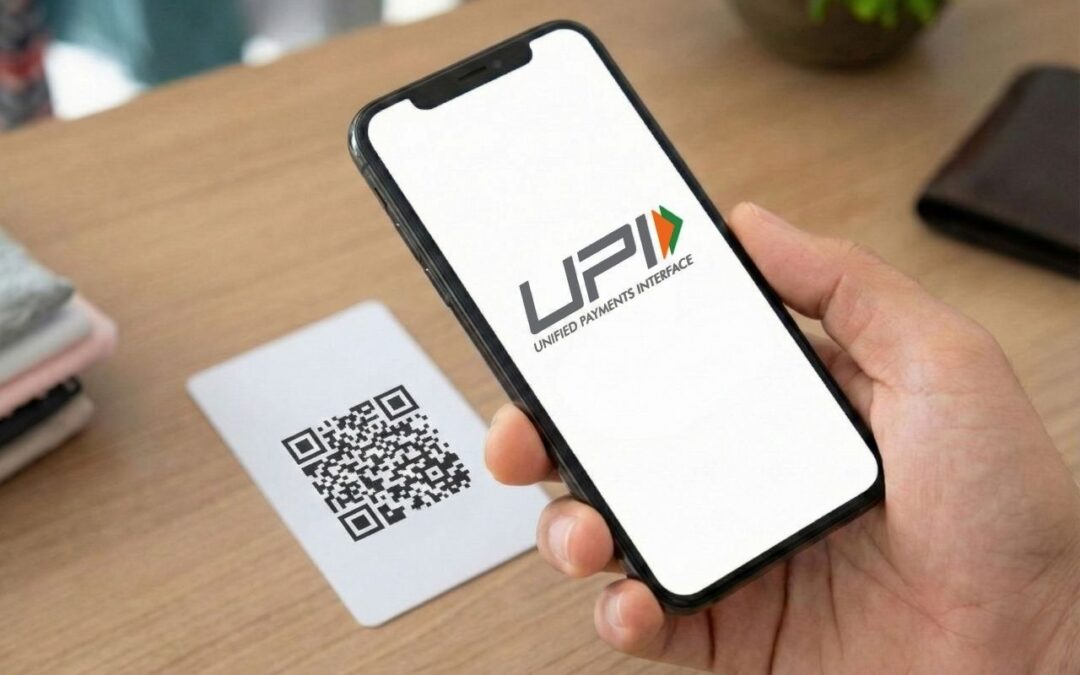
Synopsis: It is safe to say that UPI is India’s greatest fin-tech breakthrough, and has emerged as one of the world’s largest real-time payment networks and is silently reshaping a citizen’s everyday transactions. This article examines growth trends, market share, transaction types, and geographic spread using the NPCI’s ecosystem data.
Payments in India has undergone a long evolution from paper to digital to immediate payment service (IMPS) to unified payment interface (UPI). UPI launched in April 2016 by National Payments Corporation of India (NPCI), enables instant and inter-operable bank transfers through mobile. After a decade, it has scaled from being a niche tool to becoming the complete dominant structure of India’s digital payments ecosystem and now processes billions of transactions every month.
Growth Trajectory
As of 20th May 2026 data from NPCI official website, the highest monthly transactions in between April 2025 and May 2026, were in March 2026 with ₹29,52,542.03 crores in value and with an average daily value of ₹95,243.29 crores, and in April 2026 with ₹28,80,846.36 crores in value and with an average daily value of ₹96,028.21 crores.
The number of active banks on UPI was 668 in April 2025 and in March 2026 it was 705 banks, which clearly indicates a ~5.54% increase. Compared to April 2016 the number of active banks was 21 indicating a rise of ~3257.14% over a decade.
P2P and P2M: The Two Use Patterns
The P2P transactions are person to person transactions which account for 71% value in crores and P2M transactions, person to merchant transactions account for 29% value in crores for April 2026. In P2P transactions by value in crores, for April 2026,
- For ₹0 to ₹500: 4%
- For ₹501 to ₹2000: 10%
- Above ₹2000: 86%
In P2M transactions by value in crores, for April 2026,
- For ₹0 to ₹500: 16%
- For ₹501 to ₹2000: 16%
- Above ₹2000: 68%
Also read: How TDS Works on Property Transactions Above ₹50 Lakh: Rules, Process & Penalties Explained
Most Popular UPI Apps
- PhonePe- PhonePe ranks 1st in UPI applications usage with transaction value of ₹14,31,722 crore.
- Google Pay- Google Pay ranks 2nd in UPI applications usage with a transaction value of ₹9,72,068 crore.
- Paytm- Paytm ranks 3rd in UPI applications usage with a transaction value of ₹1,94,317.77 crore.
- Navi- Navi ranks 4th in UPI applications usage with a transaction value of ₹42,683.85 crore.
- Super.money- super.money ranks 5th in UPI applications usage with a transaction value of ₹16,365.13 crore.
- BHIM- BHIM ranks 6th in UPI applications usage with a volume of 210.17 million and with a transaction value of ₹25,198.44 crore.
Where India Spends the most: Merchant Category Spend
- High Transacting Category- The list tops with the groceries and supermarkets expenditures of 3,722.20 volume in millions, and fast food restaurants of 1,474.47 transaction volume in millions.
- Medium Transacting Category- In the medium category the list toppers are the package shop beers, wine and liquor transactions of 195.47 volume in millions, and debt collection agencies of 181.52 transaction volume in millions.
- All Other Categories- Under this category, electronic shops and electronic repair shops have transaction volumes of 86.54 millions and 82.61 millions respectively.
Which are the states in India which use most UPI
- Maharashtra tops this list by contributing transactions of 9.84% in volume and 9.11% in value, with Mumbai Suburban being the top contributor in transactions of 2.49% in volume in the state.
- The second top contributor with UPI usage being Uttar Pradesh of 5.37% in transaction volume and 5.51% in transaction value, and Gautam Buddha Nagar being the top contributor of the state with 0.77% in volume in transaction.
- The third state using UPI is Karnataka by contributing 5.11% in volume and 5.71% in value and Bengaluru (Urban) topping the list by transaction volume of 2.86%.
Conclusion
NPCI’s ecosystem data makes a clear point that UPI is no longer just a payment tool, it has become a strong financial structure of everyday India from groceries and supermarkets to debt collection agencies. This ecosystem is only set to deepen its reach as more banks are actively participating in the UPI ecosystem.
Written By Jahnavi