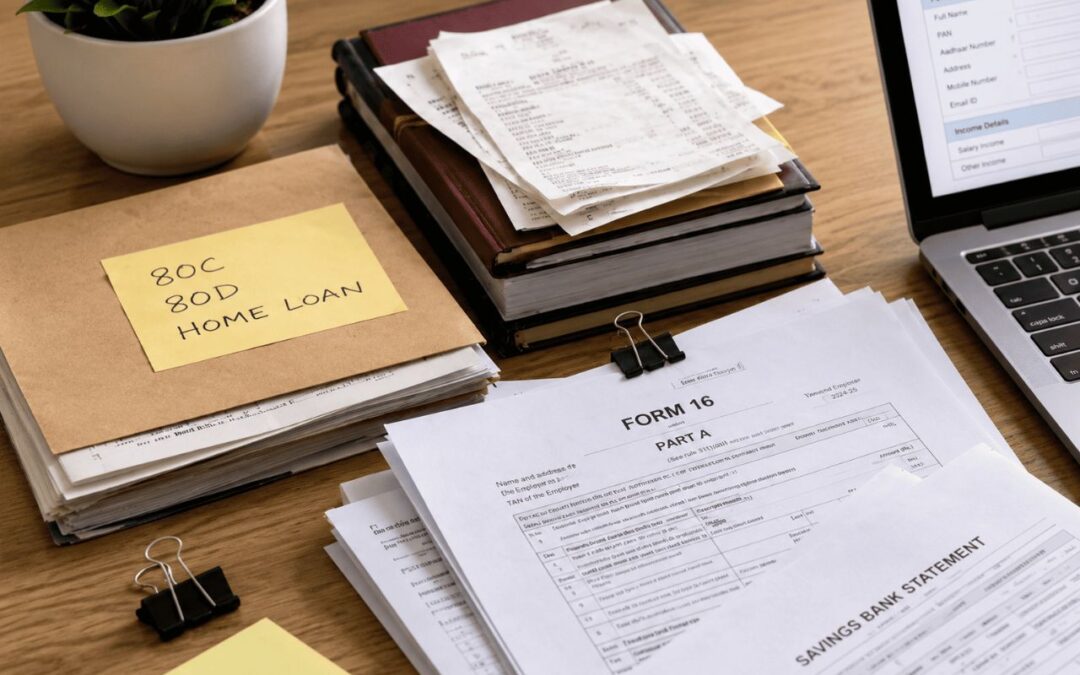
Synopsis: It is easier to file income tax returns (ITR) when all the necessary and required documents are kept in advance. This guide explains the important records and proofs taxpayers should collect for FY 2025-26 while filing the returns for AY 2026-27.
The right documents by your side not only helps in accurate income reporting but also reduces the chances of mismatches, notices, and delayed refunds. Although every taxpayer’s requirement may differ, certain documents are commonly needed to ensure smooth filing of ITR.
Basic Documents Required for ITR Filing for AY 2026-27
1. Bank Statements
- Savings accounts
- Current accounts
- Overdraft (OD) accounts
- Cash Credit (CC) accounts
For the Period: 1st April 2025 to 31st March 2026. These statements help to identify the interest income, dividend receipts, the large transactions, and tax payments.
2. Form 16 – for Salaried Individuals
- Salary details
- TDS deducted by employer
- Claimed allowances and deductions
This is one of the most important documents for the salaried taxpayers while filing the returns.
3. Form 26AS, AIS, and TIS
Before filing the returns, the taxpayers should cross-verify their income with, Form 26AS. This is an annual tax statement which provides a complete view of taxes linked to the PAN of the taxpayer. It contains information such as,
- Tax Deducted at Sources (TDS)
- Tax Collected at Source (TCS)
- Advance tax payments
- Self-assessment tax payments
- Refund details
- Transactions of high-value reported to the department
- Details of completed proceedings, if any
This helps the taxpayers to verify whether the taxes deducted or deposited have been correctly credited to their account before filing the return.
Annual Information Statement (AIS): This is a comprehensive statement which provides detailed information available with the Income Tax Department. AIS also allows the taxpayers to provide feedback if any incorrect information appears. It includes,
- Interest Income
- Dividend Income
- TDS and TCS information
- Specified Financial Transactions (SFT)
- Securities and mutual fund transactions
- Foreign remittances
- Tax payments and refunds
- Other financial information reported to the department
Taxpayer Information Summary (TIS): This is a simple summary derived from the AIS and it provides,
- Category-wise summarized information
- The processed values after considering the taxpayer feedback
- Information which is used for pre-filing income tax returns
TIS helps taxpayers to understand the income and transaction details that might be considered while processing the returns.
4. Loan Documents
Home Loan Records
- Interest Certificate
- Principal repayment details
- Loan account statement
Other Loan Documents
- Car loan statements
- Education loan statements
- Personal loan statements
- Gold loan records
These documents help to claim eligible deductions.
5. House Property Documents
The taxpayers owning property should maintain documents such as,
- Home loan interest certificate
- Property tax receipts
- Rent agreement
- Rental income details
- Municipal tax receipts
Useful for reporting house property income correctly.
6. Credit Card Statements
Credit Card statements must be maintained for the entire year by the taxpayers. These help in, tracking expenditures, reconciling financial transactions, and explaining any high-value transactions if required.
7. Investment Proofs
The records related to the following must be kept,
- Mutual funds and SIPs- The account statements, and capital gain reports
- Fixed Deposits- Interest certificates and fixed deposit statements
- Other Investments- Recurring deposits, bonds, and the deposits with the financial institutions
Also read: FD Rates Revised: 4 Banks Now Offering Up to 8.05% Interest in June 2026
8. Share Market and Trading Records
Investors should preserve the following documents,
- Contract notes
- Ledger statements
- Holding statements
- Profit and loss statements
- Capital gain reports
These documents help in calculating the capital gains and losses accurately.
9. Insurance Documents
Maintain the proofs relating to the following documents,
- Life insurance policies
- Term insurance policies
- Mediclaim policies
These documents are useful in case of applicable deductions under the old tax regime.
10. Education and Donation Receipts
The records of the schools fees, college fees, or donation receipts are useful as they may support deduction claims, wherever applicable.
11. Major Expense Records
Proof of tuition fees, medical expenses, insurance premiums and travel related expenses and helpful to improve financial documentation and assist during the tax planning.
12. Vehicle Ownership Proof
In case of owning a vehicle, the following documents should be retained,
- Registration certificate (RC)
- Loan documents, if it was financed
These are helpful for business or professional tax payers.
13. Agricultural Income Documents
Those taxpayers who earn agricultural income should keep the following documents,
- Land ownership records
- Sale receipts
- Agricultural income statements
These documents help in reporting agricultural income correctly.
Additional Documents That May Be Required
Depending on the taxpayers nature of the income, these documents may be important,
- Interest certificates from banks and post offices
- Foreign asset disclosure
- Dividend statements
- TDS certificates (Form 16A)
- Advance tax and self-assessment tax challans
- Rental receipts
- Business books of accounts
- Professional receipts and invoices
Things to Note for Hassle-Free ITR Filing
- Verify AIS and TIS before filing
- Match TDS details with Form 26AS
- Keep records for all income sources’Preserve all the supporting documents even after filling the return
- Report complete income to avoid any mismatches and notices
Written by Jahnavi