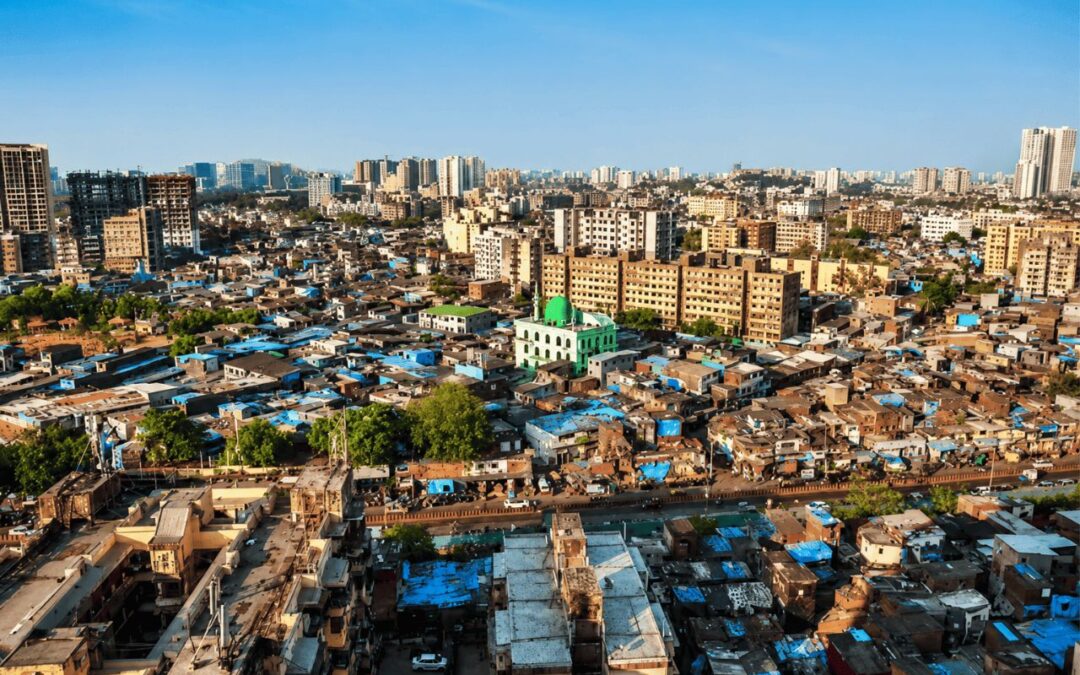
Synopsis: Dharavi Redevelopment Project is an ambitious redevelopment project covering 590 acres in central Mumbai, managed by the Adani Group, which involves in-situ rehabilitation as well as real estate development of a comprehensive nature. It is designed to turn around an Asian mega slum into a modern city.
Dharavi is a well-known informal urban settlement in the central part of Mumbai, Asia, and particularly in the Indian subcontinent, which is the largest informal urban settlement in Asia. Although it is a slum, it can be regarded as a highly integrated urban system – micro industries like leather goods manufacturing, textile, pottery, recycling units and food production make significant contributions to Mumbai’s informal economy.
Adani & Government Partnership Model for Dharavi Redevelopment
The redevelopment is done by Navbharat Mega Developers Pvt Ltd which is jointly funded by the Adani group (80%) and the Govt of Maharashtra (20%). The project is thus located at the nexus of macro-level public policy and micro-level private sector urban development.
Adani Properties is the property development company of the Adani group. The Adani group bagged the contract for Dharavi’s urban redevelopment project in November 2022 by offering to invest around ₹5,069 crores (612 million dollar). This project was one of the largest urban redevelopment contracts offered in India, and it placed the Adani group as the primary developer in the project via NMDPL.
Dharavi as an Urban Economy
Dharavi is not just a residential colony, but a genuine economy that is based on informal industries. It has thousands of small-scale production units, connected through interrelated value chains, in very high-density urban environments. Leather product manufacturing, textile and garment manufacturing, pottery, food processing (small scale), recycling and scrap processing, are the key economic activities. The industries collectively constitute a very productive informal economy sustaining lakhs of livelihoods in Mumbai. This architecture sets Dharavi apart from traditional urban settlements, where homes and jobs are intricately linked.
One of India’s Largest Urban Redevelopment Efforts
One of the major features of the Dharavi Redevelopment Project is its unprecedented size and complexity. The project covers about 590 acres of land in the Dharavi Notified Area of Mumbai, which is a highly dense urban area and needs to be completely restructured to a planned city district. The total cost of the project is estimated to be ₹2–3 lakh crore, including the cost of construction, rehabilitation, and large-scale infrastructure projects.
The project’s centrepiece is the rehabilitation of almost 1.25 lakh residential and commercial units. The structure proposed will contain approximately 58,532 residential units and 13,468 commercial and industrial units with a view to retaining the existing economic activity whilst upgrading infrastructure.
Rehabilitation Model
The rehabilitation framework is the most sensitive component of the project. General eligibility depends on available occupancy records and cut-off timelines within Dharavi, to benefit from in-situ rehabilitation. Many of the verified residents are expected to be moved to housing in the redeveloped area, with some moved to other rehabilitation units or rental housing models. Eligibility classification has already sparked debate among residents, as reported, especially on the issue of documenting eligibility and the involvement of post-cut-off settlers. The rehabilitation model is aimed at ensuring
- Resettlement on site, if possible
- Structured allocation of housing units
- Separation of residential and commercial rehabilitation as appropriate
However, there were some implementation challenges as verified records of occupancy were extremely difficult to establish, especially in such a dense informal settlement that is now 20 years old.
Dharavi Economic Ecosystem
The informal economy of Dharavi is one of the largest and densest in India with a very compact urban footprint of about 2.1 – 2.4 sq km spread across the central Mumbai area. The residential-cum-commercial structure is estimated to have 5,000 to 10,000+ micro and small-scale industrial units. They are located in dense buildings and frequently are made in several floors of the same building. It indirectly provides livelihoods for an estimated 2.5 lakh to 5 lakh individuals in the town including workers, household-based producers, small entrepreneurs and the unorganized labor in the supply-chain. Dharavi is one of the most employment intensive informal settlements in India.
- Leather goods industry: hundreds of small workshops that are engaged in export products.
- Thousands of micro-units are found in the textile & garment industry.
- It is estimated that 60–80% of the plastic waste processed in Mumbai is done so in informal networks with Dharavi (urban studies estimate).
- Transportation: thousands of small-scale food suppliers and logistics services.
- Health & beauty units: thousands of small-scale production kitchens and suppliers of food & beverages for health and beauty purposes.
- Concentrated areas of pottery and clay units to serve local and export needs.
One of the most characteristic aspects of the ecosystem is its high economic density: the production is generated by a space corresponding to a very high per-square-kilometre productivity of the informal sector. Based on the urban studies estimates, the informal sector activity in Dharavi has been estimated to generate an annual turnover of Rs 5,000 crore to Rs 7,000 crore, but due to lack of registration, the amount is variable. The production system is mainly designed on the principle of hyper-localization of the supply chain, in which the processing of raw material, the intermediate production and the final assembly are integrated within a radius of a few hundred meters.
This cuts down on logistics cost, and means production can go on around even in very limited physical space. But this also poses a huge redevelopment challenge. The spatial separation and/or relocation risks disrupt these micro supply chains and may affect the livelihood livelihoods of lakhs of workers / households who rely on competitive efficiency within the production system and on daily cash-flow cycles.
Land Value Potential
Dharavi occupies an area of around 590 acres (2.4 sq km) in central Mumbai and is situated in proximity to significant commercial locations such as BKC (Bandra-Kurla Complex), Sion, Mahim, and Lower Parel. In Mumbai’s best real estate markets, the adjacent micro-locations enjoy prices of the order of ₹30,000 to ₹70,000+ per sq ft for their properties.
Development Model
This project follows the Slum Rehabilitation Authority (SRA) model developed by Navbharat Mega Developers Pvt Ltd (NMDPL). The project involves the use of the vertical redevelopment model, which involves replacing low-rise buildings with high-rise structures to fully utilize the 590 acres of available space. One of the key elements of the plan is that of in-situ rehabilitation whereby eligible people will be relocated within Dharavi so as not to disrupt their sources of livelihood.
The masterplan has a mixed use approach as residential homes, commercial spaces, and industrial zones are incorporated into the city plan. In general, the concept incorporates land optimization, in-situ relocation, and mixed urban development approaches.
Financial Structure
- Project bid value: Adani Properties (NMDPL) secured the Dharavi redevelopment project with an investment commitment of approximately ₹5,069 crore.
- Cross-subsidy model: The project follows a redevelopment financing structure where free rehabilitation housing for eligible residents is funded through the sale of commercial and premium residential units.
- Revenue generation: Major monetization is expected from:
- Sale of high-value residential apartments in central Mumbai
- Development of commercial office and retail spaces
- Long-term lease and redevelopment of premium urban parcels
- Phased execution: Revenue inflows are expected to be staggered across multiple redevelopment phases, rather than a single-cycle return model.
- Long project horizon: The redevelopment is expected to span 15 to 20+ years, making it a long-gestation urban real estate investment project.
- Key dependency: Financial viability is heavily dependent on execution speed, market absorption of premium inventory, and successful rehabilitation rollout.
Execution Risk
- Issue of Eligibility: Determining beneficiary eligibility using past occupancy data and cut-off periods poses a problem, as record keeping in slum dwellings is generally poor.
- Execution difficulty: The project entails relocation and on-site redevelopment of about 1.25 lakh dwelling and business establishments, rendering phased implementation extremely difficult.
- Litigation concerns: The large-scale nature of displacement, in addition to being centrally located, puts the project at risk of possible legal and political controversy.
- Execution time frame: Given that development will take up to 15–20 years, delays in execution of any one stage could severely affect the bottom line.
Real Estate Market Impact
The Dharavi Redevelopment Project is poised to revolutionize the center of Mumbai’s real estate market through the creation of a huge amount of potential development within a prime piece of land spanning nearly 590 acres in one of Mumbai’s most under-supplied markets. This is bound to provide a huge supply of luxury housing units located close to high-value micro markets like BKC, Mahim, Sion, and Lower Parel, where residential rates currently average between ₹30,000 and ₹70,000 or more per square foot in luxury segments.
In addition to providing enough commercial real estate supply, including office space and retail space, the project will contribute to the growing requirement for Grade-A business infrastructure in Mumbai’s central market. Despite all the advantages associated with the project, the overall effect on the market will be felt gradually as a 15- to 20+year development process plays out.
Written By Ameet S