Synopsis: The analysis of rupee depreciation from ₹3 to ₹94 shows how the currency has decreased in value over time. This article analyzes the long-term fall in the value of India’s currency compared to the US dollar.
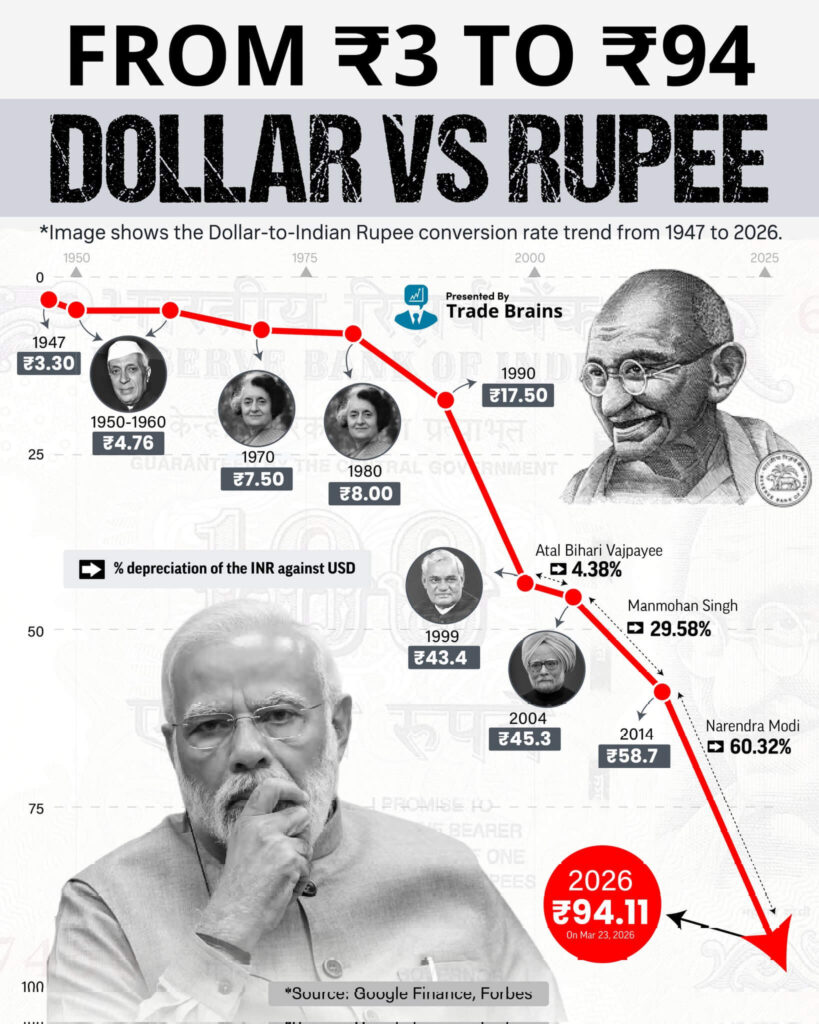
The Indian Rupee-US Dollar exchange rate history shows more than currency value changes because it demonstrates how India’s economy has grown and its position within the worldwide economic system. The rupee has continuously lost value since 1947 when it started at 3.3 per dollar until 2026 when it will reach 94 which shows that this value decrease brings actual value loss and economic factors which include inflation and increasing imports and international economic connections.
The long-term pattern shows how India has developed from an isolated economy into a global economy whose currency value depends on both domestic economic conditions and worldwide economic trends which stem from government actions and financial crises and US dollar market power.
Dollar-to-Indian Rupee Trend (1947–2026): From ₹3 to ₹94
1947 – Early 1960s | Stability Under a Controlled Economy
The Indian government under Jawaharlal Nehru maintained a fixed exchange rate system which enabled them to determine the rupee value through government restrictions. India’s limited international commerce at this point resulted in minimal foreign contact which enabled the country to keep its rupee value close to ₹3.3 per dollar. However, this stability was artificial, it depended on strict controls rather than strong economic fundamentals.
1964-1966 | Lal Bahadur Shastri and 1966-1977 | Indira Gandhi
The 1966 event marked the execution of the first major currency devaluation. The leadership transition from Lal Bahadur Shastri to Indira Gandhi brought India into an economic crisis. The 1962 war with China and the 1965 war with Pakistan drained foreign reserves, while food shortages worsened the situation. The crisis situation required India to establish a new currency value of ₹7.5 per dollar which represented the first major currency devaluation that occurred because of external forces and urgent national emergencies.
The 1970s
Indira Gandhi maintained the License Raj system which restricted private business development through heavy government control. The economy experienced weak export performance while import levels continued to grow. The rupee exchange rate decreased to a value between ₹7.5 because of systemic inefficiencies which developed through time.
The 1980s
The Indian government under Indira Gandhi(till 1984) and Rajiv Gandhi (till 1989) focused on modernization while simultaneously increasing its financial expenditures and international trade. The government faced rising fiscal deficits which forced it to obtain additional foreign loans. The currency descended to a value of ₹8 per dollar because of underlying economic deficiencies which resulted in permanent economic problems.
The 1990s
The P. V. Narasimha Rao administration started a major reform period. India faced a balance of payments crisis because its foreign reserves reached critical depletion levels. The government devalued the rupee and introduced liberalization, shifting towards a market-based economy. The rupee declined to approximately ₹17.5 before it reached a value above ₹30 per dollar.
Also read: Nifty 50 vs Real Estate: Which Actually Builds More Wealth in the Long Term?
1990s (Post-1993) | Market-Determined Exchange Rate
The rupee became market-driven after the reforms because its value now depended on international market demand and supply. The currency experienced greater fluctuations because trade and foreign investments and capital movements increased. The depreciation process gained speed but reached a point where it showed the actual market value of the rupee.
1999 | Globalization and External Dependence
Atal Bihari Vajpayee of his leadership period made India establish stronger connections with international commerce. The economy experienced growth, yet the country increased its import needs which included crude oil. The rupee dropped to approximately ₹42–₹44 per dollar because trade deficits and international business activities forced the currency to decline.
2004–2013 | Global Financial Shocks
Manmohan Singh’s government dealt with international events that affected his administration. Emerging markets including India experienced capital outflows because of the post-2008 financial crisis and 2013 US monetary policy tightening known as the taper tantrum. The rupee experienced a rapid decline which brought its value to approximately ₹59 per dollar.
2014–2020 | Structural Weaknesses Continue
The rupee entered a process of gradual depreciation under Narendra Modi. India faced the lowest with its trade deficit and inflation gap and oil import requirements. The currency moved from approx ₹59 to ₹61 per dollar, showing steady long-term pressure. The COVID-19 pandemic affected the economy and capital outflows. The rupee reached its value of almost ₹94 per dollar in 2026 because international and national structural factors determined its exchange rate such as Russia Ukraine War, West Asia Conflict (US-Iran) and tariff rates by the US.
Conclusion
The Indian rupee has experienced a decline from its original value of ₹3 to its current value of ₹94 which demonstrates India’s economic changes across multiple decades. The currency movement shows global economic pressures and structural challenges which affect its value but the currency shows the development of an economy that expands its international connections.
Written by Boyapati Sai Jasmitha