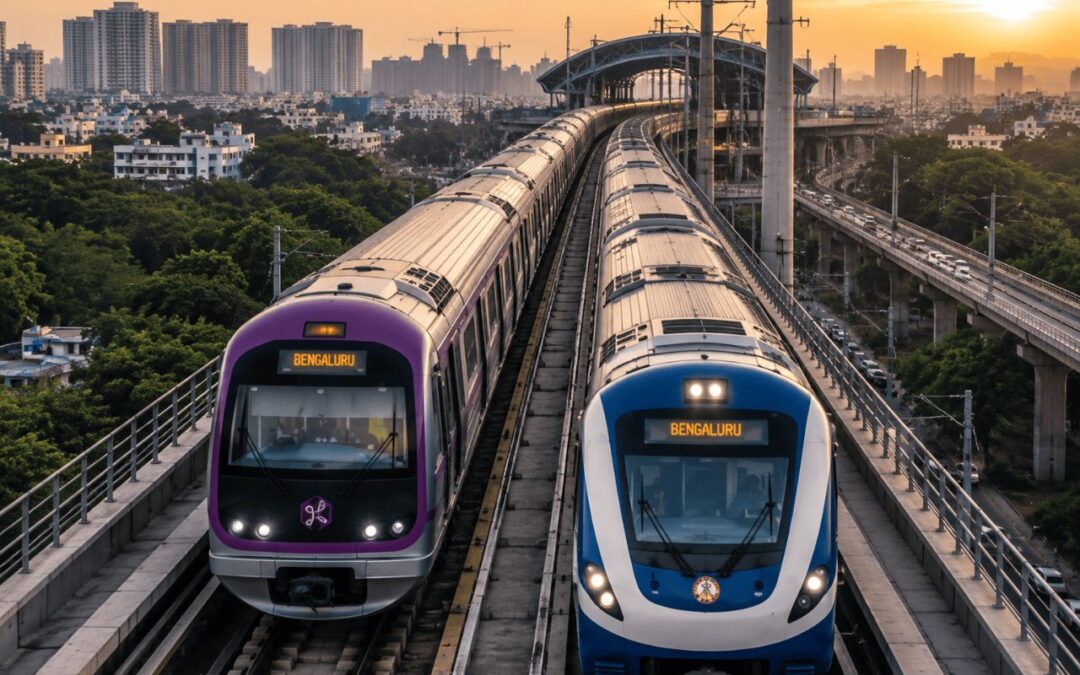
Synopsis: The Metro–Suburban Rail common corridor at Benniganahalli will help create connectivity in East Bengaluru, this article will dwell into the details of the project, benefiting areas, and its impact on the commuters.
East Bengaluru will get a significant public transport boost with Bengaluru Suburban Rail and Namma Metro to be connected at the Bengaluru Suburban Rail Station at Benniganahalli. The project coordinates a multi-modal transportation system that will enhance connectivity along some of the city’s fastest growing residential and commercial corridors.
The planned common corridor will improve the flow of traffic, facilitate future urban development, and bolster Bengaluru’s role as a pivotal transportation hub in East Bengal as the city grapples with escalating traffic congestion.
Key Highlights of Shared Corridor
The 500-metre common corridor at Benniganahalli will save the Bengaluru Namma Metro almost ₹169 crore, as it will be able to share the same infrastructure with Suburban Rail without building separate alignments. The Metro Blue Line will share the right of way with the Suburban Rail’s Mallige Corridor, thus maximizing available urban space.
The integrated design has also resulted in reduction of acquisition of approximately 1.65 acres of residential land in the over-populated Benniganahalli area. Which means that nearly 130 residences no longer have to be purchased for the project and thus costs and administration are reduced. The project not only has a positive economic impact but also a very positive social effect. The shared corridor is thus emerging as an ideal solution to developing infrastructure that cuts costs and is people-friendly in Bengaluru.
Areas likely to Benefit
- Benniganahalli and KR Puram: These will have the highest connectivity improvement as they are the point of intersection of Metro and Suburban Rail networks. The residents will get better connectivity with the city’s key business districts, railway stations and other areas of Bengaluru.
- The densely populated residential areas of Dooravani nagar, Banaswadi, Kasturi nagar, Ramamurthy nagar, and Pai layout will become more accessible for high-capacity public transport, which decreases the need for cars and enhances daily transport possibilities.
- The seamless connectivity of Metro and Suburban Rail will ease commuter travel to the various IT parks, commercial hubs and employment hubs in Bengaluru such as CV Raman Nagar, Indiranagar, Mahadevapura, and Whitefield more effectively.
- The smooth integration between the different suburban rail stations at Benniganahalli, Hebal, Yeshwanthpur and Kengeri, among others, will increase cross-city travel convenience and connectivity, helping faster travel within Bengaluru.
Also read: Top 7 Indian Cities with the Highest Rental Yields in Q1 2026; Bengaluru Isn’t No. 1
Effect on Commuters and Connectivity
This project will ensure a smooth integration of the Metro and Suburban Rail lines at Benniganahalli and make public transport easier for Bengaluru’s commuters. The passengers can switch from one rail line to the other in a more convenient way without having to rely on several road crossings, thereby saving time overall.
The project will be especially useful for those commuting between residential areas of East Bengaluru and job hubs like Whitefield, Mahadevapura, Hebbal and the city centre. Better connectivity is also to be expected to relieve traffic congestion on roads such as Old Madras Road and other arterial roads. The common corridor will be a great addition to the multi-modal transport network in the long run and will promote the use of public transport in the city, increasing mobility.
Conclusion
The common corridor at Benniganahalli is a critical milestone in the journey towards integrated mobility in Bengaluru. The project will help the Metro and Suburban Rail networks share infrastructure, which will lower costs and the need for land acquisition, as well as increase connectivity for thousands of commuters each day. The project highlights the potential benefits of such collaborative efforts, including improved transportation, reduced traffic, and better property values in East Bengaluru.
Written by Boyapati Sai Jasmitha