
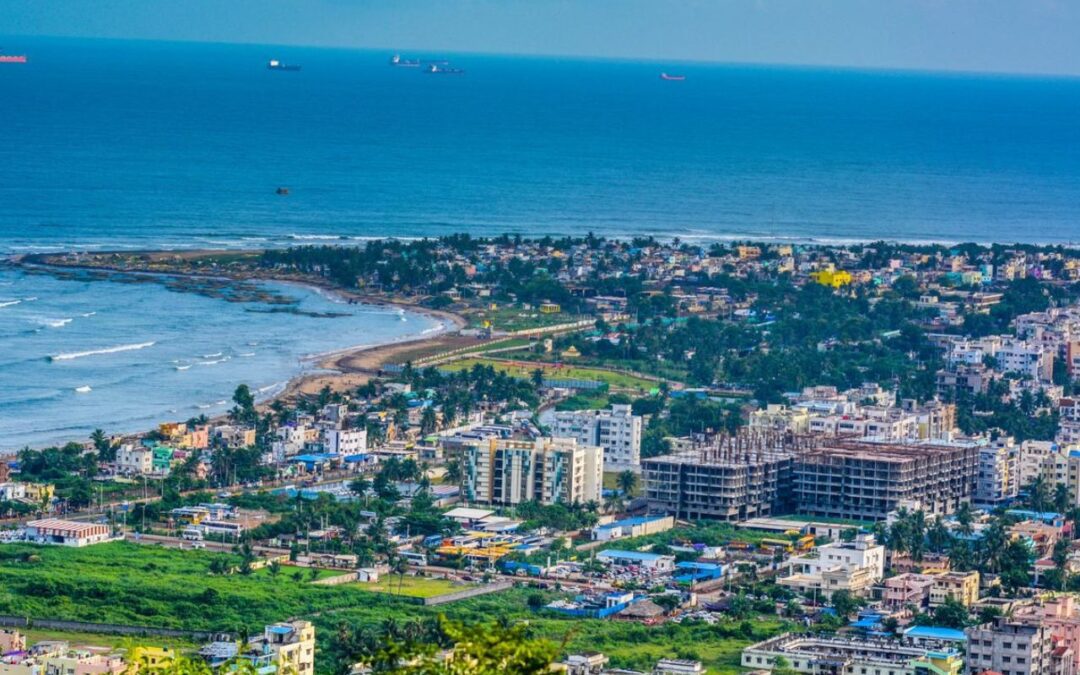
Synopsis: Both Visakhapatnam and Amaravati have simultaneously emerged as significant presences on the global investment map with Amaravati, a ‘planned’ administrative capital fueled by good governance and infrastructure, and Visakhapatnam, an emerging industrial and digital hub powered by large-scale private investments and global energy-tech projects.
Andhra Pradesh is witnessing the rise of two distinct development trajectories which defines its long term economic direction. While Amaravati is being developed as a Greenfield Administrative Capital built on Structured Planning, Governance Systems and Deep Tech Research Ecosystems; Visakhapatnam is attracting large-scale investments, not only in the form of mega data centres by global technology giants such as Google and others, but also through the establishment of leading IT companies, including TCS, Cognizant and several multinational firms.
Amravati
Amaravati is being built as a green field administrative hub, i.e. it has been built almost from scratch with government planning as the core of its development, as opposed to organic growth of industries. It is situated on the central corridor of administration in the Guntur district covering an area by the banks of the river Krishna between Vijayawada and Guntur.
The first layer of development is the Phase-I urban programme (2025–2029), valued at ₹15,000 crore (₹13,600 crore MDB + ₹1,400 crore Centre). This is a period of establishing the backbone of a capital city; trunk infrastructure, housing structures, governance, urban design for climate change. It also serves as a catalyst for investment of approximately $600 million from the private sector, suggesting the early involvement of the private sector around a strong public sector nucleus.
Beyond this, Amaravati is considerably scaled up in the CRDA Capital City Construction programme that establishes the city’s long-term physical and institutional architecture. The overall development ecosystem comprises:
- Total project pipeline: ₹81,317 crore
- Tenders floated: ₹50,552 crore
- MoUs (2025): ₹45,589 crore (36 MoUs)
- NABARD funding: ₹7,387.70 crore
This includes the main governance district (Legislature, Secretariat, High Court), LPS land development zones, utility networks and commercial districts. This investment is clearly institutional, rather than being based on an industrial export base.
One of the key pillars of Amaravati in the future is the Quantum Valley Tech Park (50 acres, opened in January 2026), which will be hosted by IBM’s 156-qubit quantum processor “Heron,” and will feature other partners like TCS, L&T, LTIMindtree and Microsoft. It aims to have 90,000 professionals working on it, with the help of government investment of ₹40 crore and private investment of ₹200 crore, which is aligned with India’s National Quantum Mission, which is set at ₹6,000 crore. This places Amaravati in the deep-tech and research arena, instead of traditional manufacturing.
Visakhapatnam
Visakhapatnam symbolizes a growth model driven by private sector investment, export-based, and heavy on infrastructure development. While a new administrative capital city is always planned, the growth of Visakhapatnam is emerging from huge private investments and energy exports.
The Google AI Data Centre Hub, located in three clusters in Adavivaram, Tarluvada, and Rambilli, with an investment of ₹1,33,215 crore ($15 billion), is the biggest. It provides 1 GW hyperscale capacity, promises a submarine cable landing station on the east coast of India and is expected to create ₹10,518 crore annual impact on GSDP and more than 1,88,220 jobs (direct + indirect) annually (2028-32) during peak load.
This is complemented by the NTPC Green Hydrogen Hub at Pudimadaka which has an investment of ₹1,85,000 crore with Phase I investment of ₹1,10,000 crore expected to be commissioned by 2026-27. It will generate Green Hydrogen and 7500 TPD of derivatives with 20 GW renewable power capacity, making Vizag a key player in the export of Green fuels such as Ammonia and Sustainable Aviation Fuel (SAF). The construction alone will create 57,000 jobs.
Key aspects of NTPC Green Hydrogen Hub:
- Place: Pudimadaka, Anakapalle District (~50 km from Visakhapatnam)
- Investment: ₹1,85,000 crore (₹1,10,000 crore Phase I)
- Timeline: 2026–27 commissioning (Phase I)
- Output: 1,500 TPD hydrogen + 7,500 TPD derivatives
- Energy base: 20 GW renewable capacity
- Jobs: 57,000 (construction phase)
- Focus: Green hydrogen, ammonia, methanol, SAF exports
Another big factor driving the rural-industrial transformation is the Reliance Industries proposal of 500 compressed biogas plants around Vizag in Andhra Pradesh. The project has an investment of ₹65,000 crores and is capable of generating 11,000 tonnes of CBG daily along with about 2.5 lakh direct and indirect employment, directly connecting agricultural, rural waste with industrial energy production.
Visakhapatnam too is emerging as a multi-operator digital infrastructure hub. The ₹15,000 crore investment in the Tillman Global 300 MW data centre campus will make it one of the densest AI and cloud corridors in South Asia, increasing the region’s overall digital capacity to over 1.3 GW.
Industrial development is ongoing in Krishnapatnam Industrial Hub Phase I, which has an investment of ₹1,518 crore in 2,500 acres, (Phase I) and a project value of ₹10,500 crore in the broader Vizag corridor. It is focused on electronics manufacturing, parts for EVs, semiconductor assembly and equipment for renewables, including 98,000 jobs at full scale.
Comparison Matrix: Amravati vs Visakhapatnam
Two Growth Engines of Andhra Pradesh
These two cities are not competitors, but complementing growth engines for AP’s future. Amaravati represents long term institutional strength rooted in governance, quantum tech, and planned urbanism while Visakhapatnam represents the near term economic explosion fueled by AI, energy exports, industrial manufacturing, and global digital connectivity.
Written By Ameet S