
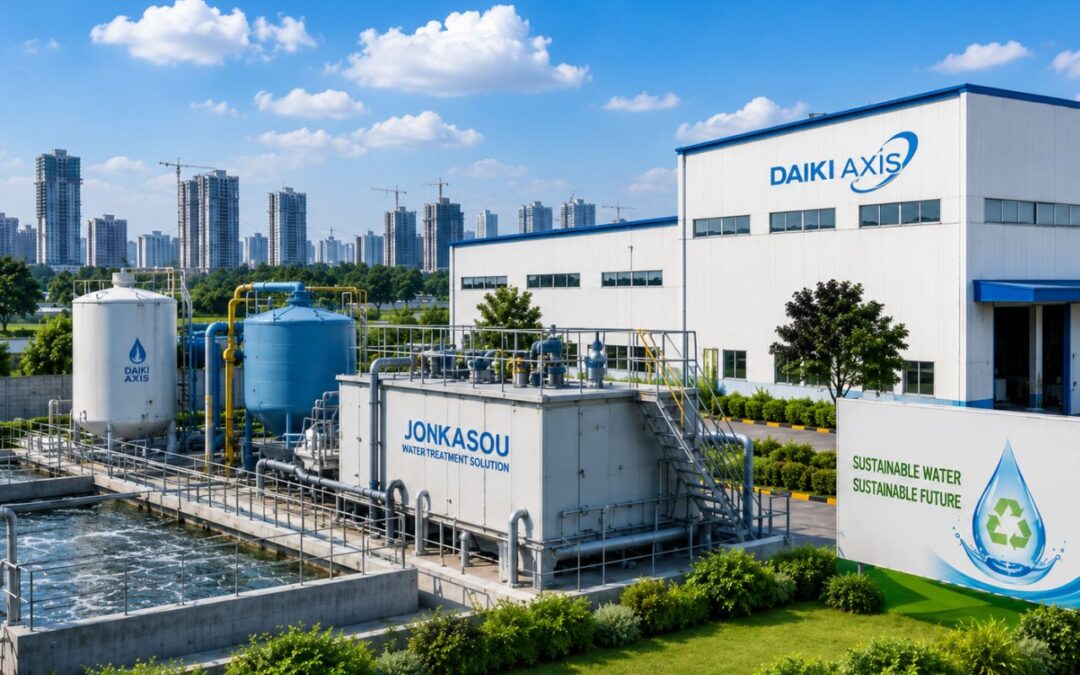
Synopsis: Japan’s Daiki Axis will invest around ₹200 crore to build its third Indian manufacturing facility in Tumakuru, Karnataka, to produce decentralised sewage treatment systems based on Japan’s Johkasou technology.
Daiki Axis is Japan based provider of water treatment solutions, and is setting up an India manufacturing facility, in Tumakuru, Karnataka, targeting increasing demand in the country’s water recycling and sustainable wastewater treatment sector.
Key Details of the Investment
What Is Johkasou Technology?
Johkasou is a decentralized wastewater treatment system designed in Japan that treats domestic wastewater at its point of origin, eliminating the need for underground infrastructure.
Why Tumakuru, Karnataka, and Why Now
The timing of this expansion lines up with rising urbanisation, industrial growth and mounting pressure on India’s water resources, which together are seen as creating a significant opportunity for advanced wastewater treatment technology. The Karnataka plant is expected to,
- Strengthen local manufacturing capabilities
- Reduce dependence on imports
- Support faster deployment of wastewater treatment systems across the country
Choosing Tumakuru region, is essential as it is an industrial node within Chennai-Bengaluru Industrial Corridor (CBIC), with an estimated investment potential of ₹7,000 crore, and hosts the Pavagada Solar Park of around 2,000 MW, approximately ₹16,500 crore investment, the Tumkur Machine Tool Park, and Karnataka’s National Investment and Manufacturing Zone spanning roughly 13,000 acres, and the strong connectivity and proximity to Bengaluru making it one of Karnataka’s most sought-after investment destinations.
India’s Market Potential
Several factors make India one of the more promising global markets for wastewater treatment and reuse,
- More than 24,000 urban parks could use treated wastewater
- India generates approximately more than 72 billion litres of sewage daily and the treatment capacity remains inadequate in several regions.
- Despite having surplus natural resources, rising demand for domestic, industrial and agricultural use has put a strain on most of India’s river basins.
Aligning With National Policy Goals
This expansion is being positioned alongside two government initiatives,
- Make in India – Daiki Axis already operates two facilities in India under this framework, with the new Karnataka plant extending that alignment
- Viksit Bharat 2047 – The government’s long-term vision for world-class urban infrastructure, sustainable water management and improved sanitation standards
Growing emphasis on circular water use, wastewater reuse, smart cities and sustainable urban development is also seen as building a strong long-term market for decentralised sewage treatment in India.
Current Status
Currently, the facility in Karnataka is at the investment and setup stage and the local arm of the Japanese firm, Daiki Axis India, is managing it. So far no timeline on construction or commissioning has been announced publicly by the company.
All in all
With its third India facility, Daiki Axis is positioning itself to capture a widening market opportunity in decentralised sewage treatment, betting on India’s urbanisation-driven demand for sustainable water management solutions in the years ahead.