

Synopsis: India is rapidly strengthening its position as a preferred GCC destination especially among Emerging Enterprises. More than 610+ emerging enterprises have GCCs in India and the number will rapidly increase by 2030.
Global Capability Centres are not solely dependent on large companies anymore. Newer businesses are using the GCC model more and more to get quicker, manage better, and develop more robust digital skills while going global. By September 2025, more than 610 emerging enterprises have established GCCs in India employing more than 4lakhs professionals. This emerging enterprises will increase to 950+ by 2030.
Reasons for the shift
1. Agility and Innovation: In today’s fast-paced business environment, GCCs enable quick innovation and adaptation through focused teams in AI, cloud, data, and machine learning, without major structural changes.
2. Low Cost and Easy Setup: GCCs located in places such as India or Eastern Europe not only significantly lower expenses but also provide access to a pool of highly skilled technology and data professionals, which in turn allows companies to grow and expand internationally without incurring heavy costs.
3. Building a Digital Workspace: Going remote and hybrid has become a constant in the work environment, and thus GCCs are the ones making it possible to have robust digital places through the use of technology, cloud systems, and also allowing smooth communication between the different geographical areas.
4. Business Continuity: GCCs are the backbone of business operations that never stop. Through the distribution of teams over different time zones, firms can guarantee non-stop work 24/7, quicker responses, and smooth delivery of services, without any of the teams or places getting too tired.
5. Access to Wider Talent: GCCs provide startups the opportunity to work with various global talents, thus making innovations quicker, solving problems better, and creating more durable teams in the long run.
Also read: South Indian Cities Dominate 64% of GCCs in India: Here’s the List
Emerging Enterprises and the GCC Inflection Point
As of September 2025, more than 610 new GCCs were already operating in India, employing over 4.62 lakh professionals. These GCCs were generating a total revenue of $14.23 billion, and almost 64% of all the new GCCs created since 2020 had been chartered with private equity. The number of GCCs in this segment is forecast to exceed 950 in 2030.
Digital transformation is an inevitable and perhaps even a fast-paced process for new businesses. Indian GCCs are the front-runners in IT cloud migration, automatic operations, machine intelligence, and new platform upgrades. These measures allow the enterprise to undergo the transformation quicker than ever without being restricted by lack of workforce or old systems at the head office. Tier-2 cities like Ahmedabad, Coimbatore, Vizag and other non-metro locations are emerging as GCC hubs and these cities account for 14% of all GCCs, that offer cost-effective talent pools for emerging enterprises.
Emerging Enterprises command over one-third (approx 34%) of India’s GCC Ecosystem
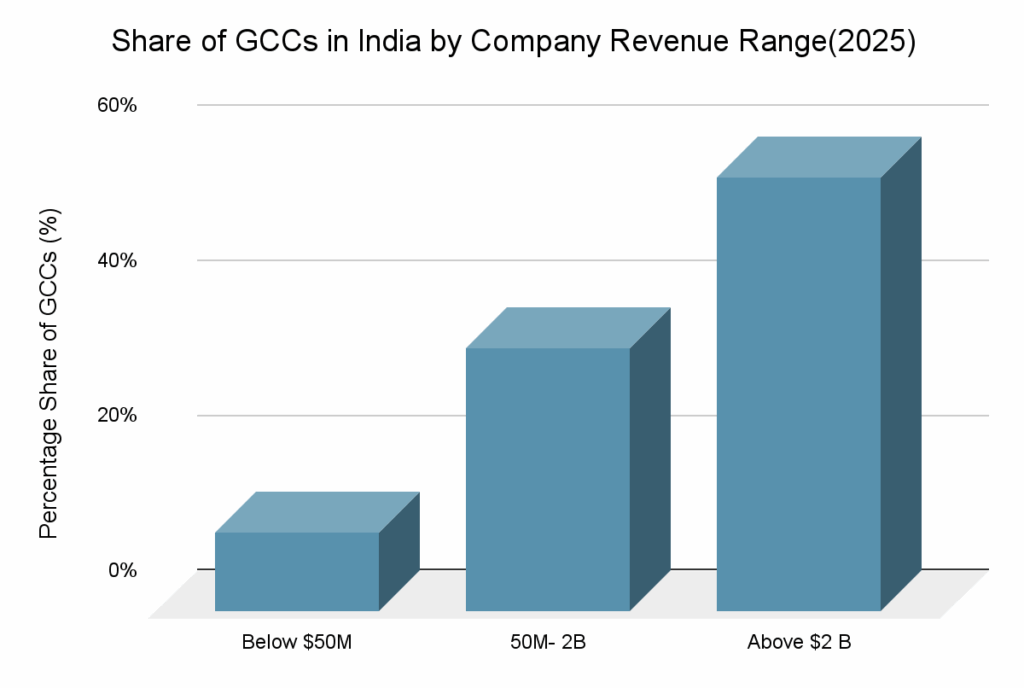
- Total companies with GCCs in India: 1,800+
- Companies with revenue below $50 million: 10%
- Companies with revenue between $50 million and $2 billion: ~34%
- Companies with revenue above $2 billion: ~56%
- Emerging enterprises with GCCs in India: 610+
The bar chart clearly shows that emerging enterprises are no longer a small or secondary group within India’s GCC ecosystem. Nearly one-third of all GCCs now belong to mid-sized companies, especially those in the $50 million to $2 billion revenue range. These firms are moving fast, using India’s mature GCC ecosystem to build capabilities, scale operations, and stay competitive without taking on excessive risk. What once looked like a model reserved for large corporations has now become a practical and strategic choice for emerging enterprises.
Latest Trends Shaping Emerging Enterprises’ GCCs in India
- Digital Transformation Leadership: Many emerging enterprises are adopting the GCC incubator model to reduce risk and speed up setup. This approach allows companies to start small with lower compliance and capital costs, stabilize operations quickly, and scale into full-fledged GCCs once the model proves effective.
- AI-Driven Transformation: GCCs are increasingly being recognized as central places for AI and deep-tech works rather than only support staff. A lot of new businesses are already putting most of their AI talent in India, the place where the teams are working on the full cycle of AI solutions with a business-oriented performance impact.
- Shift from Cost to Value: The importance of GCCs has undoubtedly shifted from mere cost reduction to their being the main source of innovation in the company. Efficiency is still a critical factor to consider; however, the new companies see the GCCs more as the facilitators of the whole process, the ones that bring the organization closer to the market through faster and more innovative product and platform development.
- Faster Path to Leadership Roles: Compared to large enterprises, GCCs in emerging companies offer quicker exposure to leadership and decision-making. With flatter structures and broader role ownership, professionals in GCCs gain faster career growth and become integral to global strategy and execution.
- GCC Incubator Model: Many emerging enterprises are adopting the GCC incubator model to reduce risk and speed up setup. This approach allows companies to start small with lower compliance and capital costs, stabilize operations quickly, and scale into full-fledged GCCs once the model proves effective.
Future Outlook
As digital and AI become the engines behind the company’s strategy, GCCs will move from backstage support to front-row players, they’ll help shape new products, fine-tune daily operations, and even weigh in on big decisions, rather than simply keeping the lights on.
Written By Aditee Das