
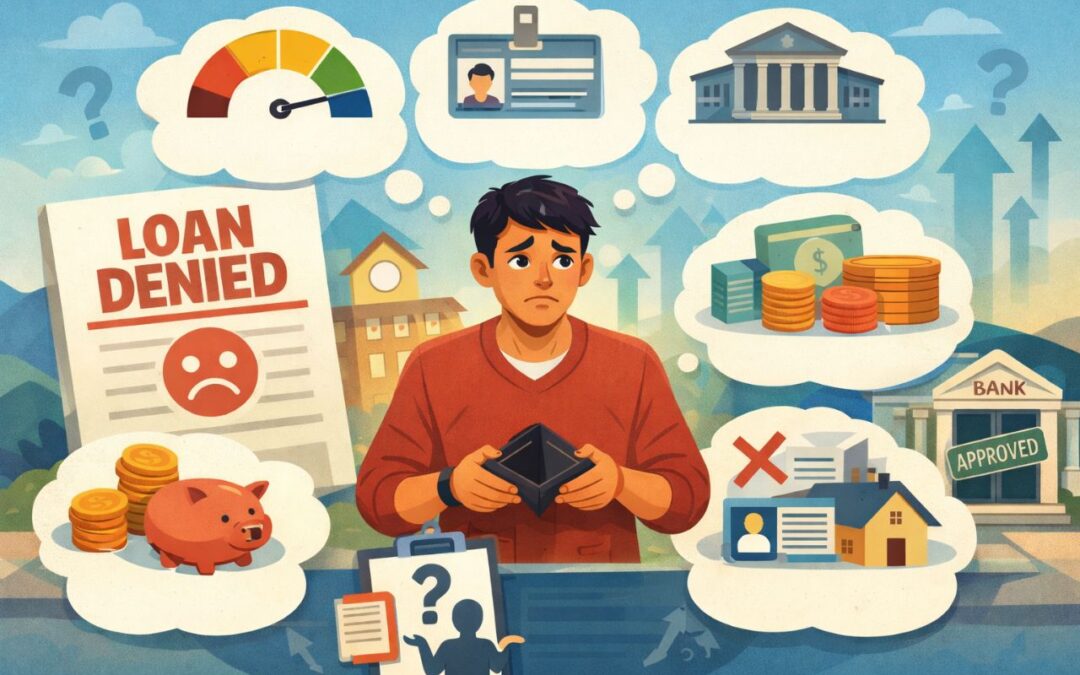
Synopsis: An approval for personal loan from banks as a newcomer seems like a daunting task. It happens due to many reasons like lack of historical data (credit scores) and stability markers which are required to calculate risk. This article explores how the banking rules create a barrier for those just starting out.
Getting a personal loan as a newcomer is another added layer of difficulties. A newcomer could be anyone starting from a young adult just starting their career or could be an immigrant settling in a new country. There are many reasons why there could be hurdles to get a loan. The most commonly known being credit history but there are actually more reasons behind.
Here is a detailed analysis of all the reasons why the doors to financing often seem locked for those just starting out.
1. No History of Credit
The main blockage for a newcomer is often the lack of a credit score. Many lenders rely on credit bureaus to provide a report or numbers to judge the financial reliability of applicants.
- The Data Gap: A newcomer has no record of past credit cards, car payments, or loans from these bureaus.
- The Risk Factor: An applicant without a track record is unpredictable for the bank. To a lender, no history falls under the risky category as they have no evidence of your repayment behavior.
2. Employment and Income Stability
Lenders don’t just want to see that you have money today; they want to be sure you will have money throughout the span of the loan.
- The Six-Month Preference: Some banks require at least six months to a year of continuous employment with the same company. New applicants are often in the middle of job transitions or have just started their first role. This makes them appear unstable on paper.
- Probationary Periods: If you are still in a probationary period at a new job, lenders may view your income as unsecured and fear that you could be let go before the loan is repaid.
3. Debt-to-Income (DTI) Ratio
Many newcomers who are new to the workforce have starting salaries that may be modest and initial settling costs (like rent and cars) are high. Lenders calculate your Debt-to-Income ratio by dividing your monthly debt obligations by your gross monthly income. If your rent and existing bills already eat up 40–50% of your paycheck, a bank is unlikely to approve an additional loan because the fear factor that you’ll be spread too thin kicks in.
4. The Framework of Risk: The 5 C’s of Credit
We have to take a look at the 5 C’s of Credit to understand better. This is one of the commonly used checklists by loan officers to judge an applicant. Most of the time newcomers fail multiple categories at once:
- Character: This is your reputation. Banks verify this through the age of your accounts. A newcomer has a credit age of zero. This means their financial character is an unproven variable.
- Capacity: This is your cash flow. While a newcomer may have a high salary but the lack of a 2-year history in that role makes the capacity seem volatile to a bank.
- Capital: This is your net worth. Most newcomers use their savings to move or pay apartment deposits, leaving them asset light with no backup funds if things go wrong.
- Collateral: Most personal loans are unsecured, meaning there is no house or car for the bank to take. When that collateral is absent the bank relies entirely on Character which is again that one thing a newcomer lacks.
- Conditions: This refers to the purpose of the loan. If a newcomer is borrowing for living expenses rather than a specific asset, banks view the condition of the loan as high-risk.
Also Read: 4 Best Banks Offering Personal Loans at Low Interest Rates: See Who Beats SBI
5. Lack of Collateral or Assets
As mentioned in the 5 C’s, most personal loans are unsecured. Because there is no backup for the bank to seize if you stop paying. They rely entirely on your reputation (credit score) and income. Newcomers rarely have significant local assets like a home with equity that could serve as soft collateral to reassure a lender.
6. Identification and Residency Hurdles
When it comes to immigrant newcomers in the credit and loan market the paperwork could be the biggest hurdle. Legal status matters as some lenders may require a permanent resident certificate or at least relevant legal paper of it or sometimes a specific type of work visa that stretches beyond the duration of the loan.
So, how can a newcomer get a personal loan?
| Strategy | How it Works |
| Secured Credit Cards | You provide a cash deposit as collateral to build your score. |
| Credit Builder Loans | Small loans designed specifically to report to credit bureaus. |
| Co-signers | Someone with good credit vouches for you. |
| Alternative Lenders | Fintechs that use bank statements instead of just credit scores. |
Conclusion
The difficulty newcomers face is not a personal judgment but a byproduct of a system run for predictability. Banks highly prefer Character and Capacity both of which require time to prove. That is why understanding the 5 C’s of credit helps newcomers to focus on building a paper trail through smaller financial products. Slowly with time their thin file eventually turns into a list of history that opens doors to various personal loans.
Written by Kenbi Riba