
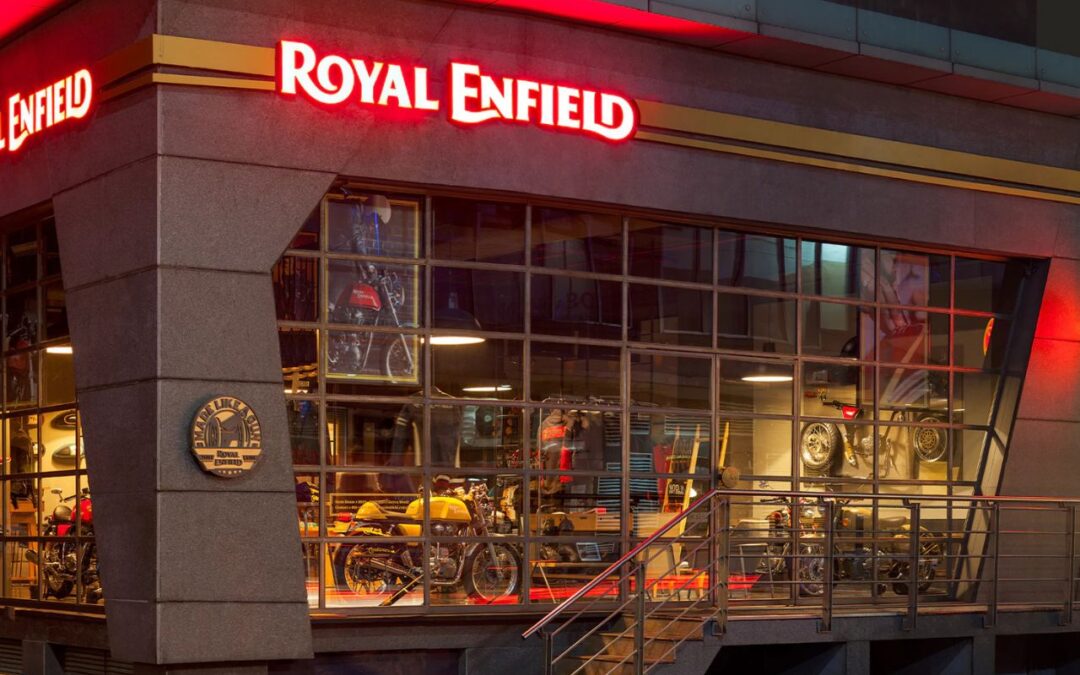
Synopsis: Eicher Motors is making one of its largest manufacturing investments in decades through a ₹2,200 crore expansion in Andhra Pradesh. While the move increases production capacity, the larger story may be about preparing Royal Enfield for its next long-term growth phase beyond brand revival and into large-scale global expansion.
For years, the story around this auto company and its flagship brand was centred around transformation. The company successfully reinvented its main flagship brand from a legacy motorcycle manufacturer into one of India’s strongest premium automotive brands with deep customer loyalty and significant pricing power.

With a market capitalisation of ₹2,02,795 crores, the shares of Eicher Motors were trading at ₹7,393 apiece in today’s market session, up by 1.11%%, and the stock has delivered a return of 11.94% over the past month, with the 1-year absolute return being 34.74%
The ₹2,200 Crore Expansion Announcement
The company has now announced a ₹2,200 crore investment to establish a major manufacturing facility and vendor park in Andhra Pradesh. The project will be developed in phases until 2032 and is expected to add nearly 900,000 motorcycles to annual production capacity.

This is particularly significant because the company already dominates India’s mid-size motorcycle market through Royal Enfield, commanding an estimated market share of nearly 90% in the segment. That makes this expansion less about solving immediate demand constraints and more about preparing for a much larger long-term opportunity.
FY25 Capex and Long-Term Capacity Plans
The Andhra Pradesh expansion also aligns with the company’s broader capital expenditure roadmap. Earlier, the company had outlined a total FY25 capex plan of ₹2,200 crore, with around ₹1,200 crore allocated toward Royal Enfield for new products and EV development, while the remaining ₹1,000 crore was earmarked for VECV’s commercial vehicle business.

The latest manufacturing investment reinforces the company’s long-term capacity expansion strategy as it prepares to meet rising domestic and global demand. The broader objective appears to be building sufficient production scale to support future growth across both traditional motorcycles and emerging mobility segments.
The Shift From Revival to Scale
The announcement signals that management likely sees the premium motorcycle category itself expanding meaningfully over the next decade, both in India and internationally. Rising premiumisation trends, growing aspirational consumption, and increasing global demand for mid-weight motorcycles are gradually creating a larger addressable market for the company.
For years, Royal Enfield’s growth story was primarily driven by brand revival and lifestyle positioning. The Andhra Pradesh expansion suggests the narrative may now be shifting toward scale creation and long-duration capacity building.

Why Andhra Pradesh Matters Strategically
The Andhra Pradesh expansion also carries strategic significance beyond capacity addition. This marks Royal Enfield’s first major manufacturing expansion outside Tamil Nadu since
1955, indicating a diversification of its production ecosystem and supply chain footprint. Andhra Pradesh has also been aggressively positioning itself as a manufacturing destination through industrial incentives and infrastructure support for large corporations.
The EV and Future Mobility Angle
Another important layer to the capex strategy is the company’s growing focus on future mobility. A significant portion of the broader capex allocation has already been earmarked toward EV development and new product platforms, including the company’s upcoming electric motorcycle brand, Flying Flea.
This becomes critical because the premium motorcycle segment itself is gradually evolving. While internal combustion motorcycles continue dominating today, long-term competitiveness will increasingly depend on how successfully manufacturers adapt toward electrification, connected mobility, and evolving consumer preferences. Through Flying Flea, the company appears to be positioning itself early within the premium electric motorcycle segment while attempting to retain Royal Enfield’s lifestyle-led brand identity in the EV era.
The Challenge of Maintaining Premium Positioning
At the same time, competition in the premium motorcycle segment is gradually intensifying. Both domestic and international manufacturers are expanding aggressively into higher-displacement categories, making product innovation and scale increasingly important.
The larger challenge for the company now is balancing expansion with brand positioning. Royal Enfield’s success has historically been built on aspirational branding, lifestyle-led marketing, and strong community engagement. Scaling production aggressively while maintaining that premium identity will remain critical.
Market Takeaway
From the market’s perspective, this may not simply be a manufacturing announcement. It appears to signal the beginning of the next strategic phase for Eicher Motors, one focused not just on brand strength, but on long-duration scale creation, EV readiness, and global expansion.
The key question now is whether Royal Enfield can successfully transition from being India’s dominant premium motorcycle brand into a much larger global mid-size motorcycle platform over the coming decade.
About the Company and Financials
Eicher Motors is one of India’s leading automobile companies with a strong presence in the premium motorcycle and commercial vehicle segments. The company is best known for Royal Enfield, which dominates India’s mid-size motorcycle market and has built a significant global lifestyle brand presence.
The company also operates in the commercial vehicle segment through VE Commercial Vehicles (VECV), a joint venture with Volvo Group. In recent years, Eicher Motors has increasingly focused on global expansion, premiumisation, EV development, and future mobility platforms, including its upcoming electric motorcycle brand, Flying Flea.
Year-on-Year analysis: Revenue from operations has increased from ₹16,536 crores in FY24 to ₹18,870 crores in FY25, up 14.11%, with reported operating and net profit being ₹5,933 crores and ₹4,734 crores for the same period.
Quarter on Quarter analysis: Revenue from operations has decreased from ₹6,172 crores to ₹6,114 crores, down 0.9% for December Q3’FY25, with reported operating and net profit being ₹1,557 crores and ₹1,421 crores for the same period. The company reported an ROCE of 29.8% and an ROE of 24.1%, and the company has a debt-to-equity ratio of 0.02.
Disclaimer: The views and investment tips expressed by investment experts/broking houses/rating agencies on tradebrains.in are their own, and not that of the website or its management. Investing in equities poses a risk of financial losses. Investors must therefore exercise due caution while investing or trading in stocks. Trade Brains Technologies Private Limited or the author are not liable for any losses caused as a result of the decision based on this article. Please consult your investment advisor before investing.