Synopsis:-With FY26 revenues surging 59 percent and PAT nearly doubling to ₹498 crore, ACME Solar Holdings has delivered a strong full-year performance, but the more consequential development is the company’s commissioning of nearly 2.3 GWh of battery energy storage capacity, one of the largest BESS deployments in India, already generating around ₹2.2 crore per day through merchant power contracts.
Shares of one of India’s largest renewable energy independent power producers came into focus this week after its Q4 and full-year FY25 results revealed a business that has quietly moved beyond its solar origins. The income statement told one story. But buried inside the investor presentation was a battery energy storage buildout of a scale that changes the conversation entirely from a generation company to something considerably more interesting.
With a market capitalization of Rs. 17,191 crore, the shares of ACME Solar Holdings were trading at Rs. 284 per share on May 8, 2026, with a 52-week range of Rs. 324.30 to 195.90. It is trading at a P/E of 34x.
Q4 and FY26 Financial Performance
The company reported consolidated total revenue of ₹705 crore in Q4 FY26, up 30.7 percent year-on-year, driven by new capacity additions and a higher capacity utilization factor. EBITDA came in at ₹636 crore for the quarter, with margins holding at 90.2 percent, a level that reflects the fixed-cost nature of operational solar assets once project debt is in place. Profit after tax for the quarter stood at ₹138 crore, up 13.3 percent year-on-year.

The full-year numbers were more compelling. Revenue reached ₹2,507 crore, a 59.2 percent jump over FY25, while EBITDA grew 61.2 percent to ₹2,265 crore. Profit after tax for FY26 stood at ₹498 crore, nearly double the ₹251 crore reported a year earlier, with a PAT margin of 19.9 percent. Cash ROE improved to 20.1 percent. Power generation for the full year crossed 6,464 million units, up 61.1 percent, supported by phased commissioning of new projects across Rajasthan and Gujarat.
On the order book front, the total portfolio now stands at 8,071 MW, including approximately 17 GWh of BESS installation, with 6,270 MW of PPA already signed, providing strong revenue visibility for the years ahead.

The BESS Story: ₹2.2 Crore Per Day and Growing
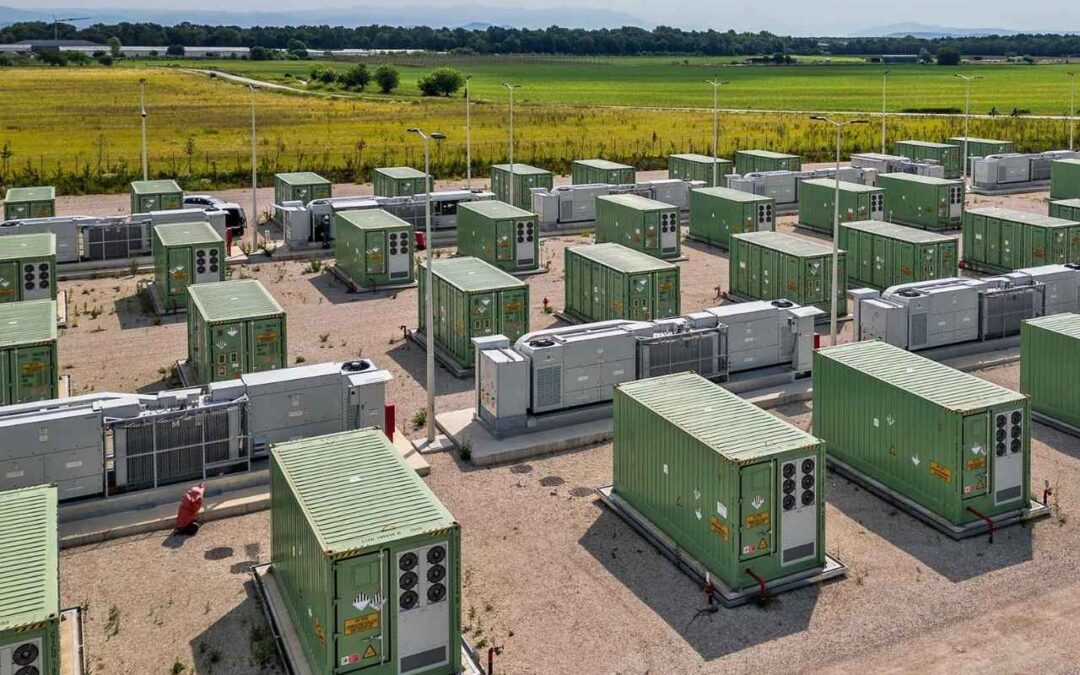
What the headline numbers don’t fully capture is where ACME is actually headed. The company commissioned approximately 2.3 GWh of battery energy storage capacity across three project sites in Rajasthan, one of the largest such deployments in India, operationalized in phases between February and May 2026.
This BESS capacity is already generating a net realization of around ₹2.2 crore per day through tariff arbitrage: buying cheap power during off-peak hours and selling during peak demand windows through merchant and short-term contracts. The round-trip efficiency of the commissioned systems runs between 88 and 90 percent, within the range that makes arbitrage economics work.
This is not a pilot. ACME has secured 4.3 GWh of ROFR grid connectivity grants, has 13-plus GWh of approvals under ROFR in place, and has applied for an additional 4-plus GWh pending approval. The total BESS portfolio target is 20 GWh by 2030. A company that was, until recently, primarily a solar power producer with contracted PPAs is now accumulating dispatchable energy assets that can generate revenue independent of generation cycles.

That distinction matters increasingly in a grid where intermittency is a structural problem and where policy, including recent MNRE and CERC clarifications, is being shaped to allow BESS operators greater commercial flexibility.
Conclusion
The renewable energy story in India is shifting from generation capacity to dispatchable capacity, and ACME appears to be positioning itself ahead of that curve. The solar foundation is solid, but the BESS buildout is the real long-term signal. As grid intermittency becomes a structural challenge and policy frameworks evolve to reward flexibility, the ability to store and dispatch power on demand could redefine what kind of company ACME actually is.
Disclaimer: The views and investment tips expressed by investment experts/broking houses/rating agencies on tradebrains.in are their own, and not that of the website or its management. Investing in equities poses a risk of financial losses. Investors must therefore exercise due caution while investing or trading in stocks. Trade Brains Technologies Private Limited or the author are not liable for any losses caused as a result of the decision based on this article. Please consult your investment advisor before investing.