
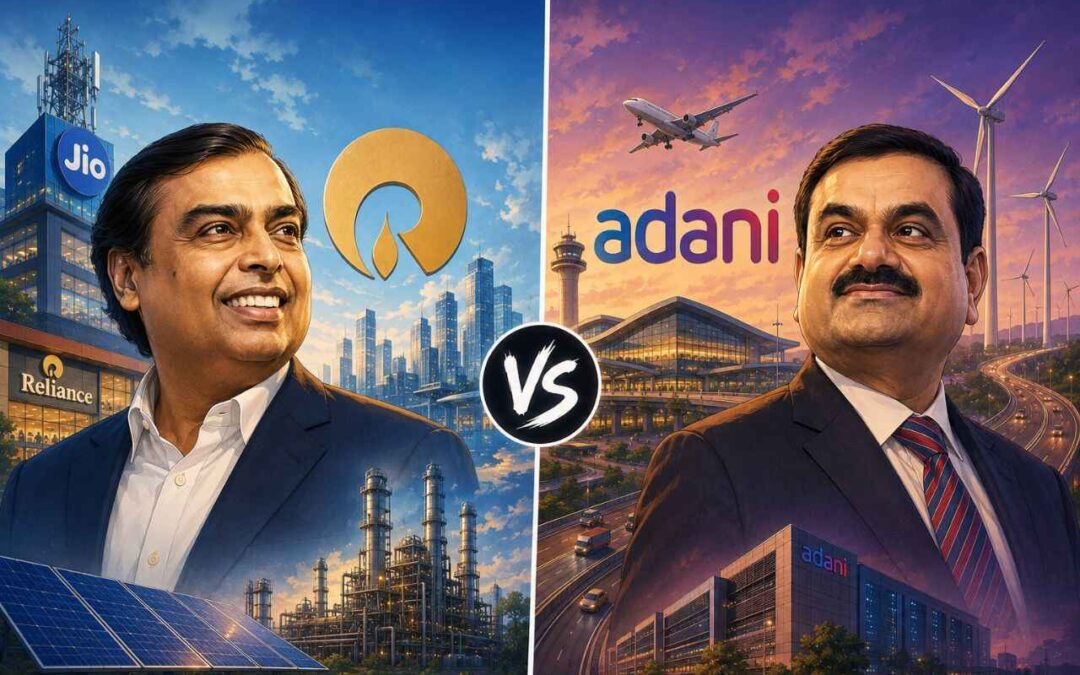
Synopsis: Reliance Industries and Adani Enterprises are building their next phase of growth through very different strategies. While one is expanding through consumer, telecom and energy businesses, the other is scaling large infrastructure platforms across airports, roads, data centres and green hydrogen. Which model could shape the next decade better?
Two of India’s biggest business groups are trying to build the next decade of growth in very different ways. One is using its massive cash-generating base across energy, telecom, retail and new energy, while the other is using an infrastructure incubation model across airports, roads, green hydrogen, data centres, mining and metals.

Reliance Industries and Adani Enterprises both represent large future-facing opportunities, but the nature of the opportunity is not the same. Reliance looks more stable, diversified and already profitable across multiple consumer and energy businesses. Adani Enterprises looks more like a high-growth infrastructure incubator where several large assets are just entering the monetisation phase.
Reliance Industries
Reliance Industries is no longer just an oil and petrochemicals company. The company now operates across Oil-to-Chemicals, Oil and Gas, Jio Platforms, Reliance Retail, FMCG, media and new energy. This makes it one of the most diversified businesses in India, with a mix of cyclical energy earnings and fast-growing consumer businesses.

In FY26, Reliance reported consolidated revenue of Rs. 11,75,919 crore, growing 9.8 percent year-on-year. EBITDA stood at Rs. 2,07,911 crore, rising 13.4 percent, while PAT came in at Rs. 95,754 crore, up 17.8 percent. The key point is that consumer businesses now contribute more than 55 percent of consolidated EBITDA, which reduces Reliance’s dependence on the more volatile energy cycle.
The company’s Q4FY26 performance was more mixed. Revenue rose 12.9 percent year-on-year to Rs. 3,25,290 crore, but EBITDA was almost flat at Rs. 48,588 crore. PAT declined 8.9 percent to Rs. 20,589 crore due to higher finance costs and depreciation, mainly linked to the operationalisation of 5G spectrum assets. So, the top line is still growing, but near-term profitability is being affected by large investments.

Growth Drivers
The biggest growth engine for Reliance is Jio. Jio Platforms ended FY26 with over 524 million subscribers, including more than 268 million 5G users. Its fixed broadband base reached 27 million connections, while JioAirFiber homes stood at 12.9 million. FY26 data traffic rose 30.8 percent to over 241 exabytes, showing that customer engagement continues to grow strongly.
Financially, Jio is already a powerful profit engine. FY26 revenue from operations stood at Rs. 1,46,885 crore, rising 14.6 percent year-on-year. EBITDA increased 18.8 percent to Rs. 76,255 crore, with EBITDA margin expanding to 51.9 percent. PAT rose 15.1 percent to Rs. 30,049 crore. This makes Jio one of Reliance’s cleanest and most visible growth businesses.
Reliance Retail is the second major consumer engine. Retail EBITDA grew 8 percent in FY26 to Rs. 27,034 crore, although growth was muted by soft fashion and lifestyle demand and investments in hyperlocal commerce. The company is scaling JioMart and quick commerce aggressively, with management earlier highlighting a 1.6 million orders run rate. This means retail is investing today to build a stronger digital and physical consumption platform.

The third future bet is new energy. Reliance is building an integrated solar manufacturing chain, including modules, cells, wafers, ingots, polysilicon and glass. The company has already commissioned phase one of its solar module and cell facilities, while wafer, ingot and polysilicon facilities are progressing. The Kutch project is also extremely large, with plans linked to 125 to 150 gigawatt peak solar power generation over time.
What Is Working And What Is Not
The best part about Reliance is that its growth is not dependent on one business. If energy faces pressure, Jio and retail can cushion the impact. This was visible in Q4FY26, where O2C EBITDA fell 3.7 percent and Oil and Gas EBITDA fell 18.1 percent, but Digital Services EBITDA rose 16 percent and Retail EBITDA rose 3 percent.
The O2C business still remains very important. FY26 O2C revenue stood at Rs. 6,62,401 crore, up 5.7 percent, while EBITDA rose 10.1 percent to Rs. 60,546 crore. However, the business faced headwinds from crude premiums, logistics costs, fuel costs, weak downstream chemical margins, under-recoveries in fuel retailing and policy risks like SAED. This shows that O2C can generate huge cash, but it is exposed to global volatility.
Oil and Gas was also weaker, with FY26 EBITDA falling to Rs. 19,050 crore from Rs. 21,188 crore. The Q4 performance was hit by lower KG-D6 gas volumes and weaker prices. This is not the main growth story anymore, but it still matters for cash flows.
Future Opportunity
Reliance’s future opportunity lies in three areas. First, Jio can keep growing through 5G, fixed broadband, AirFiber, higher data usage and digital services. Second, retail can benefit from India’s consumption growth, store expansion, quick commerce and B2B distribution. Third, new energy can become a large manufacturing and power platform if the solar value chain and Kutch project scale successfully.
The risk is that Reliance is already very large, so high percentage growth is harder. The company is also investing heavily, which can keep depreciation and finance costs elevated. O2C and energy volatility can also affect quarterly performance. But overall, Reliance looks like a steadier future opportunity because its growth engines are already visible, profitable and diversified.
Adani Enterprises
Adani Enterprises is very different from Reliance. It is not a mature operating company in the traditional sense. It is the flagship incubator of the Adani Group, built to create new infrastructure businesses, scale them and eventually unlock value through demergers or separate platforms.
AEL’s portfolio spans energy and utilities, transport and logistics, and primary industries. Its key businesses include Adani New Industries, airports, roads, data centres, mining services, integrated resource management, copper and petrochemicals. The company has already built and separated large businesses in the past, and the next generation of opportunities is now focused on green hydrogen, airports, data centres, roads, copper and petrochemicals.
In FY26, Adani Enterprises reported total income of Rs. 1,02,943 crore, up 3 percent year-on-year. EBITDA stood at Rs. 16,464 crore, down 2 percent, while PAT attributable to owners stood at Rs. 9,339 crore, up 31 percent. However, Q4FY26 was weak at the bottom line, with PAT at a loss of Rs. 221 crore, affected by depreciation on recently commissioned assets like Navi Mumbai Airport and the copper plant.
Growth Drivers
The biggest growth driver for Adani Enterprises is the shift in its EBITDA mix. Management said 80 percent of EBITDA now comes from core infrastructure and services businesses. This is important because AEL is moving away from a pure incubation and trading-heavy model towards more mature infrastructure platforms with better earnings visibility.
Airports are the clearest example. Adani Airports operates 8 airports, including the recently commissioned Navi Mumbai International Airport. The platform contributes around 23 percent of India’s passenger traffic and 29 percent of air cargo volume. In FY26, airport total income rose 28 percent to Rs. 13,081 crore, while EBITDA jumped 55 percent to Rs. 5,394 crore. Aero revenue grew 26 percent and non-aero revenue grew 31 percent.
The second growth engine is Adani New Industries, which is linked to the green hydrogen ecosystem. In FY26, ANIL total income rose 9 percent to Rs. 15,563 crore, though EBITDA declined 5 percent to Rs. 4,532 crore. Operationally, module sales rose 15 percent to 4,904 MW, while wind turbine generator sets rose 41 percent to 231. Adani Wind was also highlighted as the only Indian company in BloombergNEF’s global top 15 wind turbine manufacturers list.
Roads are another major opportunity. The Ganga Expressway, described as India’s largest greenfield expressway project, was completed in less than 3.5 years and has a 27-year concession period. Management said Ganga Expressway can significantly add to the road business and earlier indicated it could double the road EBITDA run rate.
What Is Working And What Is Not
What is working for Adani Enterprises is execution. Navi Mumbai Airport has started operations, Ganga Expressway has been completed, the copper plant is moving into contribution phase, AdaniConnex has crossed 55 MW of operational data centre capacity, and the company has tied-up capacity of more than 560 MW after a 358 MW hyperscale order in Hyderabad.
Mining services also provides a stable base. AEL has 18 MDO service agreements with peak capacity of 145 MMTPA. It is currently operating at an annual run rate of nearly 50 MMT from 6 service contracts, and the GP-II mine becoming operational increases the growth potential to 86 MMT annually. FY26 mining dispatch volume rose 14 percent to 49.4 MMT, revenue grew 20 percent to Rs. 4,536 crore and EBITDA rose 18 percent to Rs. 1,986 crore.
But the weak spot is that Adani Enterprises still carries execution, leverage and capex risk. FY26 EBITDA was slightly lower despite growth in airports because established businesses were affected by lower trade volumes and price volatility in IRM and commercial mining. Road income and EBITDA also declined in FY26. The company expects FY27 capex to remain around Rs. 40,000 crore, with major spending in airports, PVC, natural resources, metals, mining and new industries. That means growth is big, but the balance sheet needs to keep supporting it.
Future Opportunity
Adani Enterprises has a clearer near-term trigger than Reliance in some areas. Management expects Navi Mumbai Airport, Kutch Copper and Ganga Expressway to add over Rs. 3,000 crore of EBITDA in the next fiscal year. At peak capacity, these businesses are expected to contribute between Rs. 6,000 crore and Rs. 6,800 crore, with Navi Mumbai alone eventually approaching Rs. 3,000 crore EBITDA over time.
This makes AEL more of a value-unlock story. If the new assets ramp up properly, the company could see a sharp improvement in earnings quality. The business is moving from building assets to monetising assets, which is exactly the phase market usually watches closely in infrastructure companies.
Final Verdict
Reliance Industries looks like a stable, diversified opportunity with already profitable growth engines. Jio is growing strongly, retail is scaling, O2C continues to generate large cash flows, and new energy can become a major long-term optionality. The downside is that Reliance’s size makes fast growth harder, and energy volatility can still affect quarterly numbers.
Adani Enterprises on the other hand comes with higher-risk, higher-growth infrastructure opportunities. Airports, Ganga Expressway, copper, data centres, mining services and green hydrogen can create major value if execution continues well. But it also carries higher capex, debt and ramp-up risk compared to Reliance.
So, if the question is which company looks safer for the future, Reliance Industries has the edge. But if the question is which company can surprise more if large assets start contributing, Adani Enterprises may be the bigger opportunity.
Disclaimer: The views and investment tips expressed by investment experts/broking houses/rating agencies on tradebrains.in are their own, and not that of the website or its management. Investing in equities poses a risk of financial losses. Investors must therefore exercise due caution while investing or trading in stocks. Trade Brains Technologies Private Limited or the author are not liable for any losses caused as a result of the decision based on this article. Please consult your investment advisor before investing.



