
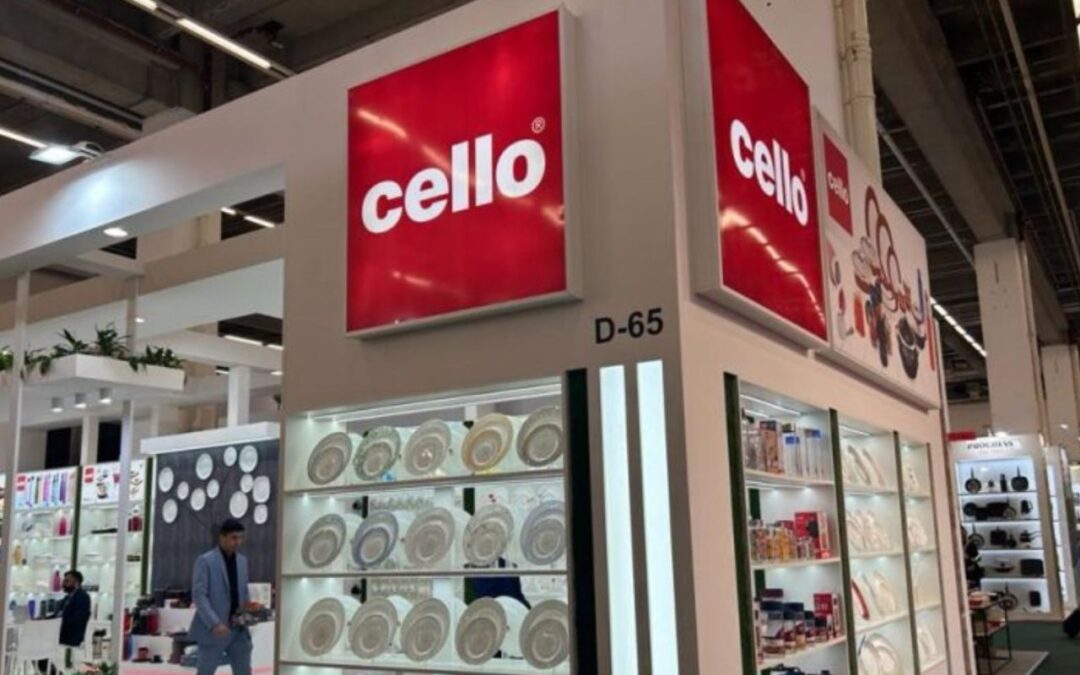
Synopsis: Cello World’s management has outlined 10–12% revenue growth guidance and 2–2.5% EBITDA margin expansion for FY27, anchored by the ramp-up of its newly commissioned steelware and glassware units, the full integration of the Cello pen brand, and a deliberate working capital cleanup while cautioning that Q1 will be a soft patch as the market absorbs 12–20% MRP increases across product lines.
Cello World’s investor call for FY26 results offered an unusually detailed window into management’s thinking on the year ahead segment-by-segment capacity targets, cash deployment philosophy, and an unambiguous near-term caution on Q1. The market is already registering discomfort: the stock has fallen 36 percent over the past year even as the business continues to generate healthy cash flows and industry-leading return ratios.

The shares of Cello World Limited were trading at Rs. 386.05 per share, against a 52-week range of Rs. 365 to Rs. 674. The company’s market capitalisation stands at Rs. 8,527.27 crore, with a P/E of 25.32.
FY27 Guidance
Management is guiding for 10–12% consolidated revenue growth in FY27. On a TTM revenue base of Rs. 2,259 crore, this implies a target range of roughly Rs. 2,485–2,530 crore for the full year. The guidance, management noted, is subject to movement depending on how macroeconomic headwinds resolve over the course of the year.

More significant for the market will be the margin trajectory. EBITDA margins are expected to expand by 200–250 basis points from current levels, with the consumerware segment potentially delivering up to 300 basis points of improvement. The margin recovery is being underwritten by three parallel drivers: the scaling of new steelware and glassware manufacturing lines, and the integration of the Cello pen brand which management expects to add approximately 100 basis points of margin on its own. TTM operating margins currently stand at 21 percent; the FY27 target would push them back toward the 23–24 percent zone the company historically operated in.
Capex for FY27 is pegged at Rs. 100 crore, predominantly maintenance-oriented. Of this, approximately Rs. 30 crore is earmarked for the steelware division and building infrastructure, reflecting that the heavy-investment phase for the newer units is now largely behind the company.

Segment Playbook
The writing instruments division carries management’s most ambitious numerical target Rs. 500 crore or more in FY27 revenues. Having acquired full control of the Cello pen brand in December 2025 (following a November deal), the company is now working to leverage its brand equity alongside the legacy Unomax franchise. The product mix strategy is shifting away from heavy dependence on the Rs. 10 price point toward Rs. 12, Rs. 15, and Rs. 20 segments, and the portfolio is being extended into adjacent categories including markers, sketch pens, and crayons.
The business is structurally seasonal Q1 and Q4 (January through June) represent the majority of annual revenue in this division, a pattern that will influence quarterly comparisons through the year.
The glassware plant, now just past its first year of operations with a ten-year furnace lifespan, has a calculated peak revenue potential of Rs. 300 crore. Once optimal utilisation is reached, management projects 28–30 percent EBITDA margins from this segment making it one of the highest-margin assets in the portfolio. The near-term challenge is Chinese import dumping, which has pressured glassware profitability; the company is actively engaging with authorities on anti-dumping protections to create a more level operating environment.

The stainless steel bottle division represents the other Rs. 300 crore capacity addition. Following partial operationalisation in early 2026, a phased rollout of four production lines in early FY27 followed by two additional lines will culminate in full-scale production by July 2026. A notable design feature of this business is its flexibility: new lines can be commissioned in a matter of months, allowing the company to scale beyond the current capacity ceiling quickly if demand so warrants.
On opalware, the plant is running at 85 percent utilisation. Given competitive intensity and recent price wars in the category, management’s immediate priority is exhausting the remaining 15 percent capacity before committing to expansion. Future capacity growth will come from a greenfield facility at the company’s Rajasthan hub, as brownfield expansion at the existing location is physically impossible due to space constraints. The recently completed merger of Wimplast Limited also brings moulded furniture under the consolidated structure, and the focus here is on extracting distribution and operational synergies with the consumerware business.
Working Capital and Cash Allocation
Debtor days, currently at 112, are a visible pressure point working capital days have expanded from 127 to 184, flagged as a concern even by Screener’s automated analysis. Management is targeting a reduction of 10–15 days in the receivables cycle, aiming to return to the historical threshold of under 100 debtor days. The levers include tighter channel inventory discipline, SKU rationalisation to reduce distributor holding complexity, and selective promotional discounts to clear slow-moving stock.
On capital allocation, Cello has explicitly ruled out share buybacks. The preference is to preserve cash for inorganic growth M&A in adjacent segments where distribution or manufacturing synergies are evident.
Q1 Warning
Management was direct about near-term conditions. Cello has implemented 12–20 percent MRP increases across product lines to pass through raw material, energy, and labour cost inflation. Channel partners are purchasing cautiously as the market digests the new pricing. Crude and polymer markets remain volatile due to ongoing geopolitical disruptions, though management expects raw material costs to peak and ease in the second half of the year.
Business Overview
Cello World is a multi-category consumer products company spanning writing instruments, consumer housewares (including opalware, glassware, and steelware), and moulded furniture. It is nearly debt-free, with borrowings of just Rs. 5 crore as of March 2025. Promoter holding stands at a stable 75 percent. Three-year ROCE averages a healthy 36 percent.
Disclaimer: The views and investment tips expressed by investment experts/broking houses/rating agencies on tradebrains.in are their own, and not that of the website or its management. Investing in equities poses a risk of financial losses. Investors must therefore exercise due caution while investing or trading in stocks. Trade Brains Technologies Private Limited or the author are not liable for any losses caused as a result of the decision based on this article. Please consult your investment advisor before investing.