

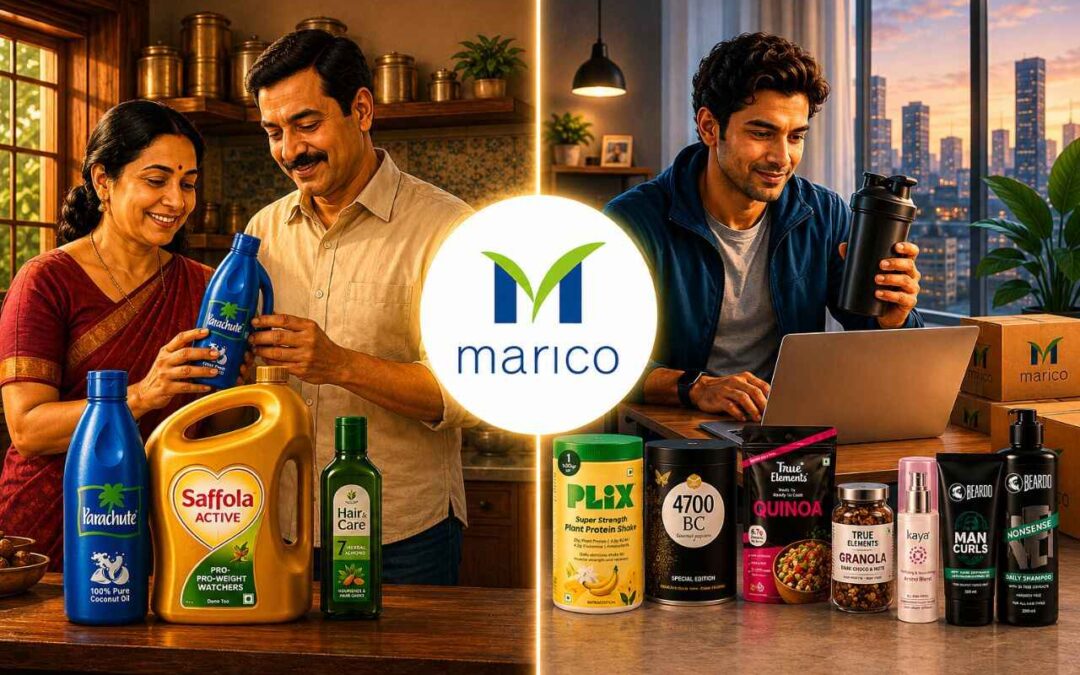
Synopsis: Marico is trying to move beyond its coconut oil and edible oil image by building new growth engines in foods, personal care and digital-first brands. The company wants to cross Rs. 20,000 crore revenue by FY30, but margins and execution remain key monitorables.
An old FMCG giant is trying to become relevant for a younger consumer base by moving beyond its traditional oil-led portfolio and building newer engines across foods, protein, beauty and digital-first brands. The idea is not to abandon its old cash-generating brands, but to use them as a base to fund the next phase of growth.

Marico Limited, the company behind brands such as Parachute, Saffola, Livon, Beardo, Plix, True Elements, 4700BC, Cosmix, Kaya and Just Herbs, ended FY26 with consolidated revenue of Rs. 13,611 crore, up 26 percent from Rs. 10,831 crore in FY25. EBITDA rose 9 percent to Rs. 2,328 crore, while recurring PAT increased 11 percent to Rs. 1,762 crore. However, EBITDA margin declined from 19.7 percent in FY25 to 17.1 percent in FY26, showing that the transformation is still being tested by input cost pressure.
The Old Marico Still Matters
The old Marico is built around highly trusted household brands. Parachute Coconut Oil, Saffola Edible Oils and Value Added Hair Oils remain the backbone of the India business. In Q4FY26, Parachute Coconut Oil contributed 36 percent of India revenues, Saffola Edible Oils contributed 17 percent and Value Added Hair Oils contributed 18 percent.

This legacy business is not weak. It is the reason Marico has pricing power, distribution strength and cash flow to invest in new categories. In FY26, India business volumes grew 8 percent, the highest in seven years, while India business revenue grew 28 percent. During Q4FY26, India business volume growth stood at 9 percent and revenue grew 21 percent.
Parachute remained resilient despite earlier pricing pressure. After adjusting for ml-age reductions, Parachute delivered low-single digit volume growth in Q4FY26. Copra prices corrected around 35 percent from peak levels, allowing selective pricing benefits to be passed on to consumers.

Value Added Hair Oils was one of the stronger pieces of the portfolio. The segment delivered robust growth in Q4FY26, supported by low-20s volume growth and market share gains. For the full year, the portfolio grew 20 percent, led by momentum in mid and premium segments outside Shanti Amla. Saffola Edible Oils remained steady, but the company continued to focus on threshold profitability instead of chasing every bit of volume.
Why Marico Wants To Become Younger
Coconut oil and edible oils are large, trusted and profitable categories, but they are also commodity-linked. In FY26, material cost as a percentage of revenue rose from 49.7 percent in FY25 to 55.5 percent. This is why EBITDA margin fell even though revenue growth was strong.
Marico wants to reduce the share of commodity-linked businesses from more than 70 percent to around 50 percent over a decade. That is the real meaning of the company trying to become “young” again. It wants a bigger part of revenue to come from categories where branding, innovation, digital reach and premium positioning matter more than raw material cycles.

This transformation is already visible. Foods and Premium Personal Care, including digital-first brands, now account for 23 percent of the India business. Marico expects this share to rise to about 27 percent in FY27 and eventually move to nearly one-third of India revenues by FY30.
The New Marico: Foods, Protein And Snacking
Foods is one of the biggest parts of Marico’s reinvention. The Foods portfolio crossed Rs. 1,000 crore revenue in FY26 and delivered 16 percent value growth in Q4FY26. Earlier, the company had paused growth in some areas to improve profitability, but it now expects to resume faster scale-up from FY27.
This portfolio is no longer just Saffola Oats. Marico now has a wider food basket covering mainstream health and wellness through Saffola, clean label breakfast and snacking through True Elements, premium gourmet snacking through 4700BC and functional nutrition through Cosmix and Plix.
The 4700BC acquisition gives Marico an entry into premium snacking. The brand is known for popcorn and has offerings such as popped chips, makhana, crunchy corn and nachos with avocado oil. Management earlier said the brand was clocking around Rs. 140 crore ARR and sees potential to scale its ARR three times over the next three years. Since 4700BC has limited retail presence today, Marico has room to use modern trade, e-commerce and distribution to widen the brand’s reach.
Cosmix gives Marico exposure to plant protein, gut-friendly nutrition, supplements and functional foods. Management earlier described it as a brand with proven D2C economics, Rs. 100 crore ARR and high-teen EBITDA margin. This is a very different customer from the traditional coconut oil buyer. It targets consumers who care about protein, wellness and cleaner labels.
True Elements gives Marico exposure to the clean-label breakfast and healthy snacking market and forms an important pillar of the company’s food strategy. Management describes the brand as its platform for clean-label and modern breakfast and snacking products, complementing Saffola’s mainstream health and wellness positioning.
Through categories such as muesli, granola, oats, nuts, seeds and healthier snacks, True Elements helps Marico target urban consumers who are becoming increasingly conscious about nutrition, ingredient quality and healthier lifestyles.
Premium Personal Care Is The Beauty Bet
The second major youth engine is Premium Personal Care. Marico is building this through brands such as Beardo for male grooming, Plix offers plant-based personal care, Kaya offers dermatologist backed solutions, Just Herbs for ayurveda inspired beauty, serums, male grooming and skincare. The portfolio comprising serums, male grooming and skincare exited FY26 at more than Rs. 350 crore ARR. The broader digital-first Premium Personal Care portfolio exited FY26 at more than Rs. 1,100 crore ARR.
Beauty and grooming categories are more suited to younger, digital consumers. They are influenced by social media, online reviews, quick commerce availability and product innovation. Marico’s core advertising spends are also shifting in that direction, with 55 percent now going towards digital media, while digital brands spend entirely on digital.
Management said it looks for product-market fit, category attractiveness, healthy unit economics, founder mentality and scalability. It is now targeting profitable brands with at least Rs. 100 crore to Rs. 150 crore scale, where Marico can use its platform to grow them faster.
Beardo and Plix are the proof points management keeps highlighting. Beardo has scaled five times after coming fully into Marico in 2020, while Plix has grown six times in two years. The company expects its digital-first portfolio to exit FY27 at double-digit EBITDA margin and reach teen EBITDA margins by FY30.
International Business Adds Another Growth Layer
Marico is also trying to become younger outside India. The international business delivered 20 percent constant currency growth in FY26, the highest in 14 years, while Q4FY26 growth stood at 19 percent. Bangladesh continued to remain strong, while Vietnam, South Africa and exports are becoming important growth engines. In Vietnam, the company is building a digital beauty and personal care play through brands such as Candid, Astroman and Lashe. Management said Candid, which forms roughly two-thirds of the Skinetiq business, is scaling in the science-based skincare segment with mid-premium positioning and mid-20s EBITDA.
Beyond Vietnam, Marico is also trying to replicate its digital-first playbook in the Middle East. Management highlighted markets such as the UAE and Saudi Arabia, which have some of the highest smartphone penetration rates globally. The company aims to build leadership in digital beauty and grooming across these markets, using the same model of premium brands, social commerce and digital-first consumer engagement that it is deploying in India and Vietnam.
The Road To FY30
Marico’s FY26 numbers show both strength and pressure. Margins remain the concern. Material cost rose 40 percent in FY26, much faster than revenue growth. EBITDA margin declined by 265 basis points for the full year and 114 basis points in Q4FY26. This shows that the company’s old commodity-linked structure still has a major influence on profitability.
For FY27, management expects high single-digit volume growth in India, mid-teen constant currency growth in international business, double-digit consolidated revenue growth, revenue crossing Rs. 15,000 crore and high-teen EBITDA growth, subject to stable macros. By FY30, the company aims to comfortably cross Rs. 20,000 crore revenue and aspire for mid-teen EBITDA growth.
Marico is not trying to become a completely new company. It is trying to make sure its old brands remain strong while new categories become large enough to change the growth profile. The legacy business gives stability, while foods, protein, snacking, beauty, grooming, digital brands and international premiumization are expected to bring youthfulness.
Commodity volatility, margin pressure, Saffola’s pricing environment and acquisition integration will remain key monitorables. If Marico executes well, the FY30 company may look very different from the coconut oil-led FMCG company investors have known for years.
Disclaimer: The views and investment tips expressed by investment experts/broking houses/rating agencies on tradebrains.in are their own, and not that of the website or its management. Investing in equities poses a risk of financial losses. Investors must therefore exercise due caution while investing or trading in stocks. Trade Brains Technologies Private Limited or the author are not liable for any losses caused as a result of the decision based on this article. Please consult your investment advisor before investing.


