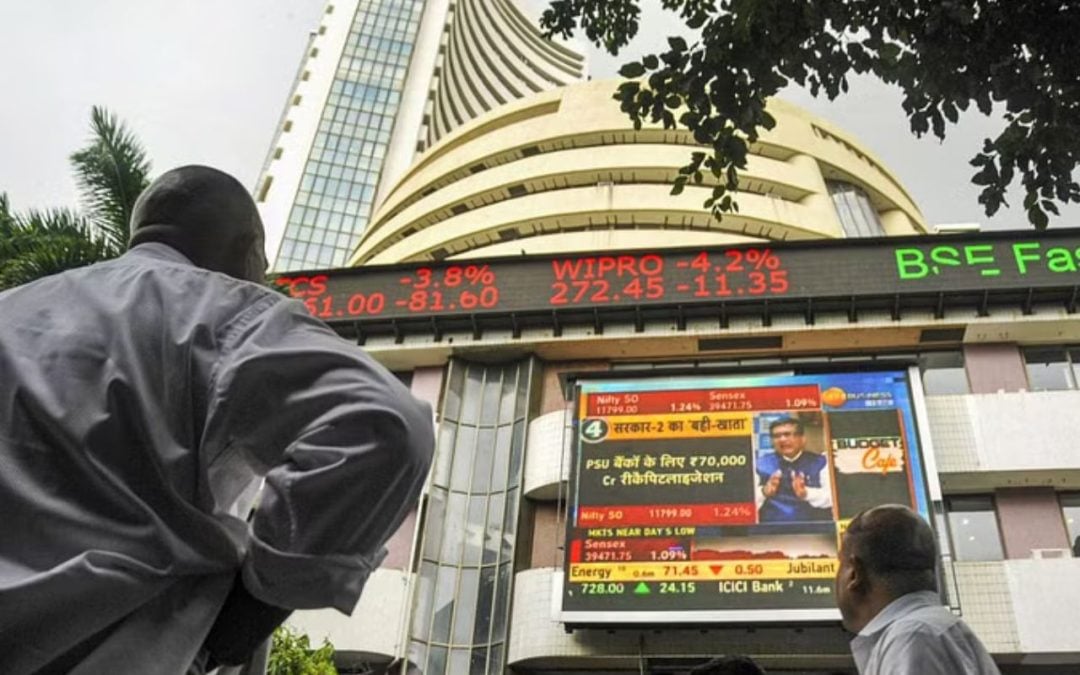
Synopsis: The share market declined sharply as rising Middle East tensions, surging crude oil prices, heavy FII selling, and weak investor sentiment weighed on benchmark indices.
Indian stock markets witnessed sharp selling pressure on Monday, with benchmark indices falling more than 1 percent in early trade as investors reacted to rising geopolitical tensions, surging crude oil prices, and sustained foreign fund outflows. The weakness was broad-based, with banking, financial, and heavyweight stocks leading the decline.

Investor sentiment remained fragile amid renewed uncertainty in the Middle East, while higher oil prices raised concerns over inflation and India’s import bill. At the same time, continued selling by foreign institutional investors and cautious market positioning following the RBI’s latest economic projections added to the risk-off mood, dragging benchmark indices lower.
Index under pressure: Indian equity benchmarks witnessed a sharp decline in early trade, reflecting weak investor sentiment. The Nifty 50 fell to an intraday low of 23,070.15, down about 1.2 percent from Friday’s closing level of 23,366.70. Meanwhile, Bank Nifty dropped to a low of 54,195.20 from its previous close of 54,781.60 points, as broad-based selling pressure impacted both frontline and banking stocks.

Key factor that might be fueling the sell-off today
Escalating Middle East Tensions: US President Donald Trump urged Israeli Prime Minister Benjamin Netanyahu not to retaliate against Iran’s latest missile barrage, warning that any military response could jeopardize ongoing negotiations aimed at securing a peace deal and ending the three-month-long conflict. According to reports, Trump also pressed Iran to return to the negotiating table and emphasized that Washington is close to reaching an agreement.
The appeal came after Iran launched missiles at Israel on Sunday, marking the first major escalation since a fragile ceasefire took effect in early April. The renewed hostilities have raised concerns about a return to intense fighting and complicated diplomatic efforts to end the war. Iran’s state broadcaster confirmed the missile launches, while Tehran shut its western airspace in anticipation of a possible Israeli response.

Gold Declines as Dollar Strengthens: Gold prices witnessed sharp selling pressure on Monday, with MCX gold August futures declining 1.27 percent to Rs 1,53,695 per 10 grams and MCX silver July futures falling 2.35 percent to Rs 2,42,763 per kg. In the international market, gold slipped nearly 0.7 percent to around $4,300 per ounce as investors assessed renewed geopolitical tensions after Israel announced military strikes on targets in Iran, extending the precious metal’s weakness following last week’s nearly 5 percent decline.
Heavy FII Selling Pressure: Foreign institutional investors remained net sellers, offloading equities worth around Rs 8,776 crore on Friday, extending their recent selling trend and adding pressure on domestic markets. While domestic institutional investors provided support by purchasing Rs 9,133 crore worth of equities, cautious investor sentiment following the RBI’s latest inflation and growth projections limited the impact of these inflows and weighed on benchmark indices.
Surging Crude Oil Prices: Crude oil prices surged over 3.5 percent on Monday as escalating tensions in West Asia heightened concerns over potential supply disruptions. Brent crude climbed to $96.39 per barrel, while WTI crude rose to $93.76 per barrel. The spike in oil prices is negative for India, as higher crude costs can increase inflationary pressures, widen the trade deficit, and weigh on market sentiment.

Disclaimer: The views and investment tips expressed by investment experts/broking houses/rating agencies on tradebrains.in are their own, and not that of the website or its management. Investing in equities poses a risk of financial losses. Investors must therefore exercise due caution while investing or trading in stocks. Trade Brains Technologies Private Limited or the author are not liable for any losses caused as a result of the decision based on this article. Please consult your investment advisor before investing.