

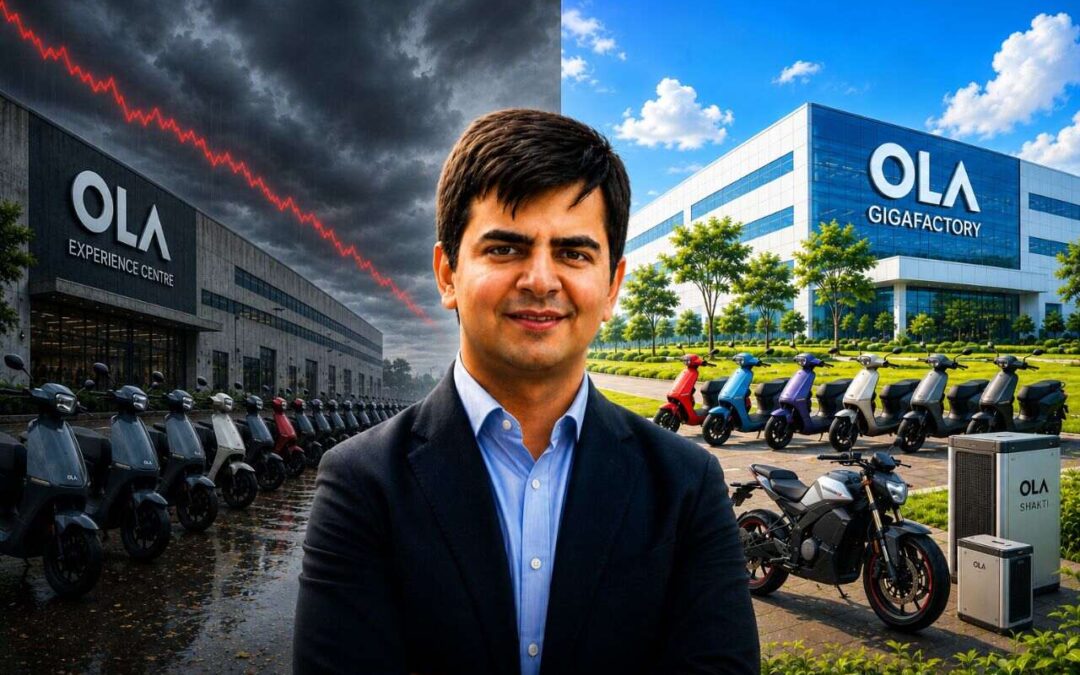
Synopsis: Ola Electric was once India’s EV market leader, but falling sales, service challenges and a collapsing share price have raised serious questions about its future. Yet behind the struggles lies a much bigger bet on batteries, motorcycles and energy storage. Can this ambitious strategy help Ola reach Rs. 150 again?
India’s electric two-wheeler market has moved from excitement to execution. A few years ago, the story was simple: electric scooters were growing fast, fuel prices were high, and new-age EV companies were expected to disrupt traditional two-wheeler giants. But as the market matured, the focus changed from hype to hard questions: Can companies scale profitably? Can they service customers properly? Can they survive without burning too much cash?

Ola Electric Mobility was once the biggest symbol of that EV excitement. The company built a strong brand, expanded rapidly and became one of the most visible names in India’s electric scooter market. However, after a sharp decline from its post-listing highs, the stock now trades in the Rs. 45-47 range. With the share price far below its earlier levels, the big question now is simple, can Ola Electric ever reach Rs. 150 again? The answer depends less on the chart and more on whether the company can convert its large EV and battery ambitions into actual revenue, cash flow and trust.
A Company In Reset Mode
FY26 was not a normal year for Ola Electric. Management itself called it a “reset” year. This is important because the company is no longer presenting itself as only a scooter company. It is now trying to become an integrated electric mobility, battery cell and energy storage platform.

For FY26, Ola reported consolidated revenue of Rs. 2,253 crore with 1,73,794 deliveries. The number looks weak when compared with FY25 revenue of Rs. 4,514 crore. In simple terms, the company’s revenue nearly halved during the year. That is the biggest reason why the stock lost investor confidence.
Q4 FY26 was even weaker on volume. Consolidated revenue stood at only Rs. 265 crore, with 20,256 deliveries. This was a low-volume quarter, and management clearly accepted that volumes were lower than where they wanted them to be. However, the company also argued that while the top line was weak, the underlying business fundamentals improved.

This is the central contradiction in Ola’s story today. On one side, sales and revenue fell sharply. On the other side, gross margins, service metrics, opex and cash flow improved. So the market is not just looking at one number. It is trying to decide whether this is a broken growth story or an early-stage turnaround.
The Big Positive: Margins Improved Sharply
The strongest number in Ola’s FY26 story is gross margin. In Q2 FY26, the company reported gross margin of 30.7 percent. In Q3, it improved to 34.3 percent. By Q4 FY26, consolidated gross margin reached 38.5 percent, while gross margin excluding PLI stood at 33.5 percent.
This is a major improvement. It shows that Ola’s vertical integration strategy is working at the product economics level. The company makes or controls several key parts of the EV stack, including batteries, electronics, software and now cells. Management believes this gives Ola a structural cost advantage.

Gen 3 also appears to be important here. In Q2, management said the scooter portfolio had largely moved to Gen 3, and later indicated that all sales had shifted to the newer platform. Gen 3 is supposed to improve quality, reduce warranty cost and improve margins. Warranty cost also supports this claim. Ola’s warranty cost fell from Rs. 555 crore in FY25 to Rs. 59 crore in FY26.
So if the question is whether Ola has a better cost structure than before, the answer is yes. But if the question is whether margins alone can take the stock back to Rs. 150, the answer is no. Margins matter only if volumes come back.
What Went Wrong: Volumes And Service
The biggest damage to Ola’s story came from service and volume weakness. In Q3, management accepted that service execution gaps had impacted brand trust among prospective customers. The company said this was more of a service scale issue rather than a product quality issue, but for customers and investors, the distinction does not matter much. If buyers are worried about service, sales suffer.
That is exactly what happened. Q2 FY26 deliveries were around 52,000 units. Q3 deliveries fell to 32,680 units. Q4 deliveries dropped further to 20,256 units. For a company built on scale, this decline was painful.
The company’s rapid retail and service expansion created complexity. Management later chose to realign its retail footprint, cost structure and operating model instead of chasing short-term volumes. This may be sensible from a long-term perspective, but it also shows that the earlier expansion model had stress points.
Ola has now shown improvement in service metrics. Average service turnaround time reduced sharply, same-day closures improved and parts pendency came down. Management also said that Gen 3 is reducing service demand at the product level. But brand trust takes time to rebuild. One or two quarters of improvement may not be enough.
The Hidden Story: Ola Is Becoming A Battery Company
The most important takeaway from Ola’s recent disclosures is the scale of its battery ambitions. While the company is widely viewed as an electric scooter manufacturer, management has continued investing heavily in cell manufacturing and energy storage alongside its vehicle business. The contrast between the Cell segment’s current revenue and its asset base highlights how important this business could become in Ola’s long-term strategy.
In FY26, the Automotive segment generated Rs. 2,245 crore of revenue, while the Cell segment generated only Rs. 20 crore. But the asset base tells a very different story. Automotive segment assets stood at Rs. 4,798 crore, while Cell segment assets were already Rs. 3,062 crore.
This means Ola has invested heavily in a business that is still at a very early revenue stage. The cell business is not yet meaningful in the P&L, but it is already meaningful on the balance sheet.
The Gigafactory is central to this strategy. In Q2, management said it had commissioned 2.5 GWh capacity and planned to scale toward 5.9 GWh by March. In Q3, the company said it had entered commercial production, with vehicles using its 4680 Bharat Cell. Management also indicated that the cell roadmap would move from 4680 to future cell formats with better energy density and fast-charging performance.
The logic is simple. Ola wants its own cells to reduce cost, improve range and control supply. Its vehicles create captive demand for the Gigafactory. The same cell technology can also support energy storage products like Shakti and Mahashakti.
This is the real bull case. If Ola becomes a serious battery and energy storage player, the stock can be valued very differently. But right now, the cell business is still a promise, not a proven profit engine.
Roadster, Shakti And The Next Growth Engines
Ola is also trying to move beyond scooters. Roadster is the company’s electric motorcycle platform. Management said motorcycles are India’s largest two-wheeler category, but EV penetration remains very low. Ola said it has more than 50 percent market share in electric motorcycles and bikes contributed 15 percent of April gross orders.
This sounds strong, but investors should remember that the electric motorcycle market is still very small. So 50 percent share in a small market does not yet mean large revenue. Still, Roadster can become important if electric motorcycles grow the way electric scooters grew earlier.
The other growth area is energy storage. Ola launched Shakti as a residential battery energy storage product using its in-house 4680 cells. Management said Shakti can target homes, small businesses, rooftop solar users and inverter replacement demand. Mahashakti is expected to target larger energy storage use cases.
This makes Ola’s strategy very ambitious. The company wants scooters, motorcycles, cells and storage to work together. But this also creates execution risk. Each of these businesses is difficult on its own. Doing all of them together requires capital, discipline and patience.
Can Ola Reach Rs. 150 Again?
For Ola to reach Rs. 150 again, three things must happen. First, the auto business must stabilize. Revenue cannot keep falling. The company has guided for Q1 FY27 consolidated revenue of Rs. 500 crore to Rs. 550 crore and 40,000 to 45,000 orders. If this recovery sustains, the market might start believing that the worst is over.
Second, the operating leverage story must play out. Ola reduced consolidated opex from Rs. 844 crore in Q4 FY25 to Rs. 428 crore in Q4 FY26, and management expects opex to reduce further toward Rs. 350 crore per quarter. With gross margins above 35 percent and lower fixed costs, management says adjusted operating EBITDA breakeven is possible at 20,000 to 25,000 units per month. If volumes recover, losses can reduce quickly.
Third, the battery business must start generating meaningful revenue. Today, the biggest mismatch is clear: Cell assets are above Rs. 3,000 crore, but FY26 cell revenue was only Rs. 20 crore. Until this gap narrows, the battery story remains more vision than financial proof.
The recent QIP also shows why execution matters. Ola raised Rs. 780.24 crore through a qualified institutions placement at Rs. 35.86 per share. This gives the company breathing room, but it also increases equity base. The market will now want to see whether this capital helps Ola scale, or simply supports another phase of losses.
In short, Ola can reach Rs. 150 again, but not with the current financial profile. It needs a clear recovery in vehicle volumes, stable service quality, lower cash burn, better utilisation of the Gigafactory and real revenue from cells and storage.
The company has built a powerful platform. But the market will not reward capacity alone. It will reward execution. Ola’s future is no longer about whether it can make EVs. It is about whether it can sell, service and scale them profitably while turning its battery ambition into a real business.
Disclaimer: The views and investment tips expressed by investment experts/broking houses/rating agencies on tradebrains.in are their own, and not that of the website or its management. Investing in equities poses a risk of financial losses. Investors must therefore exercise due caution while investing or trading in stocks. Trade Brains Technologies Private Limited or the author are not liable for any losses caused as a result of the decision based on this article. Please consult your investment advisor before investing.



