
Synopsis: A dwindling pharma company, written off after a horrific year, unexpectedly lit up as Unichem rose 15.21% to Rs. 437.40 on 10 June 2026 and was followed by a 15% positive circuit today, with the price of Rs. 500 plus on a huge surge in volume even as the Sensex and Nifty sank. Unichem itself did not issue one big press release. The true trigger is one level up—at its parent Ipca—and purchasers were chasing a turnaround tale with a number the market hadn’t forgotten: ₹440.
After a year of declining, Unichem climbed from Rs. 356.9 (8 June) to Rs. 437.40 (10 June) — approximately 22 percent positive in two sessions, with a 15.21 percent advance on 10 June alone, when it was among the NSE’s best gainers. It came with an extraordinarily heavy volume, particularly on a bad day for the market. Suddenly, a stock everyone had given up on saw a surge of purchasers.

The trigger was not a Unichem file but the parent company’s roadmap. Ipca Laboratories, which acquired control of Unichem in 2023, holds a 52.67 percent stake in the company.
Ipca put out FY27 forecasts on June 9, 2026, and, critically, spelt out how it planned to solve Unichem. The next day, the markets made the connections and re-rated the inexpensive, oversold subsidiary. Here’s the simple conversion maths Ipca laid out on the table:

Margins to nearly double
Unichem’s operating margin (EBITDA margin – profit from core activities as a percentage of sales) stands at approx 8 percent currently and is predicted to rise to 12-13 percent in FY27. A higher margin equals higher profit from identical sales. – IPCA is closing down an expensive factory plant in Ireland and moving production to India, which may lead to yearly savings of Rs. 40-50 crore. That gets to the bottom line nearly directly. The agony is mostly behind: The huge one-off “integration” and technology-transfer expenditures that wrecked prior quarters (Rs 10-12 crore in Q4 FY26 alone) are mostly spent—so future quarters should be cleaner.
Management has indicated a GST return of Rs 280 crore and monetisation of 3.5 acres of Unichem land in Jogeshwari, Mumbai – assets that are not reflected in the share price. The message to investors, taken together, was: “the worst is over, and there’s hidden value inside.”

What caused this reaction in the stock?
First, the stock was extremely oversold, down over 39 percent in a year to multi-year lows, and sellers were fatigued. When good news strikes a company like that, the short-sellers hurry to purchase it back (called ‘short-covering’), which adds to the momentum.
The second is an anchor that the market remembers. When IPCA took over, it made an open offer to public stockholders at Rs. 440 per share. Since then, the stock has sunk to Rs 357 – a long way off from what the controlling owner himself paid.
The stock hit a high of ₹437 on 10 June, almost returning to the ₹440 reference price. For value buyers, paying less than the promoter paid for a firm that the promoter is actively fixing is an easy thesis.

And so yet, there has been no one single identifiable block deal announced for these two sessions, so the surge appears like broad-based buying rather than one huge identified buyer, a mix of value/turnaround investors, short-covering and momentum traders flocking into a top gainer.
Already, domestic mutual funds own around 9 percent of Unichem, and the institutional turnaround story (from the parent’s own supervision) is precisely what attracts that money.
The “huge volume” is the hallmark of numerous hands altering the stock at once on a re-rating day, not on existing data, a quiet, solitary accumulator. If there is a bulk/block-deal disclosure on 9-10 June then that would narrow this down – worth looking at the exchange bulk-deal data, which hasn’t been published.
Company Overview
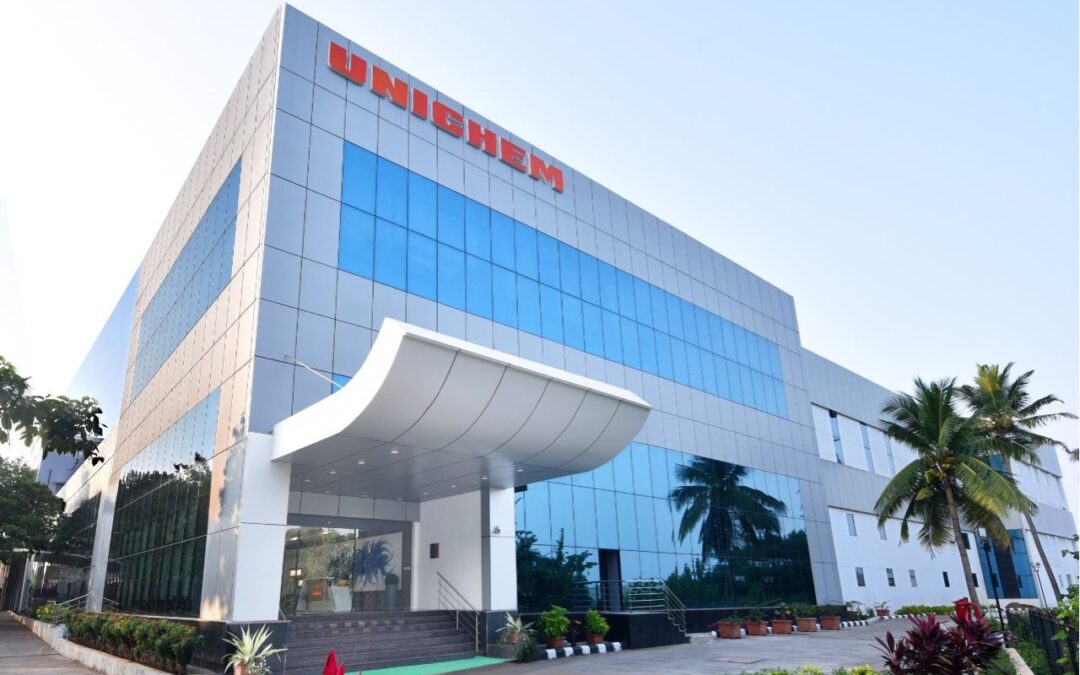
Unichem, established in 1944 and based in Mumbai, has 3,142 employees and five plants, and it produces two main products: APIs – the active compounds in medications – and completed formulations (tablets/capsules) are sold mostly to overseas markets, especially US generics. IPCA bought it after years of losses to get back into the US generics market and feed its own pipeline. Unichem, Ipca’s export and API engine that has been running hot and unprofitable, is being re-tuned presently.
The catch, which the bulls are missing, is that the “cheap P/E” is more of a fantasy than reality. Unichem’s stated P/E looks low, but that is because the Dec-2025 quarter had a big one-off gain (net profit of Rs 264 crore vs just Rs 11 crore next quarter). That strips out, and regular earnings, which are minimal, thus the stock is not as inexpensive as the headline multiple suggests.
Weak quarter: Q4FY26 net profit declined 79 percent to ₹10.9 crore on flat-to-lower sales. – The turnaround is a guideline, not results to date. Margins going from 8 percent to 13 percent, the Ireland savings, the GST refund and the land sale are promises they need to prove up in actual statistics.
What to watch next
- Quarterly proof – is the EBITDA margin really moving up to 12-13 percent?
- Cash events – Rs. 280 crore GST return plus Jogeshwari land sale in real cash flow.
- Merger/Delisting effort – Integration is happening with Ipca at 52.67 percent and any effort to fully absorb or delist Unichem will re-rate it to a buyout value.
- Bulk-deal/shareholding data – to confirm whether the volume is being driven by institutions.
The near-certain aspect is minor but real: Unichem is a fixable asset inside a respectable parent, was selling below the ₹440 the promoter itself paid, and just got a clear “worst-is-over” roadmap — enough to trigger a quick, high-volume bounce in an oversold company.
The whole bull case is questionable – every rupee of upside is dependent on guidance converting to deliverable margins and real cash from the GST return and land. The rise is a re-rating of hope and backed by a plan – powerful in the near term, but the proof is only in the following few quarterly outcomes. “Buyers are paying today for a turnaround that hasn’t happened yet.
Disclaimer: The views and investment tips expressed by investment experts/broking houses/rating agencies on tradebrains.are their own and not that of the website or its management. Investing in equities poses a risk of financial losses. Investors must therefore exercise due caution while investing or trading in stocks. Trade Brains Technologies Private Limited or the author are not liable for any losses caused as a result of the decision based on this article. Please consult your investment advisor before investing.



