
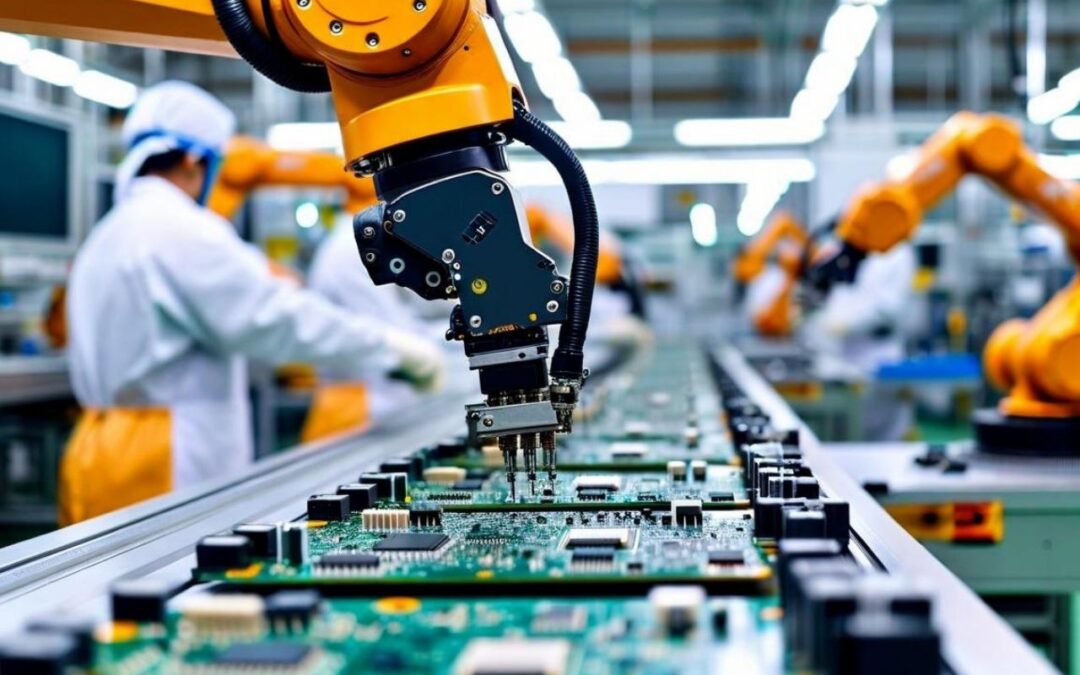
Synopsis: The global “China+1” strategy is accelerating as multinational companies look to diversify supply chains and reduce dependence on China. India has emerged as one of the biggest beneficiaries of this shift, supported by government incentives, rising manufacturing capabilities and a large domestic market. Companies operating in electronics manufacturing and industrial supply chains could be among the key beneficiaries of this long-term trend.
Global manufacturers have increasingly been adopting the China+1 strategy, which involves diversifying production bases beyond China to reduce geopolitical, supply-chain and cost-related risks. India has emerged as a major alternative manufacturing destination due to supportive government policies, Production Linked Incentive (PLI) schemes, improving infrastructure and a growing skilled workforce.

According to government estimates, India aims to increase manufacturing’s contribution to GDP from around 17 percent currently to 25 percent over the coming years. The country has also attracted billions of dollars of investments across smartphones, consumer electronics, semiconductors, automotive components and industrial manufacturing. As global companies continue to expand their manufacturing presence in India, several listed companies could emerge as key beneficiaries.
1. Dixon Technologies
One of the biggest beneficiaries of the China+1 strategy is Dixon Technologies, India’s largest electronics manufacturing services (EMS) company. The company manufactures smartphones, televisions, washing machines, LED lighting products, wearables and other consumer electronics for several leading global brands.

The company’s shares were trading at around Rs. 12,785 apiece on the stock exchange, up by 4.50 percent. The stock has delivered strong returns over the last few years as investors have increasingly viewed it as a direct play on India’s electronics manufacturing growth story.
India’s smartphone exports crossed Rs. 2 lakh crore in FY25, with a large portion of production being handled by contract manufacturers. Dixon has expanded aggressively through partnerships with global brands and has been steadily increasing its manufacturing capacity. As more multinational companies shift production away from China, the company could continue benefiting from rising order volumes, localization requirements and export opportunities.

2. Kaynes Technology
India’s ambition to build a domestic electronics and semiconductor ecosystem places Kaynes Technology in a strategically important position. The company provides end-to-end electronics manufacturing services across sectors including aerospace, defence, automotive, railways, industrial automation and medical equipment.
The company’s shares were trading at around Rs. 3,245.70 apiece on the stock exchange, up by 2.43 percent. The stock has attracted investor attention due to its exposure to high-growth segments such as electronics manufacturing, embedded systems and semiconductor-related opportunities.
The global electronics market is increasingly looking for diversified manufacturing hubs outside China. Kaynes has been expanding its manufacturing footprint while also investing in advanced electronics and semiconductor capabilities. As industries such as electric vehicles, defence electronics and industrial automation continue to grow, the company could benefit from rising demand for locally manufactured electronic components and assemblies.

3. PG Electroplast
PG Electroplast has emerged as one of the fastest-growing contract manufacturers in India’s consumer electronics and appliance ecosystem. The company manufactures air conditioners, washing machines, LED televisions and various electronic components for leading domestic and international brands.
The company’s shares were trading at around Rs. 545.70 apiece on the stock exchange, up by 3.46 percent. The stock has been one of the strongest performers within the manufacturing and electronics space as investors bet on India’s growing role in global supply chains.
India’s air-conditioner and consumer durable markets continue to witness strong growth, while global brands are increasingly looking to localize manufacturing operations. PG Electroplast has significantly expanded its production capacity and strengthened relationships with major brands. As global companies seek alternative manufacturing destinations outside China, the company could benefit from increasing outsourcing opportunities and higher localization levels across consumer electronics.
Why the China+1 opportunity matters to investors
The China+1 trend is not a short-term phenomenon but a structural shift in global manufacturing. Rising geopolitical tensions, supply-chain disruptions during the pandemic and increasing labour costs in China have encouraged multinational companies to diversify production across countries such as India, Vietnam and Mexico.
India’s manufacturing sector has received strong policy support through PLI schemes covering electronics, semiconductors, pharmaceuticals, solar equipment and automotive components. According to industry estimates, the electronics manufacturing market in India could exceed Rs. 25 lakh crore over the next decade, creating significant opportunities for domestic manufacturers.
For investors, companies such as Dixon Technologies, Kaynes Technology and PG Electroplast provide direct exposure to India’s growing role in global manufacturing supply chains. As multinational corporations continue shifting production capacity away from China, these businesses could potentially emerge among the biggest long-term beneficiaries of one of the most significant global industrial trends.
Disclaimer: The views and investment tips expressed by investment experts/broking houses/rating agencies on tradebrains.in are their own and not that of the website or its management. Investing in equities poses a risk of financial losses. Investors must therefore exercise due caution while investing or trading in stocks. Trade Brains Technologies Private Limited or the author are not liable for any losses caused as a result of the decision based on this article. Please consult your investment advisor before investing.